Comment

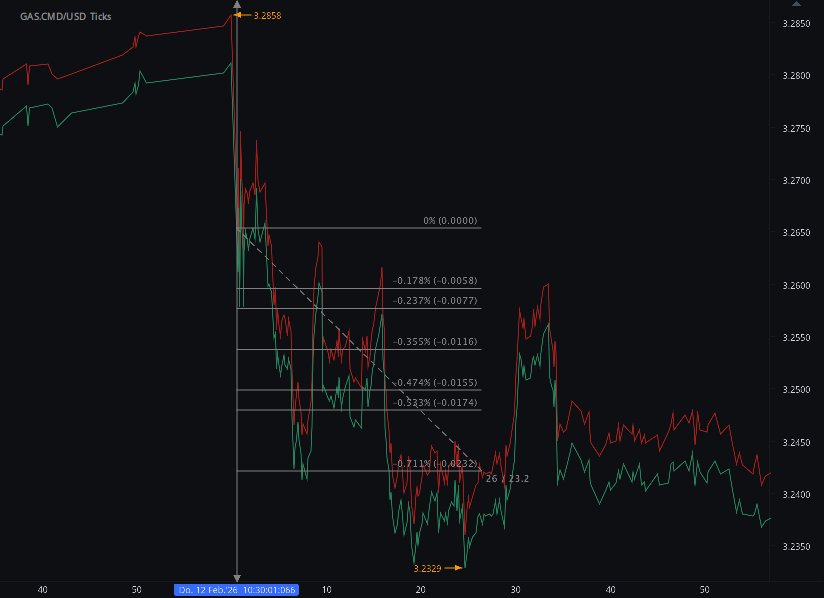
23 ticks potential profit in 26 seconds on 12 February 2026, analysis on futures news trading natural gas on DOE Natural Gas Storage Report (WNGSR) data

According to our analysis natural gas moved 23 ticks on DOE Natural Gas Storage Report (WNGSR) data on 12 February 2026.

Natural gas (23 ticks)

Charts are exported from JForex (Dukascopy).


Weekly Natural Gas Storage Update

Week Ending February 6, 2026

The latest data from the U.S. Energy Information Administration (EIA) shows a substantial withdrawal from U.S. natural gas storage as winter demand continues to impact inventories nationwide.

As of Friday, February 6, 2026, working gas in underground storage totaled 2,214 billion cubic feet (Bcf). This represents a net decrease of 249 Bcf from the previous week — one of the larger withdrawals typical of peak winter demand season.

Storage Levels at a Glance

Here’s how current inventories compare:

  • 97 Bcf lower than this time last year

  • 130 Bcf below the five-year average (2021–2025) of 2,344 Bcf

  • Still within the five-year historical range

While inventories are trailing both last year’s level and the five-year average, total working gas remains within the normal seasonal range, suggesting supply conditions are tight but not abnormal.

Regional Breakdown

East Region

  • Current stocks: 438 Bcf

  • Weekly change: -64 Bcf

  • 7.6% below last year

  • 13.4% below five-year average

The East region saw a significant draw as heating demand remained elevated.

Midwest Region

  • Current stocks: 510 Bcf

  • Weekly change: -74 Bcf

  • 9.9% below last year

  • 16.5% below five-year average

The Midwest experienced one of the largest withdrawals of the week, consistent with sustained cold temperatures across major population centers.

Mountain Region

  • Current stocks: 209 Bcf

  • Weekly change: -4 Bcf

  • 7.7% above last year

  • 37.5% above five-year average

The Mountain region remains comparatively well-supplied, with inventories well above historical norms.

Pacific Region

  • Current stocks: 273 Bcf

  • Weekly change: +1 Bcf

  • 21.3% above last year

  • 35.1% above five-year average

The Pacific region recorded a slight net injection and continues to hold comfortable inventory levels.

South Central Region

  • Current stocks: 784 Bcf

  • Weekly change: -107 Bcf

Breakdown:

  • Salt facilities: -52 Bcf

  • Nonsalt facilities: -55 Bcf

The South Central region posted the largest regional withdrawal, reflecting strong residential demand and ongoing LNG export activity along the Gulf Coast.

Data Reliability

The EIA reports a 0.5% coefficient of variation for total stocks, indicating high statistical confidence in overall inventory estimates. The standard error for the weekly net change was 1.7 Bcf, small relative to the 249 Bcf withdrawal.

Market Implications

Large winter withdrawals are typical in early February, but inventories running below both last year and the five-year average can add upward pressure to natural gas prices — particularly if:

  • Cold weather persists,

  • LNG exports remain strong,

  • Or late-season winter storms increase heating demand.

For now, storage levels remain within historical norms, which helps reduce concerns about supply shortages. However, the pace of withdrawals over the next several weeks will be critical in shaping market expectations as winter progresses.

The next storage report is scheduled for release on February 19, 2026.

Disclaimer: This blog post is for informational purposes only and should not be construed as financial advice. Always conduct thorough research and consider seeking advice from a financial professional before making any investment decisions.

Source: https://ir.eia.gov/ngs/ngs.html


Start futures forex fx commodity news trading with Haawks G4A low latency machine-readable data, one of the fastest data feeds for DOE data.

Please let us know your feedback. If you are interested in timestamps, please send us an email to sales@haawks.com.

Comment

Comment

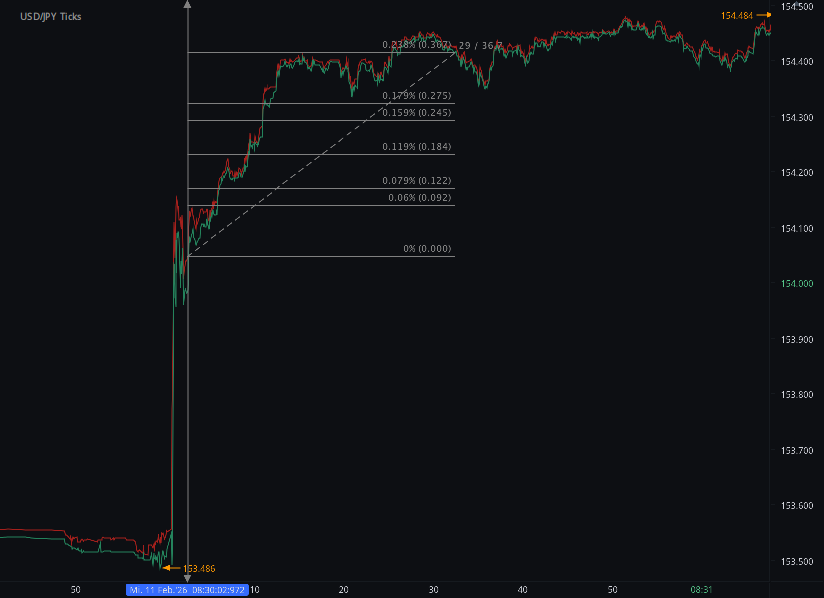
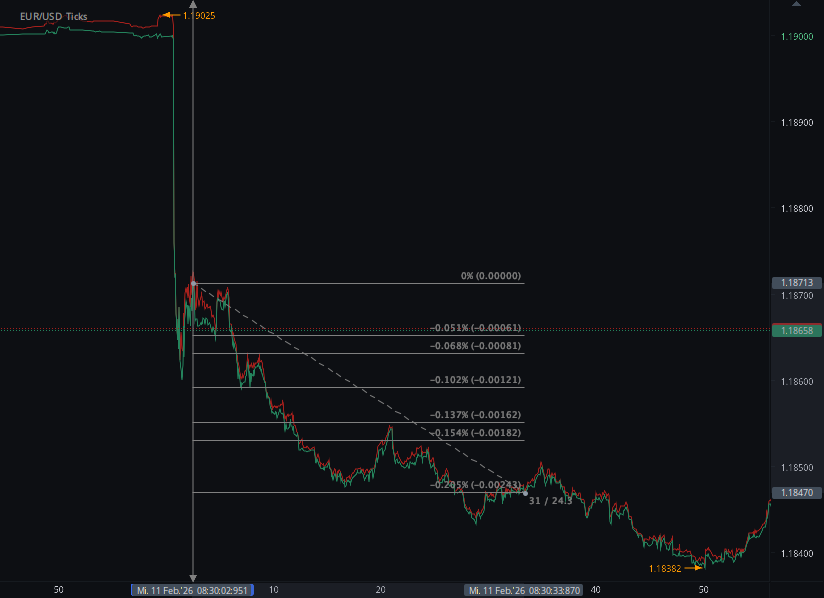
60 pips potential profit in 31 seconds on 11 February 2026, analysis on forex fx futures news trading USDJPY and EURUSD on US Employment Situation (NFP)

According to our analysis USDJPY and EURUSD moved 60 pips on US Employment Situation (Non-farm payrolls / NFP) data on 11 February 2026.

USDJPY (36 pips)

EURUSD (24 pips)

Charts are exported from JForex (Dukascopy).


U.S. Jobs Report – January 2026

Payrolls Rise by 130,000; Unemployment Rate Steady at 4.3%

The latest Employment Situation report from the U.S. Bureau of Labor Statistics shows a modest start to 2026. In January, total nonfarm payroll employment increased by 130,000 jobs, while the unemployment rate held steady at 4.3%.

Here’s what the numbers reveal about the current state of the labor market.

The Big Picture

  • 130,000 jobs added in January

  • Unemployment rate: 4.3% (unchanged)

  • Average hourly earnings: Up 0.4% to $37.17

  • Year-over-year wage growth: 3.7%

  • Labor force participation rate: 62.5% (little change)

While job growth continues, it remains moderate compared with historical expansion periods. The unemployment rate is slightly higher than a year ago (4.0% in January 2025), suggesting some cooling compared to last year.

Where Jobs Are Growing

Health Care Leads

Health care added 82,000 jobs in January:

  • +50,000 in ambulatory health care services

  • +18,000 in hospitals

  • +13,000 in nursing and residential care facilities

Health care averaged 33,000 jobs per month in 2025, making January’s increase notably strong.

Social Assistance Expands

Employment in social assistance rose by 42,000 jobs, primarily in individual and family services, reflecting continued demand for community-based support services.

Construction Rebounds

Construction added 33,000 jobs, largely in nonresidential specialty trade contractors (+25,000). After being essentially flat in 2025, the sector showed renewed momentum in January.

Sectors Losing Jobs

Not all industries expanded:

  • Federal government employment declined by 34,000, continuing a downward trend that began after a peak in October 2024. Since then, federal payrolls are down 327,000 jobs (−10.9%).

  • Financial activities fell by 22,000 jobs, including losses in insurance carriers.

These declines partially offset gains in health care and construction.

Household Survey Highlights

The household survey shows a largely stable labor market:

  • 7.4 million unemployed Americans

  • Long-term unemployed (27+ weeks): 1.8 million

  • Long-term unemployed account for 25% of all unemployed

Teen unemployment declined to 13.6%, while unemployment rates for adult men (3.8%), adult women (4.0%), and major racial and ethnic groups were largely unchanged.

The number of people working part time for economic reasons fell by 453,000 in January, though it remains higher than a year ago.

Wages and Hours

Wage growth remains steady:

  • Average hourly earnings: $37.17

  • Up 15 cents (0.4%) in January

  • Up 3.7% over the past year

For production and nonsupervisory workers:

  • $31.95 per hour

  • Also up 0.4% over the month

The average workweek edged up to 34.3 hours, suggesting stable labor demand.

Revisions and Benchmarking

The January release includes annual benchmark revisions:

  • March 2025 total nonfarm employment was revised down by 898,000 (seasonally adjusted).

  • 2025 job growth was revised from +584,000 to +181,000.

These revisions reflect updated payroll data from unemployment insurance records and improved seasonal adjustments — a standard statistical process designed to enhance accuracy.

Weather Impact?

Major winter storms affected large parts of the country in January. According to the BLS, they had no discernible impact on national payroll employment or unemployment rates, though survey response rates were slightly below average.

What This Means

January’s report shows:

  • Continued but moderate job growth

  • Stable unemployment

  • Solid wage gains

  • Sector-specific strength in health care and services

  • Ongoing weakness in federal government and financial activities

Overall, the labor market remains resilient but is expanding at a measured pace. The next Employment Situation report, due in early March, will provide further insight into whether this steady trend continues.

Disclaimer: This blog post is for informational purposes only and should not be construed as financial advice. Always conduct thorough research and consider seeking advice from a financial professional before making any investment decisions.

Source: https://www.bls.gov/news.release/empsit.nr0.htm


Start forex fx futures news trading with Haawks G4A low latency machine-readable data today, one of the fastest news data feeds for US macro-economic and commodity data.

Please let us know your feedback. If you are interested in timestamps, please send us an email to sales@haawks.com.

Comment

391 pips, US500 13 points and BTC 177 points potential forex fx futures news trading profit from 5 events in January 2026 with Haawks G4A machine-readable data feed

Comment

391 pips, US500 13 points and BTC 177 points potential forex fx futures news trading profit from 5 events in January 2026 with Haawks G4A machine-readable data feed

According to our analysis there was a potential of 391 pips, US500 13 points and BTC 177 points profit out of the following 5 events in January 2026. The potential performance in 2025 was 1,828 pips / ticks.

January 2026

Cumulative potential, indicative performance January 2026, please see all releases below.

Total trading time would have been around 4 minutes! (preparation time not included)

You can click on each release for detailed information.


January 2026 Macro & Commodity Volatility Recap: USDA, CPI, and DOE Data Drive Fast Markets

February 1, 2026

January 2026 delivered a dense run of high-impact U.S. macroeconomic and commodity data releases—and markets responded with speed. From grains and natural gas to FX, equity indices, and crypto, low-latency reactions created measurable short-term trading opportunities across multiple asset classes.

According to Haawks G4A analysis, USDA, CPI, and DOE releases generated hundreds of ticks and pips of potential performance, reinforcing the importance of machine-readable data in time-sensitive trading strategies.

Performance Snapshot — January 2026

  • USDA WASDE & Grain Stocks (Jan 12): ~200 ticks

  • US CPI (Jan 13):

    • EURUSD: 5 pips

    • US500: 13 points

    • BTC: 177 points

  • DOE Natural Gas Storage Reports:

    • Jan 15: 66 ticks

    • Jan 22: 103 ticks

    • Jan 29: 17 ticks

Total potential performance (2026 YTD): 391 pips
(2025 full year: 1,828 pips)

USDA WASDE & Grain Stocks — January 12, 2026

Big Crops, Rising Stocks, and Mixed Price Signals

The January WASDE (Report 667), released by the United States Department of Agriculture, confirmed a clear theme of abundant supply across most major crops.

Grains Reaction

Futures volatility was concentrated in:

  • Soybeans (ZS): ~80 ticks

  • Corn (ZC): ~60 ticks

  • Wheat (WC): ~60 ticks

Key Fundamentals

  • Corn:

    • Record U.S. production at 17.0 billion bushels

    • Yield: 186.5 bu/acre

    • Ending stocks: 2.2 billion bushels

    • Price forecast: $4.10/bu

  • Wheat:

    • Ending stocks: 926 million bushels

    • Season-average price: $4.90/bu

    • Global stocks rise to 278.3 million tons

  • Soybeans:

    • Production: 4.3 billion bushels

    • Ending stocks: 350 million bushels

    • Price forecast cut to $10.20/bu

    • Brazil crop raised to 178 million tons

Grain Stocks Confirmation

December 1 inventories reinforced the supply-heavy narrative:

  • Corn: +10% YoY

  • Soybeans: +6%

  • Wheat: +7%

  • Grain sorghum: +26%

Market takeaway: Record production and expanding global stocks capped upside volatility, but headline numbers still triggered fast intraday futures reactions.

US CPI — January 13, 2026

Inflation Ends 2025 Steady, Not Fully Subdued

The December CPI report from the U.S. Bureau of Labor Statistics kept inflation expectations stable—but markets still reacted immediately.

Market Moves (First Minute Reaction)

  • EURUSD: 5 pips

  • US500: 13 points

  • BTC: 177 points

Key Inflation Data

  • Headline CPI (MoM): +0.3%

  • YoY CPI: 2.7%

  • Core CPI: 2.6%

Notable Drivers

  • Shelter inflation remained sticky (+3.2% YoY)

  • Food prices accelerated (+0.7% MoM)

  • Gasoline fell, but electricity and natural gas rose sharply YoY

  • Services inflation remained firm

Market takeaway: Inflation is no longer accelerating, but persistence in housing and services continues to matter for rates, FX, and risk assets.

DOE Natural Gas Storage Reports — January 2026

Big Draws, But No Supply Stress

Natural gas futures reacted to every January storage release, with volatility driven by withdrawal size versus expectations rather than absolute inventory levels.

All reports were released by the U.S. Energy Information Administration.

January 15 Report (Week Ending Jan 9)

  • Withdrawal: 71 Bcf

  • Futures move: 66 ticks

  • Total storage: 3,185 Bcf

  • +106 Bcf vs. 5-year average

January 22 Report (Week Ending Jan 16)

  • Withdrawal: 120 Bcf

  • Futures move: 103 ticks

  • Total storage: 3,065 Bcf

  • +177 Bcf vs. 5-year average

Despite accelerating withdrawals, inventories remained well above normal.

January 29 Report (Week Ending Jan 23)

  • Withdrawal: 242 Bcf

  • Futures move: 17 ticks in 7 seconds

  • Total storage: 2,823 Bcf

  • +143 Bcf vs. 5-year average

Regional draws were led by:

  • South Central: −89 Bcf

  • Midwest: −76 Bcf

  • East: −55 Bcf

Western regions remained more than 30% above five-year averages.

Market takeaway: Winter demand intensified, but storage buffers remained sufficient—keeping price reactions fast but contained.

Final Thoughts

January 2026 reinforced a recurring theme across asset classes:

  • Speed matters more than direction in news-driven markets

  • Even supply-heavy fundamentals can generate sharp short-term volatility

  • Machine-readable data remains critical for trading USDA, CPI, and DOE releases

With weather, exports, inflation expectations, and seasonal demand still in play, event-driven volatility is likely to persist into February.

Disclaimer: This blog post is for informational purposes only and should not be construed as financial advice. Always conduct thorough research and consider seeking advice from a financial professional before making any investment decisions.


Start futures/forex/oil/grains news trading with Haawks G4A low latency machine-readable data today, we offer one of the fastest machine-readable data feeds for US macro-economic and commodity data and macro-economic data from Norway, Sweden, Turkey, Switzerland and ECB interest rates and statement.

Please let us know your feedback and check out our G4A low latency data feed.

All data is machine readable and available via API access in Chicago, New York and London. Free trials.

Comment

Comment

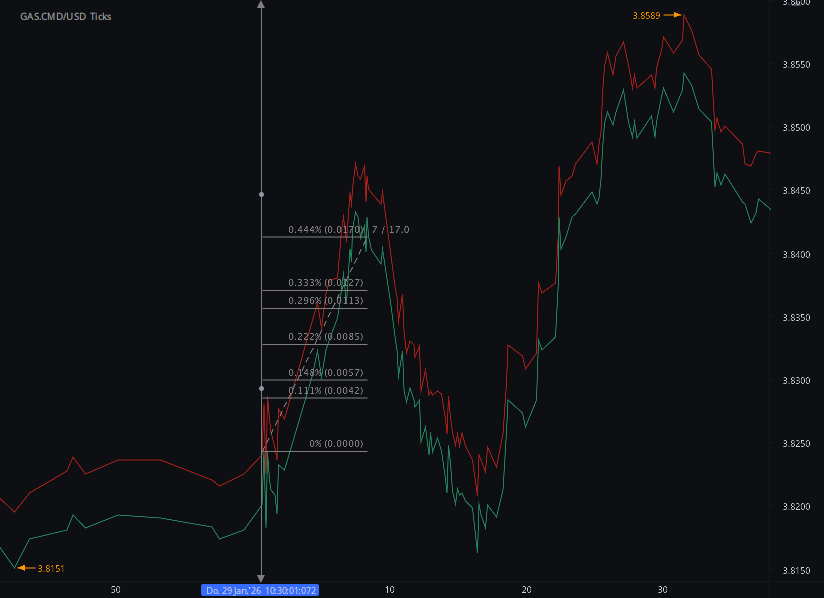
17 ticks potential profit in 7 seconds on 29 January 2026, analysis on futures news trading natural gas on DOE Natural Gas Storage Report (WNGSR) data

According to our analysis natural gas moved 17 ticks on DOE Natural Gas Storage Report (WNGSR) data on 29 January 2026.

Natural gas (17 ticks)

Charts are exported from JForex (Dukascopy).


Natural Gas Storage Update: A Big Winter Draw, But Still Comfortable

The latest Weekly Natural Gas Storage Report from the U.S. Energy Information Administration (EIA) delivers a headline-grabbing number: a 242 billion cubic feet (Bcf) withdrawal for the week ending January 23, 2026. That’s a hefty pull from storage—but zooming out, the U.S. gas market remains in a relatively solid position for late January.

Let’s break down what’s happening and why it matters.

The Big Picture: Where Storage Stands

As of January 23, working gas in underground storage totaled 2,823 Bcf across the Lower 48 states. That’s:

  • 206 Bcf higher than this time last year

  • 143 Bcf above the five-year average of 2,680 Bcf

  • Within the historical five-year range, despite the large weekly draw

In short: winter demand is clearly doing its thing, but inventories are still comfortably padded.

Regional Breakdown: Who Pulled the Most?

Every region saw withdrawals last week, with cold-driven demand leaving a visible mark.

South Central Leads the Way

  • −89 Bcf on the week

  • Total storage now at 1,050 Bcf

  • Still 14.1% above last year and 8.6% above the five-year average

Salt caverns accounted for a sizable portion of the draw, which is typical during periods of high, short-term demand.

Midwest Feels the Chill

  • −76 Bcf weekly change

  • Storage sits at 676 Bcf

  • Nearly flat versus last year, but 6.4% below the five-year average

This suggests the Midwest is leaning more heavily on storage relative to recent norms.

East Region Stays Balanced

  • −55 Bcf withdrawal

  • Ending the week at 577 Bcf

  • Slightly above last year, slightly below the five-year average

West Holds Strong

  • Mountain: −14 Bcf, but a striking 34% above the five-year average

  • Pacific: −9 Bcf, nearly 33% above the five-year average

The West continues to stand out for its strong inventory cushion.

A Large Draw—But Not a Red Flag

A 242 Bcf withdrawal is significant, especially compared with milder winters in recent years. Still, context matters:

  • Storage levels remain well above normal

  • Sampling variability is low (total coefficient of variation just 0.4%)

  • There’s no immediate signal of supply stress

Unless colder-than-normal weather persists deep into February or production falters, the market appears well-positioned to ride out the remainder of winter.

What to Watch Next

Looking ahead to the next EIA release on February 5, key questions include:

  • Will withdrawals stay this large, or ease with moderating temperatures?

  • Can storage remain above the five-year average through peak winter demand?

  • How will regional imbalances—especially in the Midwest—evolve?

For now, the takeaway is clear: winter is biting, but storage is holding up.

Stay tuned—February is often where the real storage story gets written.

Disclaimer: This blog post is for informational purposes only and should not be construed as financial advice. Always conduct thorough research and consider seeking advice from a financial professional before making any investment decisions.
Source: https://ir.eia.gov/ngs/ngs.html


Start futures forex fx commodity news trading with Haawks G4A low latency machine-readable data, one of the fastest data feeds for DOE data.

Please let us know your feedback. If you are interested in timestamps, please send us an email to sales@haawks.com.

Comment

Comment

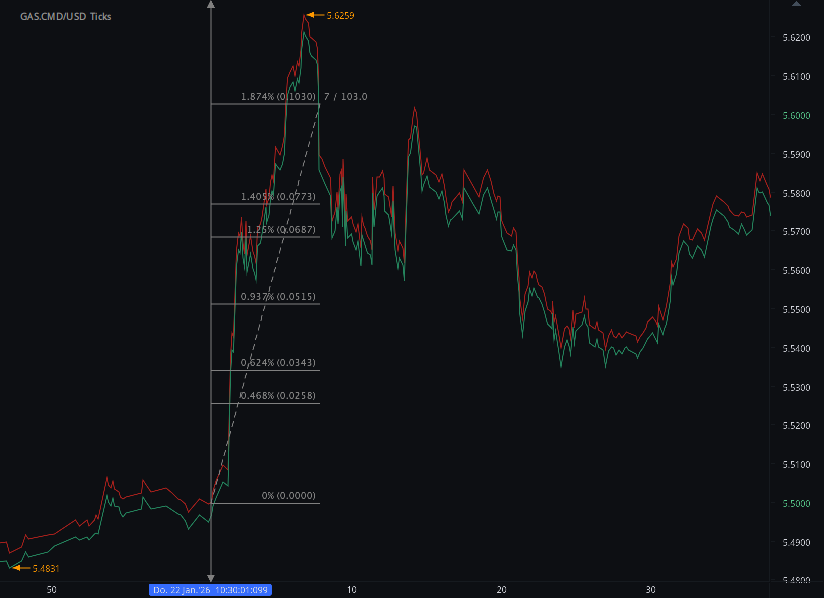
103 ticks potential profit in 7 seconds on 22 January 2026, analysis on futures news trading natural gas on DOE Natural Gas Storage Report (WNGSR) data

According to our analysis natural gas moved 103 ticks on DOE Natural Gas Storage Report (WNGSR) data on 22 January 2026.

Natural gas (103 ticks)

Charts are exported from JForex (Dukascopy).


U.S. Natural Gas Storage Remains Well Above Normal Despite Large Weekly Draw

U.S. natural gas inventories posted a significant weekly draw in mid-January, yet overall storage levels remain comfortably above historical norms—a key signal for winter market dynamics.

According to the latest Weekly Natural Gas Storage Report from the U.S. Energy Information Administration, working gas in underground storage across the Lower 48 states totaled 3,065 billion cubic feet (Bcf) for the week ending January 16, 2026.

That figure represents a net withdrawal of 120 Bcf from the prior week, reflecting stronger winter demand. Even so, inventories remain 141 Bcf higher than the same week last year and 177 Bcf above the five-year average, underscoring a well-supplied market.

Regional Breakdown: Broad-Based Withdrawals

Every major storage region reported declines during the week, with the largest draws concentrated in traditional heating-demand centers:

  • South Central: −39 Bcf

  • Midwest: −38 Bcf

  • East: −32 Bcf

  • Mountain: −9 Bcf

  • Pacific: −2 Bcf

Within the South Central region, salt cavern storage fell by 12 Bcf, while nonsalt facilities declined by 27 Bcf—both consistent with seasonal withdrawal patterns.

Still Above Normal Across Most Regions

Despite the sizable draw, inventories remain above both year-ago and five-year average levels in nearly every region:

  • Total U.S. storage: +4.8% vs. last year, +6.1% vs. five-year average

  • Mountain region: +34.4% vs. five-year average

  • Pacific region: +31.6% vs. five-year average

  • South Central: nearly 9% above historical norms

At 3,065 Bcf, total working gas remains above the five-year historical range, providing a cushion against late-season cold weather risks.

What This Means for the Market

The data tells a clear story:

  • Demand is real—winter withdrawals are accelerating

  • Supply is ample—storage remains elevated

  • Price pressure may stay muted unless colder-than-normal weather persists

For traders and analysts, the combination of strong draws and high absolute storage levels suggests a market that is responding to seasonal demand without signaling structural tightness.

As winter progresses, attention will shift to weather forecasts, withdrawal pace, and whether inventories begin converging toward historical averages—or continue to defy them.

Disclaimer: This blog post is for informational purposes only and should not be construed as financial advice. Always conduct thorough research and consider seeking advice from a financial professional before making any investment decisions.

Source: https://ir.eia.gov/ngs/ngs.html


Start futures forex fx commodity news trading with Haawks G4A low latency machine-readable data, one of the fastest data feeds for DOE data.

Please let us know your feedback. If you are interested in timestamps, please send us an email to sales@haawks.com.

Comment

Comment

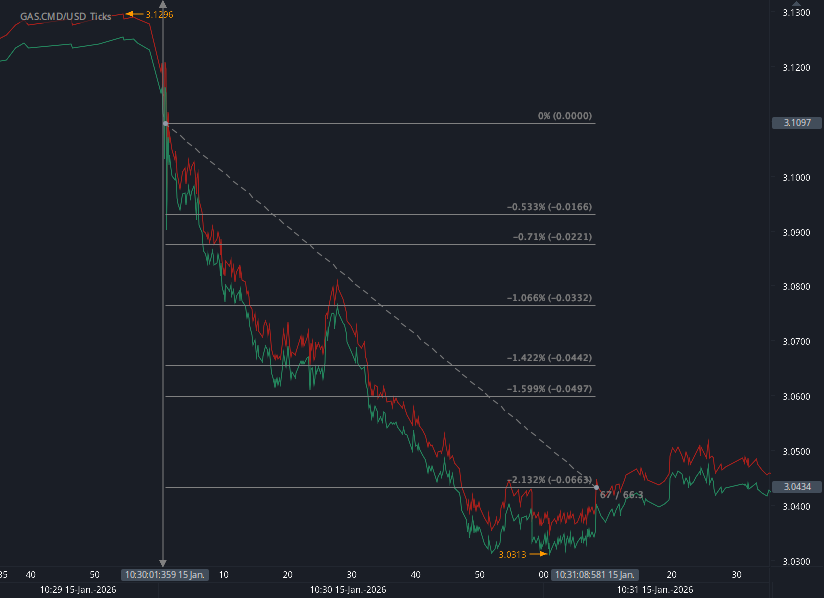
66 ticks potential profit in 67 seconds on 15 January 2026, analysis on futures news trading natural gas on DOE Natural Gas Storage Report data

According to our analysis natural gas moved 66 ticks on DOE Natural Gas Storage Report data on 15 January 2026.

Natural gas (66 ticks)

Charts are exported from JForex (Dukascopy).


U.S. Natural Gas Storage Update: A Comfortable Cushion Heading Into Mid-January

The latest Weekly Natural Gas Storage Report from the U.S. Energy Information Administration (EIA) shows that U.S. natural gas inventories remain solidly above normal as the winter heating season continues.

As of Friday, January 9, 2026, working gas in underground storage across the Lower 48 states totaled 3,185 billion cubic feet (Bcf). That represents a weekly withdrawal of 71 Bcf, in line with typical winter demand but notably less aggressive than what might be expected during periods of severe cold.

Big Picture: Above Average and Within Range

Despite the weekly draw, storage levels continue to offer a strong buffer:

  • 33 Bcf higher than this time last year

  • 106 Bcf above the five-year average of 3,079 Bcf

  • Firmly within the historical five-year range

This positioning suggests that, nationally, the market remains well supplied, reducing the risk of near-term shortages even if colder weather emerges later in the season.

Regional Breakdown: Where the Gas Moved

Most regions saw withdrawals during the week, reflecting seasonal heating demand:

  • East:
    Stocks fell by 33 Bcf, leaving inventories 2.2% below last year and 5.8% below the five-year average—a sign of tighter conditions in the region most sensitive to winter heating loads.

  • Midwest:
    A 31 Bcf draw pushed inventories 3.4% below last year and 6.2% under the five-year norm, continuing a trend of stronger winter usage.

  • Mountain & Pacific:
    Smaller declines of 5 Bcf and 2 Bcf, respectively. Both regions remain well above historical averages, with the Mountain region more than 30% above its five-year average.

  • South Central:
    Notably, no net change week over week. Salt storage increased by 12 Bcf, while nonsalt facilities declined by the same amount—keeping total inventories steady and comfortably above both last year and the five-year average.

What This Means for the Market

The data paints a picture of a well-balanced natural gas market:

  • Storage remains ample despite winter withdrawals

  • Regional tightness exists, particularly in the East and Midwest

  • Producing and storage hubs in the South Central region continue to provide stability

Unless prolonged extreme cold materializes, inventories appear sufficient to carry the market through the remainder of winter without major stress.

Looking Ahead

The next EIA storage report will be released on January 22, 2026. With winter far from over, traders and consumers alike will be watching whether withdrawals accelerate—or if above-average storage continues to keep prices and supply risks in check.

For now, the message is clear: the U.S. entered mid-January with a healthy natural gas safety net.

Disclaimer: This blog post is for informational purposes only and should not be construed as financial advice. Always conduct thorough research and consider seeking advice from a financial professional before making any investment decisions.

Source: https://ir.eia.gov/ngs/ngs.html


Start futures forex fx commodity news trading with Haawks G4A low latency machine-readable data, one of the fastest data feeds for DOE data.

Please let us know your feedback. If you are interested in timestamps, please send us an email to sales@haawks.com.

Comment

Comment

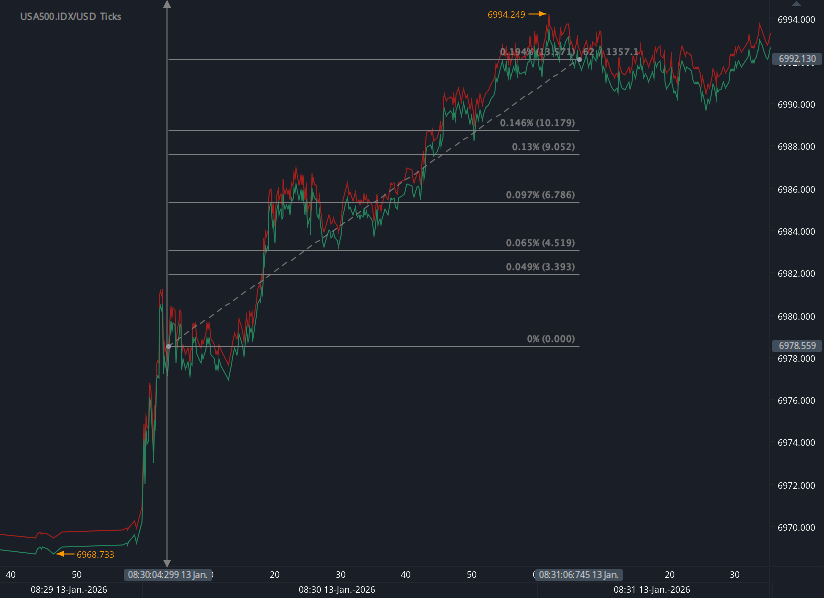
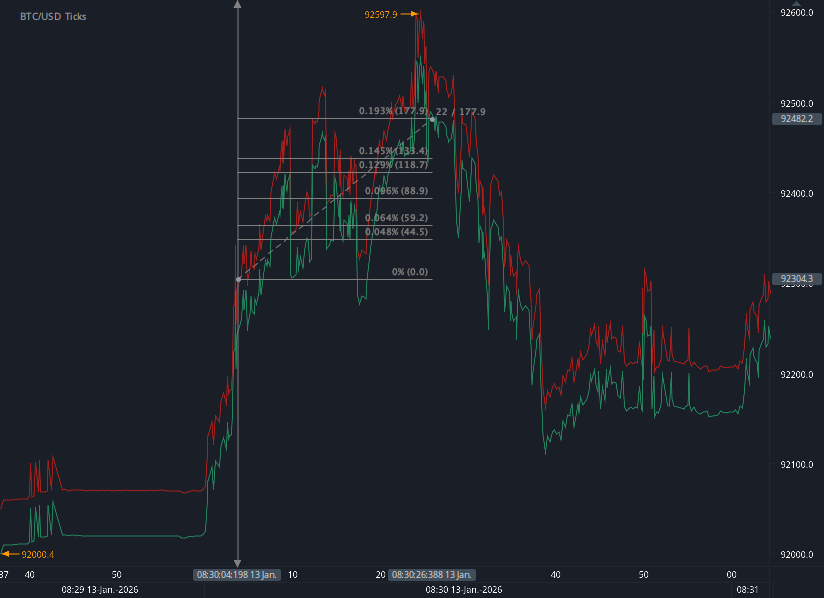
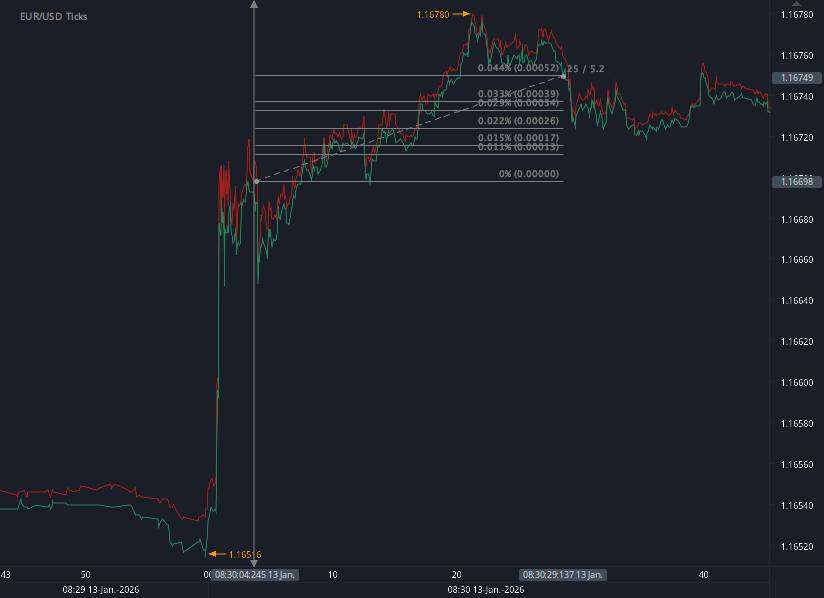
5 pips, US500 13 points, BTC 177 points potential profit in 62 seconds on 13 January 2026, analysis on futures forex fx low latency news trading EURUSD, US500 and BTC on US CPI

According to our analysis EURUSD moved 5 pips, US500 moved 13 points and BTC moved 177 points on US BLS Consumer Price Index (CPI) data on 13 January 2026.

EURUSD (5 pips)

US500 (13 points)

BTC (177 points)

Charts are exported from JForex (Dukascopy).


Inflation Ends 2025 Steady: What the December CPI Report Tells Us

The latest Consumer Price Index (CPI) report from the U.S. Bureau of Labor Statistics offers a clear snapshot of how inflation wrapped up 2025—and what it means for households heading into the new year.

Released on January 13, 2026, the report shows that inflation remains moderate but persistent, with price pressures still concentrated in essentials like housing, food, and certain services.

Headline Numbers at a Glance

  • Monthly CPI (December 2025): +0.3% (seasonally adjusted)

  • 12-month inflation rate: 2.7%, unchanged from November

  • Core inflation (excluding food & energy): 2.6% year over year

These figures suggest inflation is no longer accelerating, but it also hasn’t fully cooled back to pre-pandemic norms.

Housing: Still the Biggest Driver

Shelter costs were once again the largest contributor to December’s increase:

  • Shelter index: +0.4% in December

  • 12-month shelter inflation: +3.2%

Rent and owners’ equivalent rent both rose, while lodging away from home jumped sharply (+2.9% for the month). Housing remains the stickiest part of inflation—and the hardest for consumers to avoid.

Food Prices Pick Up Speed

Food prices rose faster than overall inflation in December:

  • Food (overall): +0.7% in December

  • Food at home: +2.4% year over year

  • Food away from home: +4.1% year over year

Notable details:

  • Grocery staples like dairy, cereals, fruits, and vegetables all increased.

  • Egg prices fell sharply (-8.2%), offering rare relief.

  • Restaurant prices continue to climb, especially for full-service meals.

For many households, food remains one of the most noticeable inflation pressures.

Energy: Mixed Signals

Energy prices edged higher overall, but the details matter:

  • Energy index: +0.3% in December, +2.3% over the year

  • Gasoline: -0.5% in December, -3.4% year over year

  • Electricity: +6.7% year over year

  • Natural gas: +10.8% year over year

Drivers benefited from cheaper gasoline, but utility bills—especially heating—continued to rise.

Services Inflation Remains Firm

Core services showed broad-based increases:

  • Medical care: +0.4% in December, +3.2% year over year

  • Recreation: +1.2% in December (largest monthly jump on record)

  • Airline fares: +5.2% in December

  • Personal care & education: continued steady increases

On the flip side:

  • Used cars and trucks: -1.1% in December

  • Communication services: -1.9%

What This Means for 2026

As 2025 closed:

  • Inflation appears stable, not surging—but not fully subdued.

  • Housing and services remain the key inflation risks.

  • Goods inflation (like vehicles and gasoline) continues to ease.

With the January 2026 CPI report scheduled for February 11, 2026, policymakers and consumers alike will be watching closely to see whether inflation finally drifts closer to the Federal Reserve’s long-term comfort zone.

Bottom Line

Inflation ended 2025 steady but uneven. While energy and goods offered some relief, everyday essentials—housing, food, and services—kept upward pressure on household budgets. The battle against inflation isn’t over, but it’s no longer spiraling out of control either.

Disclaimer: This blog post is for informational purposes only and should not be construed as financial advice. Always conduct thorough research and consider seeking advice from a financial professional before making any investment decisions.
Source: https://www.bls.gov/news.release/cpi.nr0.htm


Start futures forex fx news trading with Haawks G4A low latency machine-readable data, one of the fastest machine-readable news trading feed for US macro-economic and commodity data.

Please let us know your feedback. If you are interested in timestamps, please send us an email to sales@haawks.com.

Comment

200 ticks potential profit on 12 January 2026, analysis on trading soybeans, corn and wheat futures on USDA WASDE and USDA Grain Stocks data

Comment

200 ticks potential profit on 12 January 2026, analysis on trading soybeans, corn and wheat futures on USDA WASDE and USDA Grain Stocks data

According to our analysis soybeans (ZS), corn (ZC) and wheat (WC) futures prices moved around 200 ticks (80 ticks, 60 ticks and 60 ticks) on USDA WASDE (World Agricultural Supply and Demand Estimates) and USDA Grain Stocks data on 12 January 2026.


WASDE January 2026: Big Crops, Rising Stocks, and Mixed Price Signals

The January 2026 World Agricultural Supply and Demand Estimates (WASDE 667), approved by the World Agricultural Outlook Board and released by the United States Department of Agriculture, paints a clear picture of abundance across much of U.S. and global agriculture. Strong production gains—especially in corn, wheat, soybeans, and select global exporters—are building stocks and keeping a lid on prices, even as demand remains solid in several categories.

Below is a plain-language breakdown of the key takeaways that matter most for producers, merchandisers, and market watchers.

Wheat: Larger Stocks, Softer Prices

U.S. wheat supplies for 2025/26 are modestly higher due to increased beginning stocks reported by National Agricultural Statistics Service. Feed and residual use was cut sharply after weaker-than-expected disappearance in the first quarter, while exports remain unchanged at 900 million bushels.

  • Ending stocks: 926 million bushels (+25 million)

  • Season-average farm price: $4.90/bu (down $0.10)

Globally, wheat supplies are expanding as well. Argentina is harvesting a record crop, Russia’s production outlook improved, and world ending stocks climbed to 278.3 million tons. This reinforces a well-supplied global wheat market heading into 2026.

Corn & Coarse Grains: A Record Crop Changes the Tone

Corn is the headline story this month.

U.S. corn production is now estimated at 17.0 billion bushels, the largest on record—surpassing the previous high by a staggering 1.7 billion bushels. Higher yields and a sharp rise in harvested acres drove the increase.

  • Yield: 186.5 bu/acre

  • Ending stocks: 2.2 billion bushels

  • Season-average price: $4.10/bu (up $0.10)

Despite higher stocks, prices nudged higher thanks to strong feed demand. Globally, coarse grain production is also rising, led by China’s record corn crop of 301.2 million tons. World corn stocks now approach 291 million tons, underscoring the scale of supply.

Rice: Tighter U.S. Balance Sheet

Rice stands out as one of the tighter markets in this report.

U.S. rice supplies declined due to lower imports and slightly reduced production, while domestic use surged to a record level—driven entirely by long-grain consumption.

  • Ending stocks: 49.3 million cwt (down 9%)

  • All-rice season-average price: $11.80/cwt (up $0.20)

Globally, however, rice remains well supplied. Higher production and stocks in China and Japan pushed world ending stocks up to 190.3 million tons.

Oilseeds: Soybeans Face Global Competition

U.S. oilseed production rose modestly, with soybeans up to 4.3 billion bushels. Crushing demand remains strong, particularly for soybean meal, but exports were reduced as Brazil continues to dominate global trade.

  • U.S. soybean ending stocks: 350 million bushels

  • Season-average soybean price: $10.20/bu (down $0.30)

Brazil’s crop outlook improved again, with production raised to 178 million tons on favorable weather. Combined U.S. and Brazilian gains pushed global soybean ending stocks higher, keeping pressure on prices.

Sugar: Slightly Higher U.S. Supplies

U.S. sugar production increased marginally, more than offsetting reduced imports. Ending stocks ticked higher, pushing the stocks-to-use ratio near 16%.

In Mexico, sugar production is up from last year thanks to improved rainfall, but flooding and harvest delays forced a downward revision from last month. Exports to the U.S. remain capped by high U.S. inventories under the Suspension Agreements.

Livestock & Dairy: Production Up, Prices Mixed

Red meat and poultry production for 2025 was revised higher, with gains in pork and beef offsetting lower poultry output. Looking ahead to 2026:

  • Beef: Higher weights support production despite fewer cattle

  • Pork: Expansion continues on larger pig crops

  • Eggs: Lower production weighs on prices

  • Milk: 2026 output rises on higher production per cow

The all-milk price is now forecast at $18.25/cwt for 2026, reflecting weaker butter and cheese prices despite strong protein demand.

Cotton: Smaller Crop, Firmer Price

U.S. cotton production fell more than 2% due to lower yields in the Delta. Ending stocks declined to 4.2 million bales, tightening the balance sheet.

  • Season-average farm price: 61 cents/lb (up)

Globally, cotton stocks also fell as production slipped and consumption improved, pushing the world stocks-to-use ratio below 63%.

Grain Stocks: Abundance Confirmed

December 1 grain stocks reinforced the WASDE message:

  • Corn stocks: +10% year over year

  • Soybean stocks: +6%

  • All wheat stocks: +7%

Notably, grain sorghum stocks surged 26%, and most small grains showed higher inventories despite slower disappearance.

Final Thoughts

The January 2026 WASDE confirms a theme of ample supplies and heavy stocks across most major commodities. Corn and soybeans face the strongest headwinds from record production and global competition, while rice and cotton offer relative brightness due to tighter balances. Livestock markets remain demand-supported, but rising production will cap upside potential.

As we move deeper into 2026, weather, export competitiveness, and macroeconomic demand will determine whether these large supplies translate into sustained price pressure—or unexpected volatility.

Disclaimer: This blog post is for informational purposes only and should not be construed as financial advice. Always conduct thorough research and consider seeking advice from a financial professional before making any investment decisions.
Source: https://www.usda.gov/oce/commodity/wasde/wasde0126.pdf, https://esmis.nal.usda.gov/sites/default/release-files/795726/grst0126.pdf


Haawks G4A is one of the fastest machine-readable data feeds for USDA data. We are beating big names in the industry by seconds. Coverage includes monthly USDA WASDE (World Agricultural Supply and Demand Estimates), quarterly USDA Grain Stocks and yearly USDA Prospective Plantings and USDA Acreage.

Please let us know your feedback. If you are interested in timestamps, please send us an email to sales@haawks.com.

Comment

57 pips, US500 6 points and BTC 678 points potential forex fx futures news trading profit from 2 events in December 2025 with Haawks G4A machine-readable data feed

Comment

57 pips, US500 6 points and BTC 678 points potential forex fx futures news trading profit from 2 events in December 2025 with Haawks G4A machine-readable data feed

According to our analysis there was a potential of 57 pips, US500 6 points and BTC 678 points profit out of the following 2 events in December 2025. The potential performance in 2025 was 1,828 pips / ticks.

December 2025

Cumulative potential, indicative performance December 2025, please see all releases below.

Total trading time would have been around 2 minutes! (preparation time not included)

You can click on each release for detailed information.


Markets React to December 2025 Macro Shocks: CPI, Jobless Claims & the FOMC Rate Cut

December 2025 delivered two major clusters of U.S. macroeconomic data—each triggering sharp but short-lived volatility across FX, index futures, and crypto. Between the FOMC interest rate decision on December 10 and the CPI + Jobless Claims release on December 18, traders saw multiple high-impact opportunities in EURUSD, USDJPY, US500, and BTC.

Below is a consolidated performance recap and a deeper macro interpretation of what these releases signal for 2026.

1. Market Reaction: How Much Did Markets Move?

10 December 2025 – FOMC Decision & Projections

  • USDJPY: 26 pips

  • EURUSD: 19 pips

Total: 45 pips potential in 48 seconds
YTD (2025) potential: 1816 pips (vs 4305 in 2024)

The Fed cut rates by 25 bps to 3.50–3.75%, igniting brief but actionable volatility across major FX pairs.

18 December 2025 – CPI + Jobless Claims

  • EURUSD: 12 pips

  • US500: 6 points

  • BTC: 678 points

Total: 12 pips + 6 points + 678 points in 43 seconds
2025 YTD potential: 1828 pips

Crypto was the standout mover, with BTC reacting aggressively to the disinflationary tone and labor-market stability.

2. What the Data Actually Says: A Macro Deep Dive

A. Labor Market – Still Tight, Still Resilient

Initial claims:

  • 224k, down 13k from the previous week

  • 4-week average stable at 217.5k

These levels signal continued expansion, not recession. Historically, recessions show up closer to 300k+ claims.

Insured unemployment (SA):

  • 1.897M, within the 2025 range of 1.83–1.95M

  • IUR flat at 1.2%

No state has triggered Extended Benefits, a strong sign that labor weakness isn’t systemic.

Sectoral patterns

States with the highest insured unemployment—CA, WA, NJ, MA—mirror exposure to:

  • Tech & high-wage services

  • Construction slowdowns

  • Logistics & manufacturing adjustments

This is late-cycle choppiness, not broad deterioration.

B. Inflation – Controlled Disinflation Toward 2–3%

Headline CPI: +2.7% YoY
Core CPI: +2.6% YoY

From September to November:

  • Headline: +0.2% total

  • Core: +0.2% total

  • Shelter: +0.2% total

Annualized, that’s roughly 1–2% inflation—a notable downshift.

Food inflation

  • Food at home: +1.9%

  • Restaurant prices: +3.7% to +4.3%

Services—especially restaurants—remain sticky.

Energy

Biggest contributors:

  • Fuel oil: +11.3%

  • Electricity: +6.9%

  • Utility gas: +9.1%

Household energy remains a political and consumer pain point.

Core components

  • Shelter: +3.0%

  • Services ex-energy: +3.0%

  • Used cars: +3.6%

  • Furnishings: +4.6%

Inflation is now services-driven, not goods-driven.

3. The December 10 FOMC Rate Cut: What It Really Means

The Fed cut rates by 25 bps, despite inflation being “somewhat elevated.”

Why cut now?

Because downside risks to employment have increased—and for the first time, the Fed said so explicitly.

Fed projections to 2028

GDP growth:

  • 2025: 1.7%

  • 2026: 2.3%

  • Longer run: 1.8%

Unemployment:

  • Drifting toward 4.2–4.5%, near the Fed’s long-run estimate.

Inflation:

  • PCE 2025: 2.9%

  • Back to 2% by 2028

Rate path (median “dots”):

  • 2025: 3.6%

  • 2026: 3.4%

  • Long run: 3.0%

This is not a return to zero rates.
It’s easing within a structurally higher-rate environment.

4. Internal FOMC Divisions Make This a Turning Point

Three dissents highlight the Committee’s tension:

  • Miran: Wanted a 50 bp cut

  • Goolsbee & Schmid: Wanted no cut at all

This split implies:

  • Data signals are mixed

  • The Fed’s margin for error is narrow

  • Future moves may become more unpredictable

5. Policy Outlook for 2026: “Cautious Cuts, Persistent Uncertainty”

Monetary Policy

  • The Fed can stay on hold while watching inflation drift lower.

  • More cuts are possible—but only if unemployment rises faster than forecast.

Fiscal/Labor Policy

  • No broad-based unemployment crisis

  • Sector-specific retraining and support may be more effective than large UI expansions

Political economy

  • Utilities and shelter inflation continue pressuring lower-income households

  • Shutdown-related data gaps raise concerns about federal data quality

6. What Traders Should Take Away (Not Financial Advice)

Short-term

  • Macro releases remain high-volatility catalysts

  • Rate-sensitive FX pairs (USDJPY, EURUSD) still react strongly to policy guidance

  • BTC’s outsized reaction suggests macro-sensitive speculative flows remain dominant

Medium-term

  • A soft-landing scenario is still on the table

  • But risks are tilted both toward stickier inflation and softer labor conditions—an unusual mix

Long-term

  • The Fed’s neutral rate near 3% signals structurally higher yields for years to come

  • This environment benefits systematic traders and machine-readable news strategies that rely on precision and speed

Final Thoughts

December’s data confirms a narrative of orderly disinflation, resilient labor markets, and a Fed cautiously easing while watching both sides of its mandate.

For traders, volatility around macro releases remains high—even when trend macro signals appear stable. High-speed execution and machine-readable data continue to offer a tactical edge in capturing these short, sharp moves.

Disclaimer: This blog post is for informational purposes only and should not be construed as financial advice. Always conduct thorough research and consider seeking advice from a financial professional before making any investment decisions.

Start futures/forex/oil/grains news trading with Haawks G4A low latency machine-readable data today, we offer one of the fastest machine-readable data feeds for US macro-economic and commodity data and macro-economic data from Norway, Sweden, Turkey, Switzerland and ECB interest rates and statement.

Please let us know your feedback and check out our G4A low latency data feed.

All data is machine readable and available via API access in Chicago, New York and London. Free trials.

Comment

57 pips, US500 6 points and BTC 678 points potential futures forex fx news trading profit from 2 events in the fourth quarter of 2025 with Haawks G4A machine-readable news data feed

Comment

57 pips, US500 6 points and BTC 678 points potential futures forex fx news trading profit from 2 events in the fourth quarter of 2025 with Haawks G4A machine-readable news data feed

Due to the US government shutdown in October and November 2025 there was only a potential of 57 pips/ticks, US500 6 points and BTC 678 points profit out of the following 2 events in the fourth quarter of 2025 based on our ex-post analysis. The potential performance for 2025 was 1,828 pips/ticks.

Q4 2025

Cumulative potential, indicative performance Q4 2025 (only pips), please see all releases below.

Total trading time would have been around 2 minutes in 3 months! (preparation time not included)

You can click on each release for detailed information.


Q4 2025 Macro Trading Recap: Shutdown Data Gaps, Fed Cuts & December Volatility

The final quarter of 2025 was defined by an unusual combination of macro uncertainty, delayed government data, and sharp short-lived market reactions.

The U.S. government shutdown, which began on October 1, 2025 and lasted 43 days, created a major information gap for traders, policymakers, and economists. Several key economic releases were delayed, revised, or left incomplete, including labor-market and inflation data from October and November. The Bureau of Labor Statistics confirmed that it did not publish an October 2025 Employment Situation release, and that some household survey data for October could not be collected retroactively.

That data blackout made December’s releases especially important. When the market finally received fresh inflation, labor, and Federal Reserve guidance, volatility returned quickly—but briefly.

Key Q4 Trading Opportunities

FOMC Interest Rate Decision and Projections

10 December 2025

The December FOMC meeting delivered one of the quarter’s cleanest macro-driven moves.

The Fed cut rates by 25 basis points, bringing the target range to 3.50%–3.75%. The decision triggered sharp but short-lived volatility across major FX pairs.

Market reaction:

  • USDJPY: 26 pips

  • EURUSD: 19 pips

  • Total potential: 45 pips in 48 seconds

  • 2025 YTD potential: 1,816 pips, compared with 4,305 in 2024

The rate cut mattered not only because of the move itself, but because of the Fed’s reasoning. Inflation was still described as somewhat elevated, but downside risks to employment had increased. That made the meeting a turning point: the Fed was no longer focused only on inflation risk.

The projections also confirmed that this was not a return to zero-rate policy. The median rate path pointed to a structurally higher-rate environment, with the longer-run rate near 3%.

CPI and Jobless Claims

18 December 2025

The second major December opportunity came from the combined CPI and jobless claims release.

After weeks of shutdown-related disruption, this data cluster gave traders a clearer picture of inflation and labor-market resilience.

Market reaction:

  • EURUSD: 12 pips

  • US500: 6 points

  • BTC: 678 points

  • Total trading time: approximately 43 seconds

  • 2025 YTD potential: 1,828 pips

Bitcoin was the standout mover. The reaction suggested that crypto remained highly sensitive to macro data, especially when inflation appeared controlled and labor-market conditions stayed stable.

The Shutdown Effect: Why December Data Mattered More

The October and November 2025 government shutdown did more than delay headlines. It reduced visibility across the entire macro landscape.

BLS revised several release schedules after the shutdown, and BEA cancelled the advance estimate for Q3 2025 GDP that had originally been scheduled for October 30.

Reuters also reported that delayed government data created a backlog of economic releases, forcing markets to process multiple important indicators in a compressed window.

For traders, that created two important effects:

First, markets entered December with less confidence than usual. With missing or delayed data, positioning became more fragile.

Second, each confirmed release carried more weight. CPI, jobless claims, and the FOMC projections became not just individual events, but catch-up signals after a period of reduced visibility.

This helped explain why the market reactions were sharp, even when the underlying data did not point to a crisis.

Labor Market: Resilient, Not Recessionary

The labor-market picture remained broadly stable.

Initial jobless claims came in at 224k, down 13k from the previous week, while the four-week average held near 217.5k. These levels were consistent with continued expansion rather than recessionary stress.

Insured unemployment remained within the 2025 range, and the insured unemployment rate stayed flat at 1.2%.

The key takeaway was that the labor market was cooling selectively, not breaking broadly.

Some weakness was visible in states and sectors exposed to:

  • Technology and high-wage services

  • Construction slowdowns

  • Logistics and manufacturing adjustments

But this looked more like late-cycle adjustment than systemic deterioration.

Inflation: Disinflation Continues, But Services Stay Sticky

The inflation data supported the soft-landing narrative.

Headline CPI was running at 2.7% year over year, while core CPI was at 2.6% year over year. From September to November, headline, core, and shelter inflation each rose only around 0.2% in total, implying a clear downshift in inflation momentum.

Goods inflation was no longer the main problem. Instead, the remaining pressure came from services, shelter, utilities, and selected household costs.

Food inflation showed the same split:

  • Food at home: 1.9%

  • Restaurant prices: 3.7%–4.3%

Energy also remained politically sensitive, with electricity, utility gas, and fuel oil continuing to pressure households.

The broader message was clear: inflation was moving in the right direction, but not evenly.

The Fed’s 2026 Problem: Cutting Without Losing Control

The December rate cut showed that the Fed was willing to ease, but cautiously.

The policy message for 2026 was not aggressive stimulus. It was controlled adjustment.

The Fed’s projections suggested:

  • Growth stabilizing near trend

  • Unemployment drifting toward the low-to-mid 4% range

  • Inflation gradually returning toward 2%

  • Interest rates staying structurally higher than the post-2008 era

The internal split at the FOMC reinforced the uncertainty. One side wanted a larger cut, while others preferred no cut at all. That division showed how narrow the policy path had become.

For markets, this means 2026 may bring fewer obvious policy signals and more dependence on each incoming data release.

What Traders Should Take Away

Q4 2025 confirmed that macro events remain powerful short-term catalysts, even when the broader economic trend appears stable.

The quarter’s major opportunities were extremely brief:

  • 45 pips in 48 seconds after the FOMC decision

  • 12 pips, 6 US500 points, and 678 BTC points in 43 seconds after CPI and jobless claims

  • Total trading time: roughly 2 minutes, excluding preparation

That is the key lesson.

The edge was not in predicting a multi-week trend. The edge was in being prepared, fast, and precise when the data hit.

Final Thoughts

Q4 2025 was a reminder that macro trading is not only about the numbers. It is also about the information environment around those numbers.

The October–November U.S. government shutdown created a data vacuum. December filled that vacuum with high-impact releases, a Fed rate cut, and a renewed debate over whether the U.S. economy is heading for a soft landing or a more complicated slowdown.

For traders, the conclusion is straightforward: macro releases remain some of the most important volatility events in the market.

Even when the long-term narrative is orderly disinflation and resilient employment, the short-term reaction can be fast, sharp, and highly tradable.

Sources:

Bureau of Labor Statistics — Revised news release dates following the 2025 lapse in appropriations

https://www.bls.gov/bls/2025-lapse-revised-release-dates.htm

Bureau of Labor Statistics — Employment Situation archived releases

https://www.bls.gov/bls/news-release/empsit.htm

Reuters — Schedule for US economic data delayed by government shutdown

https://www.reuters.com/business/schedule-us-economic-data-delayed-by-government-shutdown-2025-11-28/

Reuters — US government shutdown: How it affects key economic data publishing

https://www.reuters.com/world/us/us-government-shutdown-how-it-affects-key-economic-data-publishing-2025-10-21/

Reuters — US Bureau of Economic Analysis working on new economic data calendar post-shutdown

https://www.reuters.com/business/us-bureau-economic-analysis-working-new-economic-data-calendar-post-shutdown-2025-11-14/

U.S. Department of Labor / BLS — The Employment Situation — November 2025

https://www.dol.gov/newsroom/economicdata/empsit_12162025.pdf

Disclaimer: This blog post is for informational purposes only and should not be construed as financial advice. Always conduct thorough research and consider seeking advice from a financial professional before making any investment decisions.

Start futures/forex/oil/grains news trading with Haawks G4A low latency machine-readable data today, we offer one of the fastest machine-readable data feeds for US macro-economic and commodity data and macro-economic data from Norway, Sweden, Switzerland Turkey and ECB interest rates and statement.

Please let us know your feedback and check out our G4A low latency data feed.

All data is machine readable and available via API access in Chicago, New York and London. Free trials.

Comment