
According to our analysis natural gas moved 103 ticks on DOE Natural Gas Storage Report (WNGSR) data on 22 January 2026.
Natural gas (103 ticks)
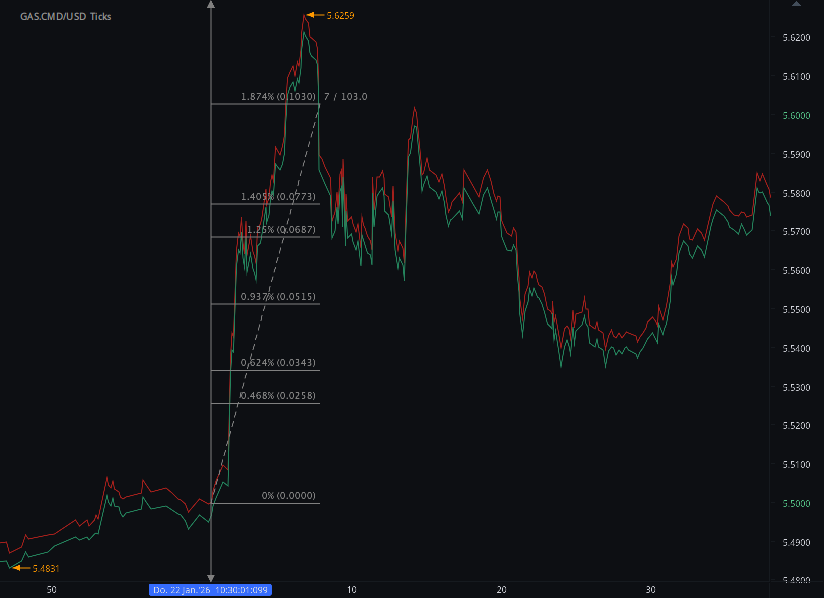
Charts are exported from JForex (Dukascopy).
U.S. Natural Gas Storage Remains Well Above Normal Despite Large Weekly Draw
U.S. natural gas inventories posted a significant weekly draw in mid-January, yet overall storage levels remain comfortably above historical norms—a key signal for winter market dynamics.
According to the latest Weekly Natural Gas Storage Report from the U.S. Energy Information Administration, working gas in underground storage across the Lower 48 states totaled 3,065 billion cubic feet (Bcf) for the week ending January 16, 2026.
That figure represents a net withdrawal of 120 Bcf from the prior week, reflecting stronger winter demand. Even so, inventories remain 141 Bcf higher than the same week last year and 177 Bcf above the five-year average, underscoring a well-supplied market.
Regional Breakdown: Broad-Based Withdrawals
Every major storage region reported declines during the week, with the largest draws concentrated in traditional heating-demand centers:
South Central: −39 Bcf
Midwest: −38 Bcf
East: −32 Bcf
Mountain: −9 Bcf
Pacific: −2 Bcf
Within the South Central region, salt cavern storage fell by 12 Bcf, while nonsalt facilities declined by 27 Bcf—both consistent with seasonal withdrawal patterns.
Still Above Normal Across Most Regions
Despite the sizable draw, inventories remain above both year-ago and five-year average levels in nearly every region:
Total U.S. storage: +4.8% vs. last year, +6.1% vs. five-year average
Mountain region: +34.4% vs. five-year average
Pacific region: +31.6% vs. five-year average
South Central: nearly 9% above historical norms
At 3,065 Bcf, total working gas remains above the five-year historical range, providing a cushion against late-season cold weather risks.
What This Means for the Market
The data tells a clear story:
Demand is real—winter withdrawals are accelerating
Supply is ample—storage remains elevated
Price pressure may stay muted unless colder-than-normal weather persists
For traders and analysts, the combination of strong draws and high absolute storage levels suggests a market that is responding to seasonal demand without signaling structural tightness.
As winter progresses, attention will shift to weather forecasts, withdrawal pace, and whether inventories begin converging toward historical averages—or continue to defy them.
Disclaimer: This blog post is for informational purposes only and should not be construed as financial advice. Always conduct thorough research and consider seeking advice from a financial professional before making any investment decisions.
Source: https://ir.eia.gov/ngs/ngs.html
Start futures forex fx commodity news trading with Haawks G4A low latency machine-readable data, one of the fastest data feeds for DOE data.
Please let us know your feedback. If you are interested in timestamps, please send us an email to sales@haawks.com.