Viewing entries tagged
monthly pnl

116 ticks potential forex fx futures news trading profit from 1 event in June 2026 with Haawks G4A machine-readable data feed

Comment

116 ticks potential forex fx futures news trading profit from 1 event in June 2026 with Haawks G4A machine-readable data feed

According to our analysis there was a potential of 116 ticks potential profit out of the following event in June 2026. The potential performance in 2025 was 1,828 pips / ticks.

June 2026

Cumulative potential, indicative performance June 2026, please see all releases below.

Total trading time would have been around 2 minutes! (preparation time not included)

You can click on each release for detailed information.


June 2026 Monthly Wrap-Up: One USDA Release, 116 Ticks of Opportunity

Meta description: June was a quiet month for scheduled HAAWKS grain-event coverage, but USDA’s June 30 Acreage and Grain Stocks reports still delivered 116 ticks of potential opportunity across corn, wheat, and soybeans. Here is what moved, why it mattered, and what traders should watch next.

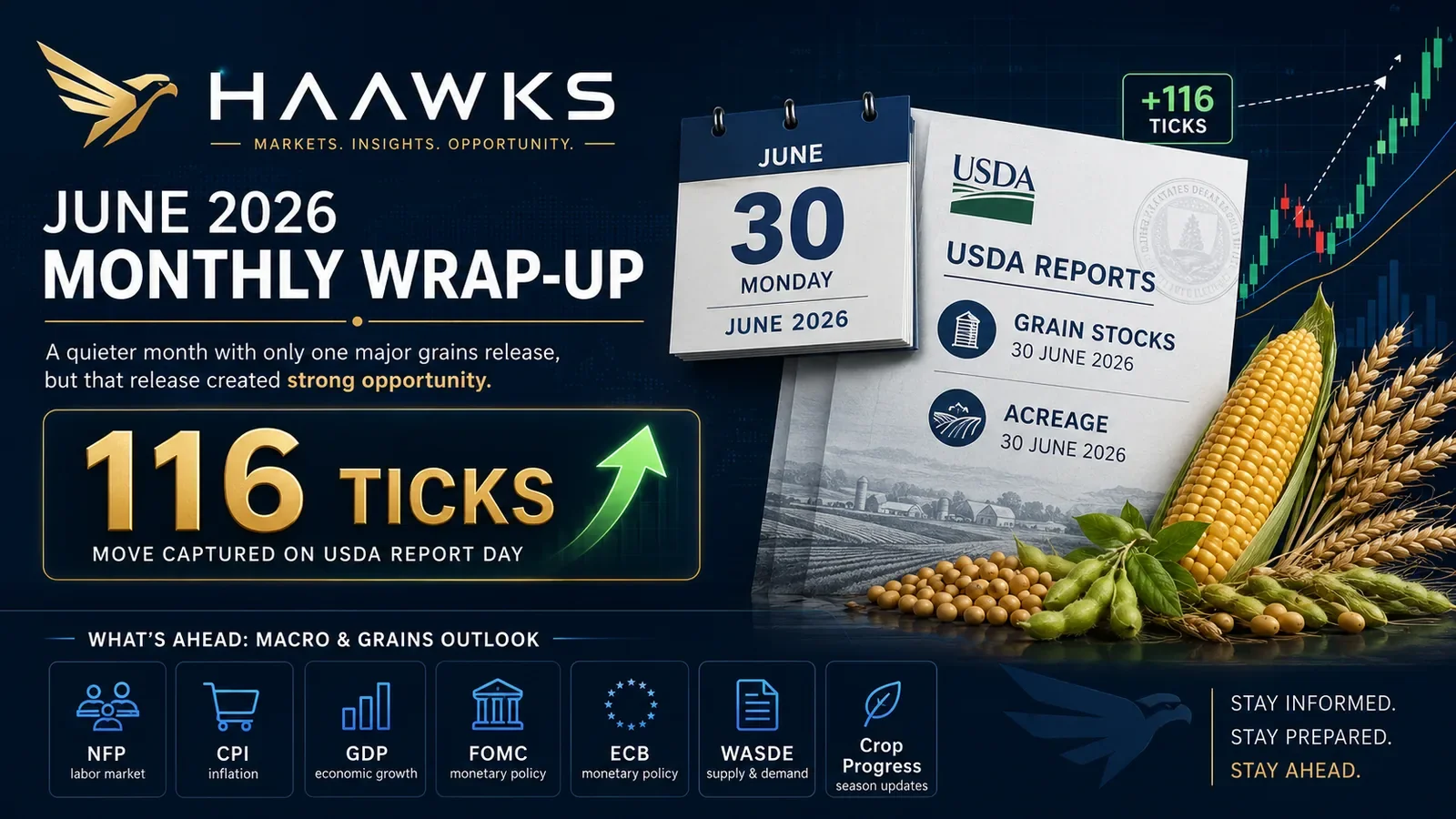
HAAWKS June 2026 monthly wrap-up graphic showing USDA Grain Stocks and Acreage, 116 ticks, grains, and market charts.

June was a quieter month for scheduled grain-event trading opportunities, with unfortunately only one major HAAWKS release in focus. But the month still ended with a meaningful USDA catalyst. On June 30, USDA published its Acreage and Grain Stocks reports, giving corn, wheat, and soybean traders a fresh summer setup and producing around 116 ticks of potential profit across ZC, ZW, and ZS futures. According to our analysis, soybeans moved around 48 ticks, wheat around 40 ticks, and corn around 28 ticks after the release.

The June Event: USDA Acreage and Grain Stocks

The June 30 reports delivered a mixed but tradable message. Old-crop supplies looked comfortable, while new-crop acreage shifted the balance of weather risk heading into July and August.

USDA estimated corn planted area at 95.3 million acres, down 3% from 2025. Soybean planted area rose to 85.4 million acres, up 5% year over year, while all wheat planted area fell to 42.7 million acres, down 6%. On the stocks side, June 1 inventories were higher for the major grain and oilseed contracts: corn stocks were 5.29 billion bushels, up 14% from last year; soybean stocks were 1.06 billion bushels, up 5%; and old-crop all wheat stocks were 920 million bushels, up 8%.

For traders, the takeaway was not simply bullish or bearish. The reports created a two-sided summer market: heavier old-crop inventories may cap nearby rallies, but acreage uncertainty and summer weather still leave room for new-crop volatility.

Corn: Bearish Stocks, Weather Optionality

Corn carried the clearest old-crop supply pressure. Larger June 1 stocks make it harder for nearby futures to sustain rallies without a demand or weather catalyst. However, planted acreage was lower year over year, and USDA’s survey still left some planting uncertainty in the final acreage picture.

That means December corn remains vulnerable to weather premium. If July forecasts turn hotter or drier, the market can quickly shift from old-crop comfort to new-crop risk pricing.

Soybeans: Bigger Acres, Stronger Demand Clues

Soybeans were pressured by the larger acreage number, but the stocks report included a more supportive demand detail. March-May disappearance was stronger than last year, which helped offset the bearish tone from expanded planted area.

The soybean setup now depends heavily on August weather, crush demand, export headlines, and whether the larger acreage base translates into comfortable production. November soybeans may struggle in benign weather, but the market remains exposed to sharp rallies if conditions deteriorate.

Wheat: Lower Acres Need Confirmation

Wheat had the most supportive acreage story, with all wheat planted area down 6% from last year. But the bullish acreage signal was softened by larger old-crop stocks.

That leaves wheat needing confirmation from yield, quality, export demand, Black Sea headlines, or adverse weather. Lower acres support the structure, but larger inventories reduce the urgency to chase rallies without a second catalyst.

Macro Outlook: June Data Arrives in July

The next macro calendar is important because June reference-month data will be released in July, just as grain markets move deeper into the weather-risk window.

The first major event is U.S. Nonfarm Payrolls for June, scheduled for July 2 at 8:30 a.m. ET. Labor-market data matters for rates, the dollar, and broader risk appetite, all of which can spill into commodities.

Inflation then returns to center stage. June CPI is scheduled for July 14 at 8:30 a.m. ET, followed by June PPI on July 15 at 8:30 a.m. ET. These releases will help shape expectations ahead of the late-July FOMC meeting.

Growth and consumer data will also matter. June retail sales are scheduled for July 16, while Q2 advance GDP and June Personal Income and Outlays / PCE are both scheduled for July 30 at 8:30 a.m. ET.

Central banks remain another source of volatility. The next FOMC meeting is scheduled for July 28-29, with the policy decision due on July 29. The ECB Governing Council monetary policy meeting is scheduled for July 22-23, with the Day 2 decision and press conference on July 23.

Grains Outlook: WASDE, Crop Progress, and Summer Weather

On the grain side, the market now shifts from acreage math to weather execution.

The next major USDA balance-sheet event is the July WASDE, scheduled for July 10 at 12:00 p.m. ET. This report will be the first major opportunity for USDA to incorporate the June acreage framework into updated supply-and-demand expectations.

Weekly Crop Progress reports also become increasingly important. USDA lists upcoming July releases for July 6, July 13, July 20, and July 27 at 4:00 p.m. ET. These reports will help traders track corn condition, soybean development, winter wheat harvest progress, and any early signs of stress from heat or dryness.

Other recurring grain-market inputs to watch include export sales, export inspections, ethanol production, weather-model updates, basis behavior, and CFTC positioning. The Commitments of Traders report is usually released on Fridays at 3:30 p.m. ET and can help show whether funds are adding to or reducing exposure in corn, wheat, and soybeans.

Bottom Line

June may have delivered only one major HAAWKS-covered grain-event opportunity, but it was an important one. The USDA Acreage and Grain Stocks reports produced 116 ticks of potential opportunity and reset the market narrative for summer.

Corn is balancing heavier old-crop stocks against new-crop weather risk. Soybeans have more acres but also stronger demand signals. Wheat has fewer acres, but larger stocks mean rallies still need confirmation.

The practical takeaway for traders is clear: old-crop supply cushions matter, but July is where weather, macro data, and USDA balance sheets begin to interact. After a quiet June, the next phase may be more active.


Disclaimer: This blog post is for informational purposes only and should not be construed as financial advice. Always conduct thorough research and consider seeking advice from a financial professional before making any investment decisions.


Start futures/forex/oil/grains news trading with Haawks G4A low latency machine-readable data today, we offer one of the fastest machine-readable data feeds for US macro-economic and commodity data and macro-economic data from Norway, Sweden, Turkey, Switzerland and ECB interest rates and statement.

Please let us know your feedback and check out our G4A low latency data feed.

All data is machine readable and available via API access in Chicago, New York and London. Free trials.

Comment

146 pips/ticks potential forex fx futures news trading profit from 4 events in May 2026 with Haawks G4A machine-readable data feed

Comment

146 pips/ticks potential forex fx futures news trading profit from 4 events in May 2026 with Haawks G4A machine-readable data feed

According to our analysis there was a potential of 146 pips/ticks potential profit out of the following 4 events in May 2026. The potential performance in 2025 was 1,828 pips / ticks.

May 2026

Cumulative potential, indicative performance May 2026, please see all releases below.

Total trading time would have been around 5 minutes! (preparation time not included)

You can click on each release for detailed information.


2026 News Trading Update: DOE (EIA) and PPI Reports Continue to Drive Fast Futures Market Moves

May 2026 delivered another active stretch for futures news traders, with several U.S. economic and commodity releases producing sharp short-term market moves. Across petroleum, natural gas, and inflation data, our analysis found meaningful tick movement shortly after key reports were released.

The strongest move in this period came from the DOE Petroleum Status Report on May 6, 2026, when crude oil moved 57 ticks in 40 seconds. Natural gas also remained highly responsive to DOE Natural Gas Storage Report data, moving 39 ticks on May 7 and 30 ticks on May 28. The U.S. BLS Producer Price Index report on May 13 also triggered a notable move in US500 futures, with the market moving 5 points, or 20 ticks, in 37 seconds.

Together, these events added to a potential 2026 performance figure of 911 pips, compared with 1,828 pips in 2025.

DOE Petroleum Status Report: Crude Oil Moves 57 Ticks on May 6

The DOE Petroleum Status Report released on May 6, 2026, produced the largest move in this group. According to our analysis, light sweet crude oil moved 57 ticks in 40 seconds following the report.

The underlying EIA data pointed to a tighter petroleum market. For the week ending May 1, U.S. commercial crude oil inventories fell by 2.3 million barrels to 457.2 million barrels. Although crude stocks remained about 1% above the five-year average for this time of year, the weekly draw showed that supply was being pulled lower as refinery activity remained strong.

Refineries operated at 90.1% of operable capacity, with crude oil refinery inputs averaging 16.0 million barrels per day. Gasoline and distillate production both declined slightly, while imports also moved lower. Crude oil imports averaged 5.5 million barrels per day, down 273,000 barrels per day from the previous week.

Fuel inventories also tightened. Motor gasoline inventories fell by 2.5 million barrels, leaving stocks about 4% below the five-year average. Distillate fuel inventories declined by 1.3 million barrels and stood about 11% below the five-year average.

The price data reinforced the market pressure. WTI crude stood at $105.38 per barrel on May 1, up $6.96 from the previous week and sharply above the year-ago level. Retail fuel prices also jumped, with regular gasoline rising to $4.452 per gallon and diesel increasing to $5.640 per gallon.

For traders, the report combined several market-moving elements: falling crude inventories, lower imports, tightening fuel stocks, firm demand, and sharply higher prices. That mix helped explain the strong short-term reaction in crude oil futures.

Natural Gas Storage Report: 39-Tick Move on May 7

Natural gas also showed strong sensitivity to DOE storage data. On May 7, 2026, the DOE Natural Gas Storage Report produced a 39-tick move in natural gas within 44 seconds.

For the week ending May 1, working natural gas in underground storage rose by 63 billion cubic feet, reaching 2,205 Bcf. Inventories were 75 Bcf higher than the same week in 2025 and 139 Bcf above the five-year average.

The report showed a generally comfortable storage position as the market moved further into injection season. Most regions posted gains, while the Mountain region recorded a small 2 Bcf withdrawal. The East region added 29 Bcf, the Midwest added 23 Bcf, and South Central added 9 Bcf.

One of the most notable details was the strength of inventories in the western regions. Mountain storage remained 48.2% above the five-year average, while Pacific storage stood 39.6% above the five-year average. By contrast, the East, Midwest, and South Central regions were much closer to normal.

The report suggested that the U.S. natural gas market was entering May with a healthy storage cushion. While national inventories were not excessively high, they were comfortably above both year-ago levels and the five-year average.

U.S. PPI Report: US500 Moves 20 Ticks on May 13

The U.S. BLS Producer Price Index report on May 13, 2026, also produced a fast futures market reaction. According to our analysis, US500 futures moved 5 points, equal to 20 ticks, in 37 seconds following the release.

The April 2026 PPI report showed a sharp acceleration in wholesale inflation. Final demand prices rose 1.4% on a seasonally adjusted monthly basis, following increases of 0.7% in March and 0.6% in February. That marked the largest monthly gain since March 2022.

On a year-over-year basis, final demand prices rose 6.0%, the largest 12-month increase since December 2022.

Services were a major contributor. Final demand services rose 1.2%, with trade services margins up 2.7% and transportation and warehousing services surging 5.0%. Freight costs were especially important, with truck transportation of freight contributing to increases across both final and intermediate demand categories.

Goods prices also rose sharply. Final demand goods increased 2.0%, driven heavily by energy. Final demand energy prices jumped 7.8%, while gasoline rose 15.6% and accounted for more than 40% of the increase in final demand goods prices.

Core producer inflation also strengthened. The index for final demand less foods, energy, and trade services rose 0.6%, the largest increase since October 2025. Over 12 months, this core measure increased 4.4%, the largest gain since February 2023.

For equity index futures, the report mattered because it pointed to broader inflation pressure across energy, freight, trade margins, services, and intermediate goods. The data complicated the inflation outlook and likely contributed to the sharp short-term move in US500 futures.

Natural Gas Storage Report: 30-Tick Move on May 28

Natural gas produced another significant move later in the month. On May 28, 2026, the DOE Natural Gas Storage Report triggered a 30-tick move in natural gas within 97 seconds.

For the week ending May 22, U.S. working natural gas in underground storage increased by 92 Bcf, bringing total stocks to 2,483 Bcf. Inventories were 21 Bcf higher than the same week in 2025 and 144 Bcf above the five-year average.

The weekly injection was broad-based across all major Lower 48 storage regions. The East region added 28 Bcf, the Midwest added 34 Bcf, the Mountain region added 3 Bcf, the Pacific region added 6 Bcf, and South Central added 21 Bcf.

At the regional level, Mountain and Pacific inventories remained especially strong relative to historical norms. Mountain storage stood 35.7% above the five-year average, while Pacific storage was 30.9% above the five-year average.

The 92 Bcf build left total U.S. storage within the five-year historical range and above the five-year average heading into the summer cooling season. While the national storage position remained comfortable, the size of the injection and regional details still produced a meaningful short-term futures reaction.

Bottom Line

May 2026 showed continued opportunity across futures news trading, especially around DOE energy reports and U.S. inflation data.

The DOE Petroleum Status Report on May 6 produced a 57-tick crude oil move as inventories tightened and fuel prices surged. The DOE Natural Gas Storage Reports on May 7 and May 28 produced 39-tick and 30-tick moves, respectively, as traders reacted to storage builds and regional inventory details. The U.S. PPI report on May 13 triggered a 20-tick move in US500 futures as wholesale inflation came in hot across headline, core, goods, services, freight, and energy components.

According to our analysis, these events contributed to 911 pips of potential performance in 2026, compared with 1,828 pips in 2025.

Disclaimer: This blog post is for informational purposes only and should not be construed as financial advice. Always conduct thorough research and consider seeking advice from a financial professional before making any investment decisions.


Start futures/forex/oil/grains news trading with Haawks G4A low latency machine-readable data today, we offer one of the fastest machine-readable data feeds for US macro-economic and commodity data and macro-economic data from Norway, Sweden, Turkey, Switzerland and ECB interest rates and statement.

Please let us know your feedback and check out our G4A low latency data feed.

All data is machine readable and available via API access in Chicago, New York and London. Free trials.

Comment

137 pips, US500 4 points potential forex fx futures news trading profit from 5 events in April 2026 with Haawks G4A machine-readable data feed

Comment

137 pips, US500 4 points potential forex fx futures news trading profit from 5 events in April 2026 with Haawks G4A machine-readable data feed

According to our analysis there was a potential of 137 pips and US500 4 points potential profit out of the following 5 events in April 2026. The potential performance in 2025 was 1,828 pips / ticks.

April 2026

Cumulative potential, indicative performance April 2026, please see all releases below.

Total trading time would have been around 5 minutes! (preparation time not included)

You can click on each release for detailed information.


Fast Markets, Faster Data: What Late-April 2026 Tells Us About News Trading

The final weeks of April 2026 offered a textbook example of how high-impact economic releases can drive rapid price movements across energy and equity markets. From natural gas storage data to petroleum inventories and consumer sentiment, traders saw sharp, short-lived opportunities—often lasting less than two minutes.

This post breaks down what happened, why it mattered, and what it reveals about the evolving landscape of low-latency news trading.

Natural Gas: Injection Season Drives Quick Moves

On April 30, 2026, the Weekly Natural Gas Storage Report from the U.S. Energy Information Administration (EIA) triggered an 18-tick move in just 24 seconds.

What the Data Showed

  • +79 Bcf injection, bringing total storage to 2,142 Bcf

  • +116 Bcf vs last year

  • +153 Bcf above the five-year average

This confirmed a strong start to the injection season, with supply comfortably exceeding historical norms.

Market Interpretation

The reaction was fast because the data reinforced a bearish short-term narrative:

  • Mild weather → lower demand

  • Strong injections → rising inventories

  • Oversupply risk → downward price pressure

Yet, the move was brief—highlighting how quickly markets digest structured data when expectations are clear.

Crude Oil: Inventory Draws Fuel Volatility

A day earlier, on April 29, the EIA’s petroleum status report triggered a much larger reaction:

  • 49 ticks in 81 seconds in light sweet crude oil

Key Highlights

  • Crude inventories: -6.2 million barrels

  • Gasoline: -6.1 million barrels

  • Distillates: -4.5 million barrels

  • Imports declined sharply

At the same time:

  • WTI surged to $98.42/barrel

  • Demand remained strong, especially for distillates

Why It Moved

This was a classic bullish supply shock setup:

  • Falling inventories

  • Strong demand

  • Reduced imports

Unlike natural gas, where oversupply capped upside, crude oil showed tightening fundamentals, leading to stronger and longer price movement.

Consumer Sentiment: Smaller Data, Smaller Moves

Not all releases generate the same opportunity.

On April 24, the University of Michigan Consumer Sentiment report moved the US500 index by:

  • 4 points in 31 seconds

Key Takeaways

  • Sentiment dropped to 49.8

  • Inflation expectations jumped to 4.7%

Despite its macro importance, the market reaction was muted compared to energy data.

Why?

  • Equity markets often price in sentiment trends gradually

  • No immediate supply/demand shock like in commodities

  • Lower urgency for algorithmic execution

A Pattern Emerges: Speed vs Substance

Looking across these events:

Event Instrument Move Time
Natural Gas Storage (Apr 30) Natural Gas 18 ticks 24 sec
Petroleum Report (Apr 29) Crude Oil 49 ticks 81 sec
Consumer Sentiment (Apr 24) US500 4 points 31 sec
Natural Gas Storage (Apr 23) Natural Gas 19 ticks 32 sec

Key Observations

  1. Energy data dominates short-term volatility

  2. Inventory surprises = strongest reactions

  3. Speed matters—most moves happen within 1–2 minutes

  4. Consistency exists: similar reports produce repeatable reactions

The Bigger Picture: 2026 vs 2025

  • 2026 YTD: 765 pips potential

  • 2025: 1,828 pips

This suggests:

  • Either lower volatility so far in 2026

  • Or fewer large surprises relative to expectations

But the structure remains intact—predictable, fast bursts of opportunity around scheduled releases.

What Drives These Moves?

Across all reports, three core drivers stand out:

1. Expectations vs Reality

Markets don’t react to data—they react to surprises.

2. Supply/Demand Imbalances

Especially in commodities:

  • Inventory builds → bearish

  • Inventory draws → bullish

3. Machine-Speed Execution

Modern trading systems process releases instantly, leaving:

  • Milliseconds—not minutes—for entry

  • A premium on low-latency data feeds

Looking Ahead

With summer approaching, several catalysts could amplify volatility:

  • Heatwaves → increased natural gas demand

  • LNG exports → tighter supply

  • Refinery activity → crude and product imbalances

The next EIA releases will be critical in confirming whether:

  • Natural gas oversupply persists

  • Oil markets continue tightening

Final Thoughts

Late April 2026 reinforces a simple reality:

The biggest opportunities in news trading are fast, data-driven, and increasingly dominated by speed.

Energy markets—especially those tied to EIA reports—remain among the most responsive instruments for short-term traders. But success depends on more than just interpretation:

  • Timing

  • Execution

  • Access to machine-readable data

Without those, even the clearest opportunity can be gone in seconds.

Disclaimer: This blog post is for informational purposes only and should not be construed as financial advice. Always conduct thorough research and consider seeking advice from a financial professional before making any investment decisions.


Start futures/forex/oil/grains news trading with Haawks G4A low latency machine-readable data today, we offer one of the fastest machine-readable data feeds for US macro-economic and commodity data and macro-economic data from Norway, Sweden, Turkey, Switzerland and ECB interest rates and statement.

Please let us know your feedback and check out our G4A low latency data feed.

All data is machine readable and available via API access in Chicago, New York and London. Free trials.

Comment

54 pips, XAUUSD 16 points and US500 31 points potential forex fx futures news trading profit from 3 events in March 2026 with Haawks G4A machine-readable data feed

Comment

54 pips, XAUUSD 16 points and US500 31 points potential forex fx futures news trading profit from 3 events in March 2026 with Haawks G4A machine-readable data feed

According to our analysis there was a potential of 54 pips, XAUUSD (Spot Gold) 16 points and US500 31 points potential profit out of the following 3 events in March 2026. The potential performance in 2025 was 1,828 pips / ticks.

March 2026

Cumulative potential, indicative performance March 2026, please see all releases below.

Total trading time would have been around 2 minutes! (preparation time not included)

You can click on each release for detailed information.


Trading the Data: How USDA and U.S. Macro Releases Are Driving Futures Volatility in 2026

March 2026 has delivered a clear reminder of one thing traders already know—but often underestimate: data moves markets fast. From agricultural reports to labor market surprises and energy storage updates, short-term volatility has created measurable opportunities across futures and FX markets.

In this post, we break down three key data-driven moves:

  • Soybeans reacting to USDA reports

  • Gold and equity indices responding to U.S. jobs data

  • Natural gas shifting on storage figures

And more importantly—what traders can learn from them.

Soybeans: 40 Ticks on USDA Grain Stocks & Plantings

On March 31, 2026, soybean futures (ZS) moved approximately 40 ticks following the release of:

  • USDA Grain Stocks

  • USDA Prospective Plantings

What drove the move?

The data painted a bearish-leaning but nuanced picture:

  • Soybean stocks: +10% YoY → rising supply

  • Off-farm stocks: +16% → weaker demand/export flow

  • Demand ("disappearance"): slightly down

  • Planted acreage: +4% → more future supply

Market interpretation

This combination signals a classic setup:

  • Short-term: Supply pressure → downside bias

  • Medium-term: Risk of oversupply if demand doesn’t recover

However, the reaction wasn’t one-directional. The 40-tick move suggests:

  • Fast repricing

  • Liquidity gaps around release time

  • Algorithmic trading dominance

Bigger macro context

Grain markets are entering a transitional phase:

  • Higher inventories across major crops

  • Farmers rotating from corn into soybeans

  • Weather risks (drought, low snowpack) acting as a wildcard

Key takeaway: Even when data is broadly bearish, uncertainty + positioning = volatility.

Gold & S&P 500: NFP Shock Moves Markets in Seconds

On March 6, 2026, the U.S. Employment Situation report triggered sharp moves:

  • Gold (XAUUSD): +16 points

  • US500 (S&P 500 futures): +31 points

  • Reaction time: ~24 seconds

What did the data say?

  • Payrolls: –92,000 jobs (unexpected decline)

  • Unemployment: steady at 4.4%

  • Wage growth: still solid (+3.8% YoY)

Why markets reacted

This was a mixed macro signal:

  • Weak job creation → economic slowdown concerns

  • Stable unemployment + rising wages → no immediate collapse

Market logic

  • Gold: benefited from risk-off sentiment

  • Equities: initial volatility as traders reassessed growth outlook

The speed of the move highlights:

  • Machine-readable news trading dominance

  • Execution advantage measured in milliseconds

Key takeaway: It’s not just the data—it’s the difference between expectations and reality that drives price.

Natural Gas: 14 Ticks on Storage Data

On March 5, 2026, natural gas futures moved 14 ticks following the DOE storage report.

The numbers

  • Storage: 1,886 Bcf

  • Weekly withdrawal: –132 Bcf

  • Still:

    • Above last year

    • Slightly below 5-year average

Interpretation

This is a balanced but sensitive market:

  • Large withdrawal = bullish signal

  • But overall supply still comfortable

Regional imbalances also matter:

  • Midwest & East → tighter

  • Pacific & Mountain → oversupplied

Key takeaway: Even “neutral” reports can trigger tradable moves when positioning is tight.

Performance Snapshot (2026 vs 2025)

  • 2026 (YTD): 628 pips potential

  • 2025: 1,828 pips

Early 2026 shows:

  • Lower total movement so far

  • But high-quality, fast reaction opportunities

What Traders Should Learn

1. Speed is an edge

Markets are reacting in seconds:

  • Soybeans: immediate repricing

  • NFP: moves within 24 seconds

  • Gas: sub-minute reactions

Manual trading is increasingly disadvantaged without preparation.

2. Context matters more than headlines

Raw numbers aren’t enough:

  • Soybeans: bearish supply + weather uncertainty

  • NFP: weak jobs but stable unemployment

  • Gas: large draw but balanced inventories

Markets trade interpretation, not just data.

3. Cross-market awareness is critical

Different assets react differently:

  • Commodities → supply/demand

  • Equities → growth expectations

  • Gold → macro risk sentiment

Understanding correlations improves trade selection.

4. Volatility clusters around data releases

All three examples share:

  • Predictable timing

  • Sudden liquidity shifts

  • Short-lived inefficiencies

This is where news trading strategies thrive.

The Bigger Picture: A Market in Transition

Across sectors, 2026 is shaping up around three themes:

  1. Supply is comfortable—but fragile

  2. Demand signals are diverging

  3. Weather and macro risks are rising

This creates a trading environment where:

  • Trends are less stable

  • Reactions are sharper

  • Opportunities are shorter-lived

Final Thoughts

March 2026 highlights a clear reality:

The edge in modern trading is no longer just what you know—but how fast you can act on it.

From soybeans to gold to natural gas, data releases remain one of the most reliable catalysts for short-term price movement.

But success requires:

  • Preparation

  • Contextual understanding

  • Execution speed

Disclaimer: This blog post is for informational purposes only and should not be construed as financial advice. Always conduct thorough research and consider seeking advice from a financial professional before making any investment decisions.


Start futures/forex/oil/grains news trading with Haawks G4A low latency machine-readable data today, we offer one of the fastest machine-readable data feeds for US macro-economic and commodity data and macro-economic data from Norway, Sweden, Turkey, Switzerland and ECB interest rates and statement.

Please let us know your feedback and check out our G4A low latency data feed.

All data is machine readable and available via API access in Chicago, New York and London. Free trials.

Comment

183 pips and US500 12 points potential forex fx futures news trading profit from 6 events in February 2026 with Haawks G4A machine-readable data feed

Comment

183 pips and US500 12 points potential forex fx futures news trading profit from 6 events in February 2026 with Haawks G4A machine-readable data feed

According to our analysis there was a potential of 183 pips and US500 12 points potential profit out of the following 6 events in February 2026. The potential performance in 2025 was 1,828 pips / ticks.

February 2026

Cumulative potential, indicative performance February 2026, please see all releases below.

Total trading time would have been around 5 minutes! (preparation time not included)

You can click on each release for detailed information.


News Trading Performance Review – February 2026

Natural Gas, Crude Oil, and Major U.S. Macro Releases

February 2026 provided several high-impact trading opportunities for futures and FX news traders. Key U.S. macroeconomic releases and energy inventory reports triggered rapid price movements across natural gas, crude oil, and major currency pairs.

Using low-latency machine-readable data feeds, several events generated measurable short-term volatility within seconds of release. Below is a review of the most notable market reactions.

Overall Performance Snapshot

During February 2026, the following news events generated measurable trading opportunities:

Date Event Market Potential Move Reaction Window
Feb 11, 2026 US Employment Situation (NFP) USDJPY 36 pips 31 seconds
Feb 11, 2026 US Employment Situation (NFP) EURUSD 24 pips 31 seconds
Feb 12, 2026 DOE Natural Gas Storage Report (WNGSR) Natural Gas 23 ticks 26 seconds
Feb 13, 2026 US Consumer Price Index (CPI) USDJPY 11 pips 31 seconds
Feb 13, 2026 US Consumer Price Index (CPI) EURUSD 5 pips 31 seconds
Feb 13, 2026 US Consumer Price Index (CPI) US500 12 points 31 seconds
Feb 19, 2026 DOE Natural Gas Storage Report (WNGSR) Natural Gas 41 ticks 25 seconds
Feb 25, 2026 DOE Petroleum Status Report (WPSR) Light Sweet Crude Oil 17 ticks 57 seconds
Feb 26, 2026 DOE Natural Gas Storage Report (WNGSR) Natural Gas 26 ticks 74 seconds

Aggregate Performance (2026 Year-to-Date)

Metric Result
Total Potential Performance 574 pips equivalent
Largest Single Event Move 60 pips (NFP – Feb 11)
Fastest Market Reaction 25 seconds (Natural Gas Storage – Feb 19)
Total Major Events 6 economic releases

Energy Market Volatility Summary

Energy Report Date Potential Move
Natural Gas Storage Report Feb 12, 2026 23 ticks
Natural Gas Storage Report Feb 19, 2026 41 ticks
Natural Gas Storage Report Feb 26, 2026 26 ticks
Petroleum Status Report Feb 25, 2026 17 ticks

Total energy-related volatility: 107 ticks across four reports.

Total potential performance recorded in 2026 so far: 574 pips (2025 total: 1,828 pips).

Natural Gas: Storage Reports Driving Volatility

The DOE Weekly Natural Gas Storage Report (WNGSR) continues to be one of the most consistent volatility catalysts in the energy markets.

February 12, 2026 Release

The EIA reported a 249 Bcf withdrawal from storage for the week ending February 6.

Key market context:

  • Total working gas: 2,214 Bcf

  • 97 Bcf below last year

  • 130 Bcf below the five-year average

Regional highlights:

  • East: –64 Bcf

  • Midwest: –74 Bcf

  • South Central: –107 Bcf

  • Pacific: +1 Bcf

This data triggered a 23-tick move within 26 seconds in natural gas futures.

February 19, 2026 Release

The following week showed another significant withdrawal:

  • Storage decline: 144 Bcf

  • Total inventories: 2,070 Bcf

  • 123 Bcf below the five-year average

Regional withdrawals remained strong:

  • East: –50 Bcf

  • Midwest: –53 Bcf

  • South Central: –37 Bcf

This report produced an even stronger market response, with 41 ticks of movement in just 25 seconds.

February 26, 2026 Release

The final February report indicated a smaller draw:

  • Net change: –52 Bcf

  • Total storage: 2,018 Bcf

  • 7 Bcf below the five-year average

  • 141 Bcf above the same week last year

Regional dynamics were mixed:

  • East: –24 Bcf

  • Midwest: –16 Bcf

  • Pacific: –12 Bcf

  • Mountain: –6 Bcf

  • South Central: +6 Bcf injection

Despite the moderate withdrawal, natural gas futures still reacted quickly, generating a 26-tick move within 74 seconds.

The series of reports illustrates how traders closely monitor deviations from seasonal expectations, particularly during the final weeks of the winter withdrawal season.

Crude Oil: Inventory Build Triggers Short-Term Move

DOE Petroleum Status Report – February 25, 2026

The EIA’s weekly petroleum update showed a significant build in crude oil inventories alongside reduced refinery activity.

Key data points:

  • Crude refinery inputs: 15.7 million barrels/day

  • Down 416,000 bpd from the previous week

  • Refinery utilization: 88.6%

Fuel production also softened:

  • Gasoline: 9.2 million bpd

  • Distillates: 4.8 million bpd

The headline inventory increase triggered a 17-tick move in light sweet crude oil futures within 57 seconds of the release.

Seasonal refinery maintenance contributed to the inventory build, a typical pattern in late winter.

U.S. Macroeconomic Releases

Beyond energy markets, two major U.S. macroeconomic indicators generated strong FX volatility.

US Employment Situation (NFP) – February 11, 2026

The January employment report showed:

  • 130,000 jobs added

  • Unemployment rate: 4.3%

  • Average hourly earnings: +0.4%

Sector performance:

Strong gains:

  • Health care: +82k jobs

  • Social assistance: +42k

  • Construction: +33k

Declines:

  • Federal government: –34k

  • Financial activities: –22k

The release generated a 60-pip combined move across USDJPY and EURUSD within 31 seconds.

US Consumer Price Index (CPI) – February 13, 2026

Inflation data for January indicated continued moderation:

  • Monthly CPI: +0.2%

  • Year-over-year CPI: 2.4%

  • Core CPI: 2.5%

Energy prices declined:

  • Gasoline: –3.2% monthly

  • Overall energy: –1.5%

Core services remained firm:

  • Shelter: +0.2%

  • Medical care: +0.3%

This release generated:

  • 16 pips across USDJPY and EURUSD

  • 12 points in the US500 index

All within 31 seconds of the data release.

Key Market Takeaways

Several themes emerged across February’s news releases:

Energy inventories remain a major volatility driver

Weekly natural gas storage data repeatedly generated fast price reactions due to tight seasonal supply conditions.

Macroeconomic releases continue to influence FX

Employment and inflation data remain the most significant catalysts for currency market volatility.

Reaction windows are extremely short

Most measurable moves occurred within 25–75 seconds of the release, highlighting the importance of low-latency data processing.

Looking Ahead

As the winter heating season winds down, traders will closely monitor:

  • End-of-season natural gas storage levels

  • Early spring injection trends

  • U.S. production levels

  • LNG export demand

On the macro side, upcoming releases that could generate volatility include:

  • February CPI

  • March employment report

  • Federal Reserve policy signals

For energy traders, the Weekly Natural Gas Storage Report will remain one of the most closely watched data points as markets transition toward the injection season.

Disclaimer: This blog post is for informational purposes only and should not be construed as financial advice. Always conduct thorough research and consider seeking advice from a financial professional before making any investment decisions.


Start futures/forex/oil/grains news trading with Haawks G4A low latency machine-readable data today, we offer one of the fastest machine-readable data feeds for US macro-economic and commodity data and macro-economic data from Norway, Sweden, Turkey, Switzerland and ECB interest rates and statement.

Please let us know your feedback and check out our G4A low latency data feed.

All data is machine readable and available via API access in Chicago, New York and London. Free trials.

Comment

391 pips, US500 13 points and BTC 177 points potential forex fx futures news trading profit from 5 events in January 2026 with Haawks G4A machine-readable data feed

Comment

391 pips, US500 13 points and BTC 177 points potential forex fx futures news trading profit from 5 events in January 2026 with Haawks G4A machine-readable data feed

According to our analysis there was a potential of 391 pips, US500 13 points and BTC 177 points profit out of the following 5 events in January 2026. The potential performance in 2025 was 1,828 pips / ticks.

January 2026

Cumulative potential, indicative performance January 2026, please see all releases below.

Total trading time would have been around 4 minutes! (preparation time not included)

You can click on each release for detailed information.


January 2026 Macro & Commodity Volatility Recap: USDA, CPI, and DOE Data Drive Fast Markets

February 1, 2026

January 2026 delivered a dense run of high-impact U.S. macroeconomic and commodity data releases—and markets responded with speed. From grains and natural gas to FX, equity indices, and crypto, low-latency reactions created measurable short-term trading opportunities across multiple asset classes.

According to Haawks G4A analysis, USDA, CPI, and DOE releases generated hundreds of ticks and pips of potential performance, reinforcing the importance of machine-readable data in time-sensitive trading strategies.

Performance Snapshot — January 2026

  • USDA WASDE & Grain Stocks (Jan 12): ~200 ticks

  • US CPI (Jan 13):

    • EURUSD: 5 pips

    • US500: 13 points

    • BTC: 177 points

  • DOE Natural Gas Storage Reports:

    • Jan 15: 66 ticks

    • Jan 22: 103 ticks

    • Jan 29: 17 ticks

Total potential performance (2026 YTD): 391 pips
(2025 full year: 1,828 pips)

USDA WASDE & Grain Stocks — January 12, 2026

Big Crops, Rising Stocks, and Mixed Price Signals

The January WASDE (Report 667), released by the United States Department of Agriculture, confirmed a clear theme of abundant supply across most major crops.

Grains Reaction

Futures volatility was concentrated in:

  • Soybeans (ZS): ~80 ticks

  • Corn (ZC): ~60 ticks

  • Wheat (WC): ~60 ticks

Key Fundamentals

  • Corn:

    • Record U.S. production at 17.0 billion bushels

    • Yield: 186.5 bu/acre

    • Ending stocks: 2.2 billion bushels

    • Price forecast: $4.10/bu

  • Wheat:

    • Ending stocks: 926 million bushels

    • Season-average price: $4.90/bu

    • Global stocks rise to 278.3 million tons

  • Soybeans:

    • Production: 4.3 billion bushels

    • Ending stocks: 350 million bushels

    • Price forecast cut to $10.20/bu

    • Brazil crop raised to 178 million tons

Grain Stocks Confirmation

December 1 inventories reinforced the supply-heavy narrative:

  • Corn: +10% YoY

  • Soybeans: +6%

  • Wheat: +7%

  • Grain sorghum: +26%

Market takeaway: Record production and expanding global stocks capped upside volatility, but headline numbers still triggered fast intraday futures reactions.

US CPI — January 13, 2026

Inflation Ends 2025 Steady, Not Fully Subdued

The December CPI report from the U.S. Bureau of Labor Statistics kept inflation expectations stable—but markets still reacted immediately.

Market Moves (First Minute Reaction)

  • EURUSD: 5 pips

  • US500: 13 points

  • BTC: 177 points

Key Inflation Data

  • Headline CPI (MoM): +0.3%

  • YoY CPI: 2.7%

  • Core CPI: 2.6%

Notable Drivers

  • Shelter inflation remained sticky (+3.2% YoY)

  • Food prices accelerated (+0.7% MoM)

  • Gasoline fell, but electricity and natural gas rose sharply YoY

  • Services inflation remained firm

Market takeaway: Inflation is no longer accelerating, but persistence in housing and services continues to matter for rates, FX, and risk assets.

DOE Natural Gas Storage Reports — January 2026

Big Draws, But No Supply Stress

Natural gas futures reacted to every January storage release, with volatility driven by withdrawal size versus expectations rather than absolute inventory levels.

All reports were released by the U.S. Energy Information Administration.

January 15 Report (Week Ending Jan 9)

  • Withdrawal: 71 Bcf

  • Futures move: 66 ticks

  • Total storage: 3,185 Bcf

  • +106 Bcf vs. 5-year average

January 22 Report (Week Ending Jan 16)

  • Withdrawal: 120 Bcf

  • Futures move: 103 ticks

  • Total storage: 3,065 Bcf

  • +177 Bcf vs. 5-year average

Despite accelerating withdrawals, inventories remained well above normal.

January 29 Report (Week Ending Jan 23)

  • Withdrawal: 242 Bcf

  • Futures move: 17 ticks in 7 seconds

  • Total storage: 2,823 Bcf

  • +143 Bcf vs. 5-year average

Regional draws were led by:

  • South Central: −89 Bcf

  • Midwest: −76 Bcf

  • East: −55 Bcf

Western regions remained more than 30% above five-year averages.

Market takeaway: Winter demand intensified, but storage buffers remained sufficient—keeping price reactions fast but contained.

Final Thoughts

January 2026 reinforced a recurring theme across asset classes:

  • Speed matters more than direction in news-driven markets

  • Even supply-heavy fundamentals can generate sharp short-term volatility

  • Machine-readable data remains critical for trading USDA, CPI, and DOE releases

With weather, exports, inflation expectations, and seasonal demand still in play, event-driven volatility is likely to persist into February.

Disclaimer: This blog post is for informational purposes only and should not be construed as financial advice. Always conduct thorough research and consider seeking advice from a financial professional before making any investment decisions.


Start futures/forex/oil/grains news trading with Haawks G4A low latency machine-readable data today, we offer one of the fastest machine-readable data feeds for US macro-economic and commodity data and macro-economic data from Norway, Sweden, Turkey, Switzerland and ECB interest rates and statement.

Please let us know your feedback and check out our G4A low latency data feed.

All data is machine readable and available via API access in Chicago, New York and London. Free trials.

Comment

57 pips, US500 6 points and BTC 678 points potential forex fx futures news trading profit from 2 events in December 2025 with Haawks G4A machine-readable data feed

Comment

57 pips, US500 6 points and BTC 678 points potential forex fx futures news trading profit from 2 events in December 2025 with Haawks G4A machine-readable data feed

According to our analysis there was a potential of 57 pips, US500 6 points and BTC 678 points profit out of the following 2 events in December 2025. The potential performance in 2025 was 1,828 pips / ticks.

December 2025

Cumulative potential, indicative performance December 2025, please see all releases below.

Total trading time would have been around 2 minutes! (preparation time not included)

You can click on each release for detailed information.


Markets React to December 2025 Macro Shocks: CPI, Jobless Claims & the FOMC Rate Cut

December 2025 delivered two major clusters of U.S. macroeconomic data—each triggering sharp but short-lived volatility across FX, index futures, and crypto. Between the FOMC interest rate decision on December 10 and the CPI + Jobless Claims release on December 18, traders saw multiple high-impact opportunities in EURUSD, USDJPY, US500, and BTC.

Below is a consolidated performance recap and a deeper macro interpretation of what these releases signal for 2026.

1. Market Reaction: How Much Did Markets Move?

10 December 2025 – FOMC Decision & Projections

  • USDJPY: 26 pips

  • EURUSD: 19 pips

Total: 45 pips potential in 48 seconds
YTD (2025) potential: 1816 pips (vs 4305 in 2024)

The Fed cut rates by 25 bps to 3.50–3.75%, igniting brief but actionable volatility across major FX pairs.

18 December 2025 – CPI + Jobless Claims

  • EURUSD: 12 pips

  • US500: 6 points

  • BTC: 678 points

Total: 12 pips + 6 points + 678 points in 43 seconds
2025 YTD potential: 1828 pips

Crypto was the standout mover, with BTC reacting aggressively to the disinflationary tone and labor-market stability.

2. What the Data Actually Says: A Macro Deep Dive

A. Labor Market – Still Tight, Still Resilient

Initial claims:

  • 224k, down 13k from the previous week

  • 4-week average stable at 217.5k

These levels signal continued expansion, not recession. Historically, recessions show up closer to 300k+ claims.

Insured unemployment (SA):

  • 1.897M, within the 2025 range of 1.83–1.95M

  • IUR flat at 1.2%

No state has triggered Extended Benefits, a strong sign that labor weakness isn’t systemic.

Sectoral patterns

States with the highest insured unemployment—CA, WA, NJ, MA—mirror exposure to:

  • Tech & high-wage services

  • Construction slowdowns

  • Logistics & manufacturing adjustments

This is late-cycle choppiness, not broad deterioration.

B. Inflation – Controlled Disinflation Toward 2–3%

Headline CPI: +2.7% YoY
Core CPI: +2.6% YoY

From September to November:

  • Headline: +0.2% total

  • Core: +0.2% total

  • Shelter: +0.2% total

Annualized, that’s roughly 1–2% inflation—a notable downshift.

Food inflation

  • Food at home: +1.9%

  • Restaurant prices: +3.7% to +4.3%

Services—especially restaurants—remain sticky.

Energy

Biggest contributors:

  • Fuel oil: +11.3%

  • Electricity: +6.9%

  • Utility gas: +9.1%

Household energy remains a political and consumer pain point.

Core components

  • Shelter: +3.0%

  • Services ex-energy: +3.0%

  • Used cars: +3.6%

  • Furnishings: +4.6%

Inflation is now services-driven, not goods-driven.

3. The December 10 FOMC Rate Cut: What It Really Means

The Fed cut rates by 25 bps, despite inflation being “somewhat elevated.”

Why cut now?

Because downside risks to employment have increased—and for the first time, the Fed said so explicitly.

Fed projections to 2028

GDP growth:

  • 2025: 1.7%

  • 2026: 2.3%

  • Longer run: 1.8%

Unemployment:

  • Drifting toward 4.2–4.5%, near the Fed’s long-run estimate.

Inflation:

  • PCE 2025: 2.9%

  • Back to 2% by 2028

Rate path (median “dots”):

  • 2025: 3.6%

  • 2026: 3.4%

  • Long run: 3.0%

This is not a return to zero rates.
It’s easing within a structurally higher-rate environment.

4. Internal FOMC Divisions Make This a Turning Point

Three dissents highlight the Committee’s tension:

  • Miran: Wanted a 50 bp cut

  • Goolsbee & Schmid: Wanted no cut at all

This split implies:

  • Data signals are mixed

  • The Fed’s margin for error is narrow

  • Future moves may become more unpredictable

5. Policy Outlook for 2026: “Cautious Cuts, Persistent Uncertainty”

Monetary Policy

  • The Fed can stay on hold while watching inflation drift lower.

  • More cuts are possible—but only if unemployment rises faster than forecast.

Fiscal/Labor Policy

  • No broad-based unemployment crisis

  • Sector-specific retraining and support may be more effective than large UI expansions

Political economy

  • Utilities and shelter inflation continue pressuring lower-income households

  • Shutdown-related data gaps raise concerns about federal data quality

6. What Traders Should Take Away (Not Financial Advice)

Short-term

  • Macro releases remain high-volatility catalysts

  • Rate-sensitive FX pairs (USDJPY, EURUSD) still react strongly to policy guidance

  • BTC’s outsized reaction suggests macro-sensitive speculative flows remain dominant

Medium-term

  • A soft-landing scenario is still on the table

  • But risks are tilted both toward stickier inflation and softer labor conditions—an unusual mix

Long-term

  • The Fed’s neutral rate near 3% signals structurally higher yields for years to come

  • This environment benefits systematic traders and machine-readable news strategies that rely on precision and speed

Final Thoughts

December’s data confirms a narrative of orderly disinflation, resilient labor markets, and a Fed cautiously easing while watching both sides of its mandate.

For traders, volatility around macro releases remains high—even when trend macro signals appear stable. High-speed execution and machine-readable data continue to offer a tactical edge in capturing these short, sharp moves.

Disclaimer: This blog post is for informational purposes only and should not be construed as financial advice. Always conduct thorough research and consider seeking advice from a financial professional before making any investment decisions.


Start futures/forex/oil/grains news trading with Haawks G4A low latency machine-readable data today, we offer one of the fastest machine-readable data feeds for US macro-economic and commodity data and macro-economic data from Norway, Sweden, Turkey, Switzerland and ECB interest rates and statement.

Please let us know your feedback and check out our G4A low latency data feed.

All data is machine readable and available via API access in Chicago, New York and London. Free trials.

Comment

219 pips, US500 14 points and BTC 1124 points potential forex fx futures news trading profit from 6 events in September 2025 with Haawks G4A machine-readable data feed

Comment

219 pips, US500 14 points and BTC 1124 points potential forex fx futures news trading profit from 6 events in September 2025 with Haawks G4A machine-readable data feed

According to our analysis there was a potential of 219 pips, US500 14 points and BTC 1124 points profit out of the following 6 events in September 2025. The potential performance in 2024 was 4,305 pips / ticks.

September 2025

Cumulative potential, indicative performance September 2025, please see all releases below.

Total trading time would have been around 7 minutes! (preparation time not included)

You can click on each release for detailed information.


September 2025 Recap: U.S. Labor and Inflation Data Drive Market Volatility

September 2025 was packed with U.S. macroeconomic releases, and each provided sharp, tradeable moves across forex pairs, Bitcoin, and indices. From labor market updates (JOLTS, NFP, jobless claims) to inflation gauges (PPI, CPI), the data shaped sentiment on growth and monetary policy. Below is a recap of key events, market reactions, and trading performance.

Market Reactions at a Glance

  • US JOLTS (Sept 3): 22 pips across USDJPY/EURUSD, BTC +144 points

  • US NFP (Sept 5): 68 pips across USDJPY/EURUSD, BTC +306 points

  • US PPI (Sept 10): 14 pips across USDJPY/EURUSD, BTC +674 points

  • US CPI + Jobless Claims (Sept 11): 64 pips across USDJPY/EURUSD, US500 +14 points

  • US Jobless Claims (Sept 18): 16 pips across USDJPY/EURUSD

  • US Jobless Claims (Sept 25): 35 pips across USDJPY/EURUSD

Total September 2025 potential: +219 pips in FX, BTC +1,124 points, US500 +14 points.

Key Data Releases and Insights

September 3 – JOLTS

The Bureau of Labor Statistics reported 7.2 million job openings in July, essentially steady month-over-month. Sector-level declines were concentrated in health care and entertainment, but the overall labor market looked stable.

  • Market reaction: USDJPY & EURUSD moved 22 pips; BTC spiked 144 points.

September 5 – NFP

The August Employment Situation showed only +22,000 jobs added with unemployment unchanged at 4.3%. Revisions shaved off summer job gains, pointing to softer hiring momentum.

  • Market reaction: USDJPY 42 pips, EURUSD 26 pips, BTC +306 points.

September 10 – PPI

Headline PPI fell -0.1% m/m in August, while core PPI (ex-food & energy) also dipped -0.1%. Pipeline pressures eased, though year-on-year inflation (+2.6%) stayed above pre-pandemic norms.

  • Market reaction: Smaller FX moves (14 pips) but BTC surged +674 points, highlighting crypto’s sensitivity to inflation signals.

September 11 – CPI & Jobless Claims

Data released simultaneously showed:

  • CPI (Aug): +0.4% m/m, 2.9% y/y; Core CPI held at +0.3% m/m, 3.1% y/y.

  • Jobless Claims: Jumped to 263K, the highest since 2021, signaling cooling in the labor market.

  • Market reaction: USDJPY & EURUSD combined for 64 pips, US500 gained 14 points.

September 18 – Jobless Claims

Claims fell sharply to 231K, reversing the prior spike. Insured unemployment was steady at 1.3%.

  • Market reaction: USDJPY/EURUSD moved just 16 pips.

September 25 – Jobless Claims

Another positive surprise as claims dropped to 218K, lowest in over a month, confirming resilience in the U.S. labor market.

  • Market reaction: USDJPY & EURUSD moved 35 pips.

Trading Takeaways

  • Volatility clustered around labor & inflation data: NFP and CPI/Claims provided the strongest sustained FX moves.

  • Crypto remains inflation-sensitive: BTC’s biggest jump (+674 points) came on softer PPI data.

  • Labor market resilience vs. cooling signs: Jobless claims whipsawed, but the broader trend still points to steady employment levels despite slowing payroll growth.

  • Total potential (Sept 2025): 219 pips (FX), 1,124 BTC points, 14 US500 points.

What’s Next?

  • September Employment Situation (NFP): October 3, 2025

  • September CPI: October 15, 2025

  • September PPI: October 16, 2025

As Q4 begins, the balance between labor market cooling and sticky inflation will likely drive both FX and risk asset volatility.

Disclaimer: This blog post is for informational purposes only and should not be construed as financial advice. Always conduct thorough research and consider seeking advice from a financial professional before making any investment decisions.


Start futures/forex/oil/grains news trading with Haawks G4A low latency machine-readable data today, we offer one of the fastest machine-readable data feeds for US macro-economic and commodity data and macro-economic data from Norway, Sweden, Turkey, Switzerland and ECB interest rates and statement.

Please let us know your feedback and check out our G4A low latency data feed.

All data is machine readable and available via API access in Chicago, New York and London. Free trials.

Comment

388 pips, US500 17 points and BTC 1056 points potential forex fx futures news trading profit from 6 events in August 2025 with Haawks G4A machine-readable data feed

Comment

388 pips, US500 17 points and BTC 1056 points potential forex fx futures news trading profit from 6 events in August 2025 with Haawks G4A machine-readable data feed

According to our analysis there was a potential of 388 pips, US500 17 points and BTC 1056 points profit out of the following 6 events in August 2025. The potential performance in 2024 was 4,305 pips / ticks.

August 2025

Cumulative potential, indicative performance August 2025, please see all releases below.

Total trading time would have been around 10 minutes! (preparation time not included)

You can click on each release for detailed information.


August 2025 Market Recap: Macro Data, Volatility, and Trading Opportunities

August 2025 proved to be another active month for traders navigating U.S. macroeconomic releases. From labor market updates to inflation reports, agricultural supply data, and GDP revisions, markets saw measurable volatility across forex, commodities, equities, and crypto. Using Haawks G4A machine-readable news feeds, here’s a breakdown of how key events unfolded and what they meant for trading.

Non-Farm Payrolls (NFP) – 1 August 2025

  • Market Moves: USDJPY & EURUSD combined moved 157 pips, BTC jumped 158 points.

  • Headline Data: July payrolls rose by just 73,000 jobs, well below expectations. Downward revisions cut May and June by a combined 258,000 jobs, confirming a slowing trend. Unemployment held at 4.2%.

  • Sectors: Health care (+55k) and social assistance (+18k) provided the only real gains. Federal government jobs fell by 12k.

  • Implication: Weak job creation alongside steady wages (+3.9% YoY) suggests a cooling labor market. Markets reacted swiftly, producing 305 seconds of high-volatility trading opportunity.

DOE Natural Gas Storage – 7 August 2025

  • Market Moves: Natural gas futures shifted 19 ticks within seconds.

  • Report: Storage rose by 7 Bcf to 3,130 Bcf, still 173 Bcf above the 5-year average, though 137 Bcf below last year.

  • Regional Standouts:

    • South Central: -17 Bcf draw (led by salt facility withdrawals).

    • East & Midwest: modest builds.

  • Implication: Tightening year-over-year levels but healthy reserves above 5-year average kept markets balanced, though traders found quick opportunities.

CPI Inflation – 12 August 2025

  • Market Moves: USDJPY (+35 pips), EURUSD (+24 pips), US500 (+17 pts), BTC (+461 pts).

  • Headline Data: CPI rose 0.2% MoM, up 2.7% YoY. Core CPI increased 0.3% MoM and 3.1% YoY.

  • Drivers:

    • Shelter: +0.2% (ongoing pressure from rents).

    • Food: Flat overall (groceries ↓0.1%, dining out +0.3%).

    • Energy: -1.1% (gasoline -2.2%).

    • Services: Strong gains in medical care and airline fares.

  • Implication: Inflation remains moderate but sticky in services. Markets saw fast spikes across FX, equities, and crypto.

USDA WASDE – 12 August 2025

  • Market Moves: Corn, wheat, and soybeans shifted 96 ticks combined.

  • Key Findings:

    • Corn: Record 16.7B bu crop → prices under pressure, ending stocks at 2.1B bu.

    • Wheat: Lower U.S. and global stocks → prices supported.

    • Soybeans: Production cut to 4.3B bu, exports trimmed, ending stocks down to 290M bu.

    • Cotton: Output slashed, prices up.

  • Implication: A mixed picture—record U.S. corn supplies versus tightening soybeans, wheat, and cotton kept agricultural futures volatile.

PPI Inflation – 14 August 2025

  • Market Moves: USDJPY (+28 pips), EURUSD (+14 pips), BTC (+437 pts).

  • Headline Data: Producer prices jumped 0.9% MoM, +3.3% YoY—the biggest annual increase since February 2025.

  • Details:

    • Services: +1.1% (wholesale/retail margins +2%).

    • Goods: +0.7% (vegetables +38.9%, gasoline -1.8%).

    • Core PPI: +0.6% MoM, +2.8% YoY.

  • Implication: Rising input costs signal continued inflationary pressure downstream, keeping markets alert for CPI spillovers.

GDP – 28 August 2025

  • Market Moves: USDJPY (+12 pips), EURUSD (+3 pips).

  • Report: U.S. Q2 GDP grew 3.3%, up from -0.5% in Q1. Stronger consumer spending, investment, and reduced imports drove the rebound. Corporate profits rose $65.5B after Q1’s sharp drop.

  • Inflation: PCE price index up 2.0%, core PCE steady at 2.5%.

  • Implication: Solid growth and stable inflation suggest resilience heading into H2, though the Federal Reserve’s policy stance remains key.

August 2025 Trading Recap

Across major U.S. releases, 1552 pips of potential forex performance were recorded in 2025 year-to-date, compared with 4305 pips in 2024. Crypto markets (BTC) in particular showed outsized reactions to CPI and PPI, while agricultural markets reacted strongly to WASDE surprises.

For traders leveraging machine-readable data, August demonstrated the importance of speed and precision in capturing profit opportunities across asset classes.

Next Up:

  • August Jobs Report (NFP): September 5, 2025

  • Benchmark Employment Revision: September 9, 2025

  • CPI (August): September 11, 2025

  • GDP 3rd Estimate: September 25, 2025

Disclaimer: This blog post is for informational purposes only and should not be construed as financial advice. Always conduct thorough research and consider seeking advice from a financial professional before making any investment decisions.


Start futures/forex/oil/grains news trading with Haawks G4A low latency machine-readable data today, we offer one of the fastest machine-readable data feeds for US macro-economic and commodity data and macro-economic data from Norway, Sweden, Turkey, Switzerland and ECB interest rates and statement.

Please let us know your feedback and check out our G4A low latency data feed.

All data is machine readable and available via API access in Chicago, New York and London. Free trials.

Comment

196 pips, US500 3 points and BTC 95 points potential forex fx futures news trading profit from 6 events in July 2025 with Haawks G4A machine-readable data feed

Comment

196 pips, US500 3 points and BTC 95 points potential forex fx futures news trading profit from 6 events in July 2025 with Haawks G4A machine-readable data feed

According to our analysis there was a potential of 196 pips, US500 3 points and BTC 95 points profit out of the following 6 events in July 2025. The potential performance in 2024 was 4,305 pips / ticks.

July 2025

Cumulative potential, indicative performance July 2025, please see all releases below.

Total trading time would have been around 8 minutes! (preparation time not included)

You can click on each release for detailed information.


July 2025 U.S. Macro Recap: Market Reactions & Trading Opportunities from Key Economic Reports

July 2025 brought a series of crucial U.S. macroeconomic data releases that impacted forex, futures, and commodities markets—albeit with varied levels of volatility. While none of the individual reports caused major price shocks, traders using Haawks’ ultra-low latency machine-readable data feeds still had multiple profit opportunities across FX pairs, equity indices, and agricultural futures. Below, we break down the most tradable events of the month and how the markets reacted.

US Non-Farm Payrolls (NFP) – July 3, 2025

Potential Market Move: 61 pips in 26 seconds
USDJPY: +40 pips | EURUSD: -21 pips

The June Employment Situation Report released on July 3 delivered largely in-line results. Nonfarm payrolls rose by 147,000—slightly above the 12-month average—while unemployment remained at 4.1%. Wage growth was modest, with average hourly earnings up 0.2%.

Despite the lack of major surprises, forex markets responded with quick but contained moves ahead of the U.S. holiday weekend. USDJPY spiked 40 pips, while EURUSD slipped 21 pips, highlighting dollar strength tied to steady job creation and earnings stability.

Key sectors driving job gains: State Government (+47K) and Health Care (+39K)
Long-term unemployment: Up 190K to 1.6 million

US Jobless Claims – July 10 & July 24, 2025

Potential Market Move: 13 pips (July 10) | 19 pips (July 24)

Initial claims fell in both reports, but insured unemployment climbed, suggesting labor market strain beneath the surface. Notably:

  • July 10: USDJPY moved 10 pips, EURUSD 3 pips

  • July 24: USDJPY moved 14 pips, EURUSD 5 pips

While volatility was limited, traders capitalized on quick directional shifts using Haawks G4A feed. The biggest insured unemployment jumps came from states like New York and New Jersey, while Michigan and Pennsylvania showed improvement.

USDA WASDE Report – July 11, 2025

Potential Market Move: 76 ticks total
Corn: 16 | Wheat: 32 | Soybeans: 28

Agricultural markets offered one of the month’s most robust trading setups. The WASDE report highlighted declining U.S. corn production, increased wheat exports, and rising demand for soybean oil due to biofuel policy changes.

Top Takeaways:

  • U.S. wheat stocks dipped despite higher output

  • Corn production forecast cut by 115 million bushels

  • Soybean crush increased due to biofuel demand

Traders watching grains futures (ZC, WC, ZS) had several opportunities to capture significant price movement within minutes of the release.

US Producer Price Index (PPI) – July 16, 2025

Potential Market Move: 16 pips | US500: 3 points

The June PPI came in flat (0.0%), confirming easing inflation pressures. Goods prices rose slightly, driven by energy, while service prices fell. Core PPI also showed no change, supporting the view that inflation may be under control at the producer level.

Notable price movements:

  • Communication equipment: +0.8%

  • Gasoline: +0.6%

  • Chicken eggs: -21.8%

Though not a high-volatility event, the release still offered tight-window scalping setups in USDJPY, EURUSD, and the S&P 500 (US500).

US GDP Q2 Advance Estimate – July 30, 2025

Potential Market Move: 11 pips | BTC: 95 points

The U.S. economy rebounded sharply in Q2, growing at a 3.0% annualized rate following a Q1 contraction. This surge was fueled by strong consumer spending and reduced imports. Inflation metrics continued to cool, adding to the Fed’s likely data-dependent, wait-and-see stance.

What moved markets most?

  • Core PCE down to 2.5%

  • Private inventory investment fell sharply

Cumulative Market Impact – July 2025

Total Potential Trading Movement Captured: 120 pips (FX) + 76 ticks (Grains) + 95 points (BTC) + 3 points (US500)
YTD : 1,164 pips | 2024 Total: 4,305 pips

Final Thoughts: July Was Quiet—but Profitable

Even with modest reactions, July 2025 provided a dozen tradeable windows. The key was speed and precision. Haawks' machine-readable G4A feed ensured that users received economic releases faster than traditional news sources, enabling scalpers and algo traders to extract value even from low-volatility prints.

Traders, prepare for potentially stronger volatility as Q3 unfolds and rate speculation heats back up.

Disclaimer: This blog post is for informational purposes only and should not be construed as financial advice. Always conduct thorough research and consider seeking advice from a financial professional before making any investment decisions.


Start futures/forex/oil/grains news trading with Haawks G4A low latency machine-readable data today, we offer one of the fastest machine-readable data feeds for US macro-economic and commodity data and macro-economic data from Norway, Sweden, Turkey, Switzerland and ECB interest rates and statement.

Please let us know your feedback and check out our G4A low latency data feed.

All data is machine readable and available via API access in Chicago, New York and London. Free trials.

Comment