Viewing entries tagged
US CPI

Comment

16 pips, US500 12 points points potential profit in 31 seconds on 13 February 2026, analysis on futures forex fx low latency news trading USDJPY, EURUSD and US500 on US Consumer Price Index (CPI)

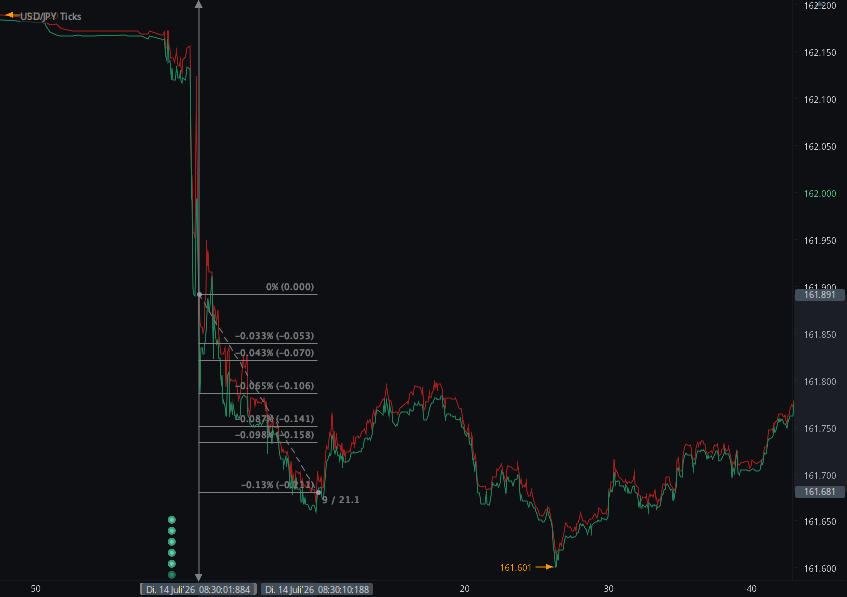
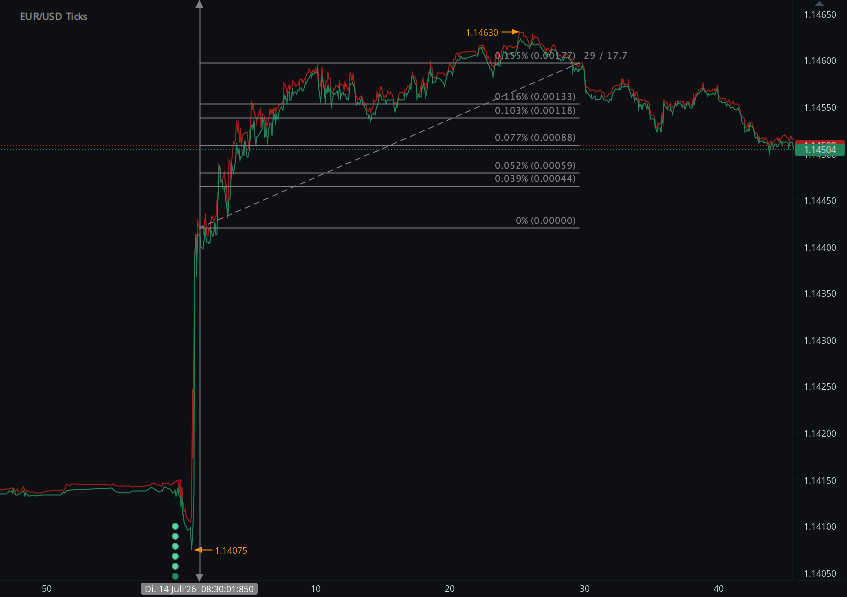
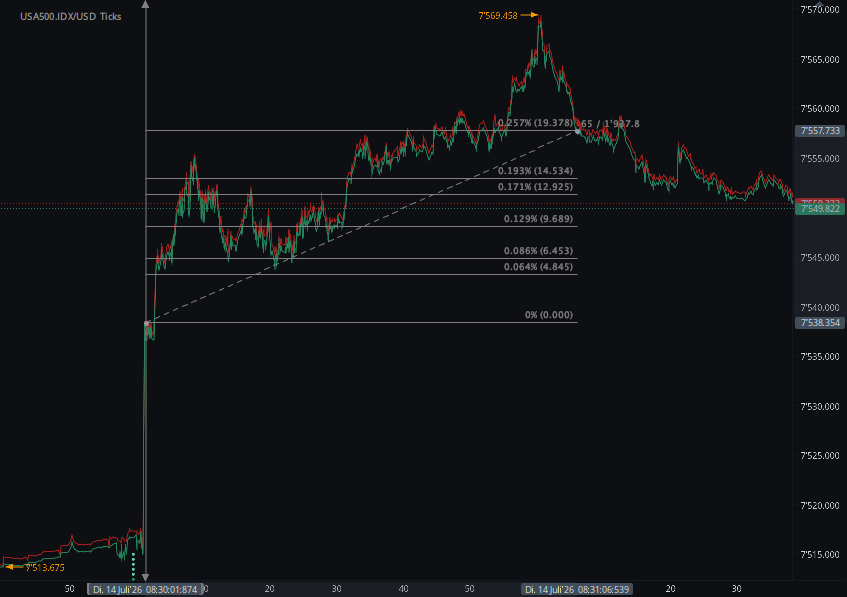
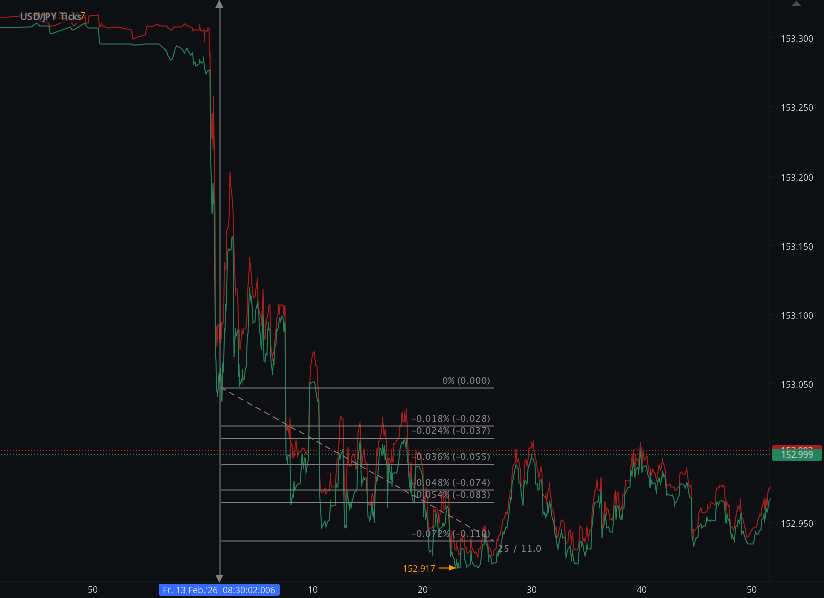
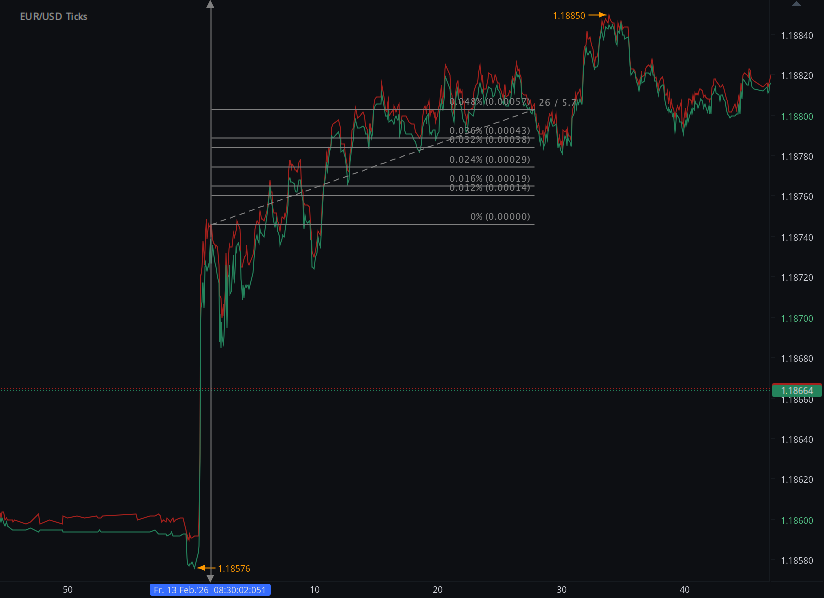
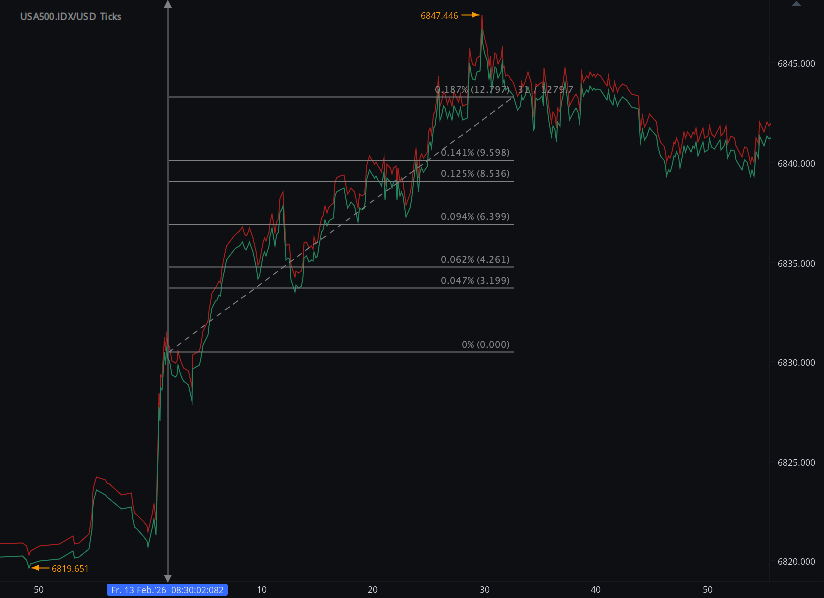
According to our analysis USDJPY and EURUSD moved 16 pips and US500 moved 12 points on US BLS Consumer Price Index (CPI) data on 13 February 2026.

USDJPY (11 pips)

EURUSD (5 pips)

US500 (12 points)

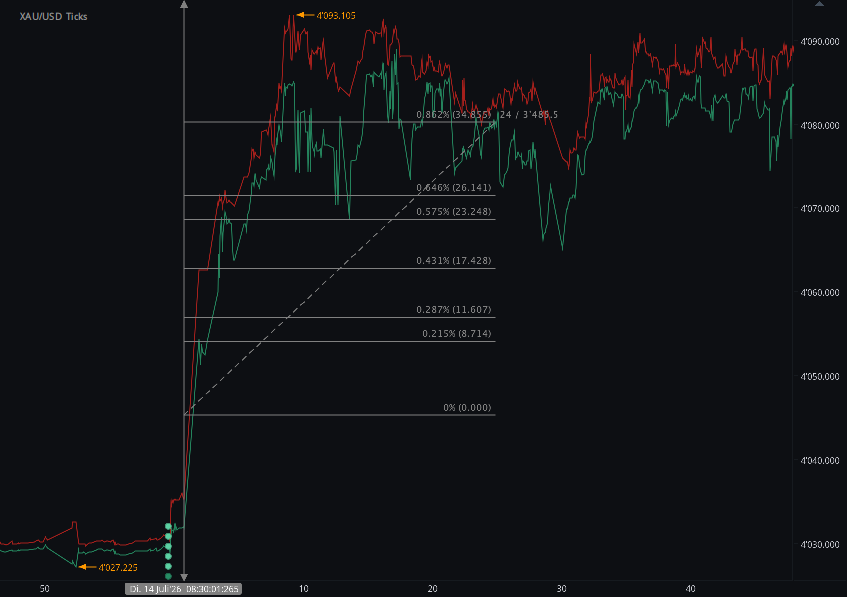
Charts are exported from JForex (Dukascopy).


Inflation Cools Further in January 2026 as Energy Prices Fall

The latest data from the U.S. Bureau of Labor Statistics show that inflation continued to moderate in January 2026, with overall price growth easing on both a monthly and annual basis.

Headline Inflation: Modest Monthly Increase

The Consumer Price Index for All Urban Consumers (CPI-U) rose 0.2 percent in January (seasonally adjusted). Over the past 12 months, prices increased 2.4 percent, down from 2.7 percent in December.

This marks continued progress toward price stability, with year-over-year inflation now firmly in the mid-2 percent range.

What Drove January’s Increase?

Several categories contributed to the monthly increase:

  • Shelter: +0.2%

  • Food: +0.2%

  • Core inflation (all items less food and energy): +0.3%

However, falling energy prices helped offset some of the upward pressure.

Energy Prices: A Key Relief Factor

Energy prices declined 1.5 percent in January, providing a notable offset to increases elsewhere.

  • Gasoline: −3.2% (−7.5% over the past year)

  • Electricity: −0.1% (but +6.3% over the past year)

  • Natural gas: +1.0% (+9.8% over the past year)

Over the last 12 months, overall energy prices are down 0.1 percent, largely due to the steep annual decline in gasoline.

Food Prices: Gradual but Persistent Growth

Food prices increased 0.2 percent in January.

Grocery Prices (Food at Home): +0.2%

Five of six major grocery categories rose:

  • Cereals and bakery products: +1.2%

  • Dairy products: +0.8%

  • Meats, poultry, fish, and eggs: +0.2%

  • Fruits and vegetables: +0.1%

  • Nonalcoholic beverages: +0.1%

On a 12-month basis, grocery prices are up 2.1 percent.

Dining Out (Food Away from Home): +0.1%

Restaurant prices rose more modestly in January but are still up 4.0 percent over the past year, with:

  • Full service meals: +4.7%

  • Limited service meals: +3.2%

Restaurant inflation continues to outpace grocery inflation.

Core Inflation: Services Still Firm

Core CPI (excluding food and energy) rose 0.3 percent in January and is up 2.5 percent year-over-year.

Key contributors:

Shelter

  • +0.2% in January

  • +3.0% over the past year

Owners’ equivalent rent and rent both rose 0.2% for the month.

Transportation Services

  • +1.4% in January

  • Airline fares surged 6.5% for the month.

Medical Care

  • +0.3% in January

  • +3.9% over the past year

  • Hospital services: +0.9% in January

Used Cars

  • −1.8% in January

  • −2.0% over the past year

Vehicle prices continue to normalize after earlier volatility.

Big Picture: Inflation Is Cooling, But Not Gone

Here’s where inflation stands:

Category12-Month ChangeAll Items2.4%Core (less food & energy)2.5%Food2.9%Energy−0.1%Shelter3.0%

The overall trend shows:

  • Energy prices helping moderate inflation.

  • Core services (especially shelter and medical care) continuing to rise.

  • Restaurant inflation remaining elevated.

  • Goods prices (like used vehicles) generally softening.

Additional Notes

  • The CPI index level now stands at 325.252 (1982–84 = 100).

  • CPI-W (Urban Wage Earners and Clerical Workers) rose 2.2% year-over-year.

  • The Chained CPI (C-CPI-U) increased 2.2% year-over-year.

  • October and November 2025 data were unavailable due to the 2025 lapse in appropriations.

  • Seasonal adjustment factors were revised, affecting data back five years.

What to Watch Next

The February 2026 CPI report will be released on March 11, 2026.

Markets and policymakers will be watching closely to see:

  • Whether energy continues to ease pressure,

  • If shelter inflation continues to moderate,

  • And whether core services remain sticky.

For now, January’s data suggest inflation is gradually stabilizing, though certain categories—particularly services—remain areas of persistent upward pressure.

Disclaimer: This blog post is for informational purposes only and should not be construed as financial advice. Always conduct thorough research and consider seeking advice from a financial professional before making any investment decisions.

Source: https://www.bls.gov/news.release/cpi.nr0.htm


Start futures forex fx news trading with Haawks G4A low latency machine-readable data, one of the fastest machine-readable news trading feed for US macro-economic and commodity data.

Please let us know your feedback. If you are interested in timestamps, please send us an email to sales@haawks.com.

Comment

Comment

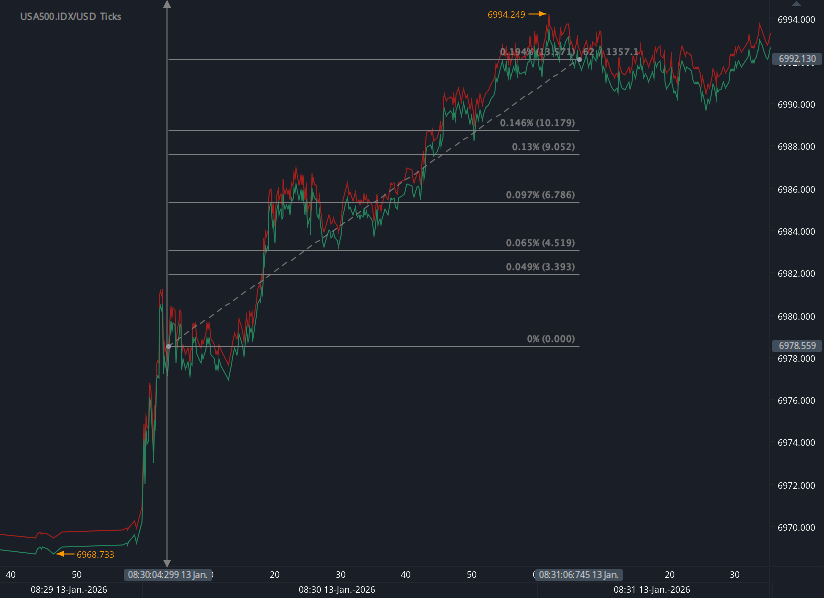
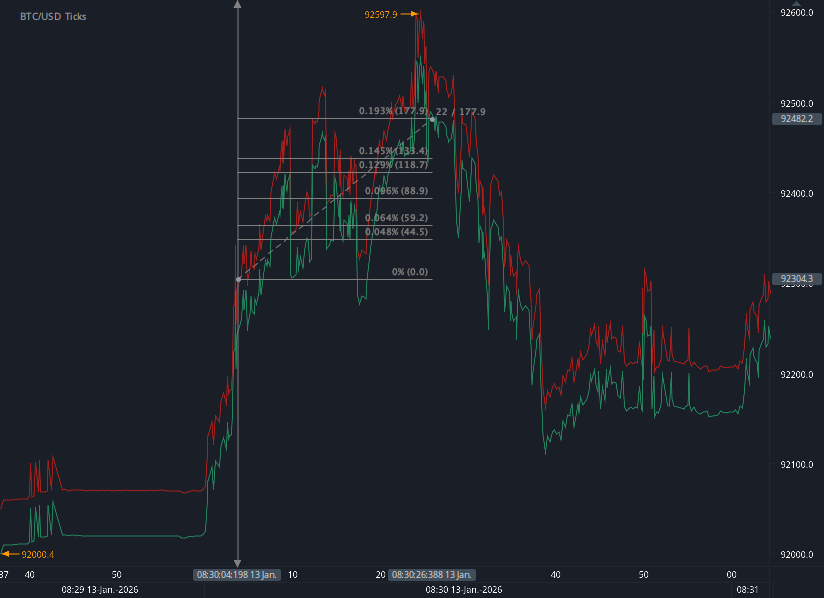
5 pips, US500 13 points, BTC 177 points potential profit in 62 seconds on 13 January 2026, analysis on futures forex fx low latency news trading EURUSD, US500 and BTC on US CPI

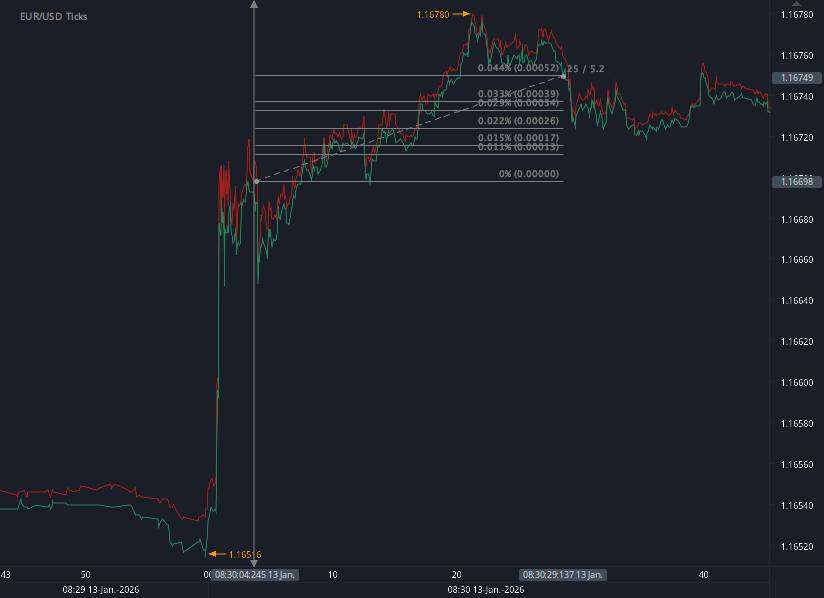
According to our analysis EURUSD moved 5 pips, US500 moved 13 points and BTC moved 177 points on US BLS Consumer Price Index (CPI) data on 13 January 2026.

EURUSD (5 pips)

US500 (13 points)

BTC (177 points)

Charts are exported from JForex (Dukascopy).


Inflation Ends 2025 Steady: What the December CPI Report Tells Us

The latest Consumer Price Index (CPI) report from the U.S. Bureau of Labor Statistics offers a clear snapshot of how inflation wrapped up 2025—and what it means for households heading into the new year.

Released on January 13, 2026, the report shows that inflation remains moderate but persistent, with price pressures still concentrated in essentials like housing, food, and certain services.

Headline Numbers at a Glance

  • Monthly CPI (December 2025): +0.3% (seasonally adjusted)

  • 12-month inflation rate: 2.7%, unchanged from November

  • Core inflation (excluding food & energy): 2.6% year over year

These figures suggest inflation is no longer accelerating, but it also hasn’t fully cooled back to pre-pandemic norms.

Housing: Still the Biggest Driver

Shelter costs were once again the largest contributor to December’s increase:

  • Shelter index: +0.4% in December

  • 12-month shelter inflation: +3.2%

Rent and owners’ equivalent rent both rose, while lodging away from home jumped sharply (+2.9% for the month). Housing remains the stickiest part of inflation—and the hardest for consumers to avoid.

Food Prices Pick Up Speed

Food prices rose faster than overall inflation in December:

  • Food (overall): +0.7% in December

  • Food at home: +2.4% year over year

  • Food away from home: +4.1% year over year

Notable details:

  • Grocery staples like dairy, cereals, fruits, and vegetables all increased.

  • Egg prices fell sharply (-8.2%), offering rare relief.

  • Restaurant prices continue to climb, especially for full-service meals.

For many households, food remains one of the most noticeable inflation pressures.

Energy: Mixed Signals

Energy prices edged higher overall, but the details matter:

  • Energy index: +0.3% in December, +2.3% over the year

  • Gasoline: -0.5% in December, -3.4% year over year

  • Electricity: +6.7% year over year

  • Natural gas: +10.8% year over year

Drivers benefited from cheaper gasoline, but utility bills—especially heating—continued to rise.

Services Inflation Remains Firm

Core services showed broad-based increases:

  • Medical care: +0.4% in December, +3.2% year over year

  • Recreation: +1.2% in December (largest monthly jump on record)

  • Airline fares: +5.2% in December

  • Personal care & education: continued steady increases

On the flip side:

  • Used cars and trucks: -1.1% in December

  • Communication services: -1.9%

What This Means for 2026

As 2025 closed:

  • Inflation appears stable, not surging—but not fully subdued.

  • Housing and services remain the key inflation risks.

  • Goods inflation (like vehicles and gasoline) continues to ease.

With the January 2026 CPI report scheduled for February 11, 2026, policymakers and consumers alike will be watching closely to see whether inflation finally drifts closer to the Federal Reserve’s long-term comfort zone.

Bottom Line

Inflation ended 2025 steady but uneven. While energy and goods offered some relief, everyday essentials—housing, food, and services—kept upward pressure on household budgets. The battle against inflation isn’t over, but it’s no longer spiraling out of control either.

Disclaimer: This blog post is for informational purposes only and should not be construed as financial advice. Always conduct thorough research and consider seeking advice from a financial professional before making any investment decisions.

Source: https://www.bls.gov/news.release/cpi.nr0.htm


Start futures forex fx news trading with Haawks G4A low latency machine-readable data, one of the fastest machine-readable news trading feed for US macro-economic and commodity data.

Please let us know your feedback. If you are interested in timestamps, please send us an email to sales@haawks.com.

Comment

Comment

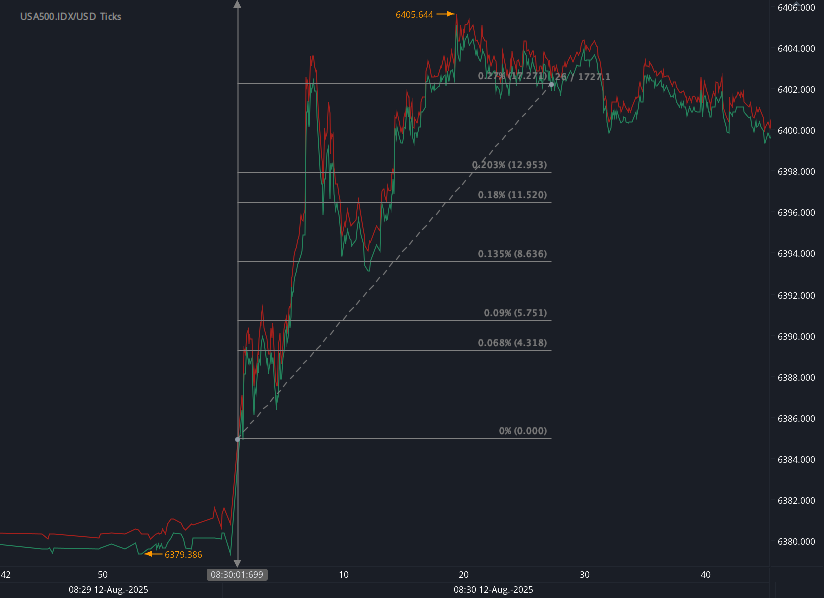
59 pips, US500 17 points, BTC 461 points potential profit in 72 seconds on 12 August 2025, analysis on futures forex fx low latency news trading EURUSD, USDJPY, US500, BTC on US CPI

According to our analysis USDJPY and EURUSD moved 59 pips, US500 moved 17 points and BTC moved 461 points on US BLS Consumer Price Index (CPI) data on 12 August 2025.

USDJPY (35 pip)

EURUSD (24 pips)

US500 (17 points)

BTC (461 points)

Charts are exported from JForex (Dukascopy).


July 2025 Consumer Price Index (CPI) Update: What You Need to Know

The U.S. Bureau of Labor Statistics (BLS) released its Consumer Price Index (CPI) data for July 2025, offering important insights into inflation and price changes affecting everyday Americans. Here’s a breakdown of the key takeaways from the latest report:

Modest Monthly Increase in Overall Prices

The CPI for All Urban Consumers (CPI-U) rose by 0.2% in July on a seasonally adjusted basis, a slight slowdown from June’s 0.3% increase. Over the past year, prices have increased by 2.7%, showing steady but moderate inflation.

What’s Driving the July Increase?

  • Shelter Costs: The main contributor to the monthly rise was shelter, which increased by 0.2%. Rent and owners' equivalent rent both edged up, indicating that housing costs continue to be a significant factor in inflation.

  • Food Prices: The overall food index remained flat in July. However, food away from home (restaurants, takeout) saw a small 0.3% rise, while food at home (groceries) actually decreased slightly by 0.1%. Within groceries, dairy products and meats experienced price gains, but other categories like cereals and bakery products fell.

  • Energy Prices: Energy costs declined by 1.1%, largely due to a 2.2% drop in gasoline prices. Electricity and natural gas prices also edged lower, easing some pressure on household energy bills.

Core Inflation (Excluding Food and Energy)

Prices for all items excluding food and energy rose 0.3% in July, following a 0.2% increase in June. This category includes:

  • Medical Care: Increased notably, with dental services up 2.6% and hospital services also rising.

  • Transportation Services: Airline fares jumped 4.0%, reversing a previous decline.

  • Recreation, Household Furnishings, and Used Vehicles: All saw moderate price increases.

Conversely, lodging away from home and communication services saw price declines.

Year-Over-Year Inflation Trends

  • The all items index rose 2.7% over the past 12 months.

  • Core inflation (less food and energy) increased by 3.1%, reflecting ongoing upward pressure on many services and goods.

  • Energy prices dropped 1.6% year-over-year, driven largely by lower gasoline costs.

  • Food prices climbed 2.9%, with food away from home rising faster (3.9%) than food at home (2.2%).

Noteworthy Changes and Methodology Updates

  • The BLS has updated how it measures wireless telephone services prices by using alternative data sources and methods, aiming for more accurate inflation tracking in this sector.

  • Starting with October 2025 data, long-term care insurance will be removed from the health insurance index due to changes in that market.

What Does This Mean for You?

The July CPI data suggests that while inflation remains moderate, housing and medical care costs continue to be significant contributors to rising prices. Consumers may see some relief from falling energy prices, but dining out and healthcare expenses are becoming more costly.

Looking Ahead

The next CPI report is scheduled for release on September 11, 2025.

Disclaimer: This blog post is for informational purposes only and should not be construed as financial advice. Always conduct thorough research and consider seeking advice from a financial professional before making any investment decisions.

Source: https://www.bls.gov/news.release/cpi.nr0.htm


Start futures forex fx news trading with Haawks G4A low latency machine-readable data, one of the fastest machine-readable news trading feed for US macro-economic and commodity data.

Please let us know your feedback. If you are interested in timestamps, please send us an email to sales@haawks.com.

Comment

Comment

3 pips and BTC 222 points potential profit in 23 seconds on 11 June 2025, analysis on futures forex fx low latency news trading EURUSD, USDJPY and BTC on US Consumer Price Index (CPI)

According to our analysis USDJPY and EURUSD moved 3 pips and BTC moved 222 points on US BLS Consumer Price Index (CPI) data on 11 June 2025.

USDJPY (1 pip)

EURUSD (2 pips)

BTC (222 points)

Charts are exported from JForex (Dukascopy).


May 2025 CPI Report: Inflation Holds Steady, Energy Prices Drag Down Headline Numbers

June 12, 2025

The U.S. Bureau of Labor Statistics (BLS) released its Consumer Price Index (CPI) report for May 2025, and the data shows a continued cooling in inflation, with a slight 0.1% increase in consumer prices on a seasonally adjusted basis. This marks a slowdown from April’s 0.2% increase and offers further evidence that inflationary pressures are moderating—albeit unevenly across categories.

Headline Figures at a Glance

  • Monthly CPI (seasonally adjusted): +0.1% in May

  • 12-month CPI (unadjusted): +2.4%

  • Core CPI (excluding food and energy): +0.1% for the month; +2.8% year-over-year

  • Energy index: -1.0% for the month; -3.5% year-over-year

  • Food index: +0.3% for the month; +2.9% year-over-year

What’s Driving the Numbers?

Shelter Continues to Lead

Shelter prices rose 0.3% in May, maintaining a steady upward climb that has been a consistent inflation driver over the past year. Over the last 12 months, shelter prices are up 3.9%, making it the single largest contributor to the overall price increase.

Food Prices Edge Up

Food prices increased 0.3% in May, reversing April’s slight decline. The increase was spread across both food at home (+0.3%) and food away from home (+0.3%). Notably:

  • Cereals and bakery products rose 1.1%

  • Egg prices dropped 2.7%, though they’re still up 41.5% year-over-year

  • Fruits and vegetables nudged up 0.3%, but are down 0.5% over the year

Energy Prices Plunge

Energy was the biggest drag on the overall index. The energy index dropped 1.0%, led by a 2.6% decline in gasoline prices. Over the last 12 months:

  • Gasoline is down 12.0%

  • Fuel oil is down 8.6%

  • Electricity, however, is up 4.5%

  • Natural gas soared 15.3%

Core Services Show Mild Growth

Excluding food and energy, prices rose only 0.1% in May. Increases were noted in:

  • Medical care services (+0.2%)

  • Motor vehicle insurance (+0.7%)

  • Education (+0.3%)

At the same time, several consumer items saw declines, including:

  • Used cars and trucks (-0.5%)

  • New vehicles (-0.3%)

  • Apparel (-0.4%)

  • Airline fares (-2.7%)

What Does This Mean?

The May CPI report underscores a key theme: inflation is slowing but not uniformly. Core inflation remains sticky, especially in services like shelter and insurance, while energy and some goods prices continue to drop, giving the Federal Reserve more breathing room as it weighs future interest rate decisions.

A 2.4% annual inflation rate is close to the Fed’s 2% target, but the 2.8% core inflation figure suggests more progress is needed before declaring full victory over inflation.

What to Watch Next

Looking ahead, two major changes are coming:

  • Rebasing of CPI series starting in July 2025 will align selected indexes to a new reference base of December 2024 = 100.

  • Changes to wireless services CPI methodology beginning with July data will use alternative data sources and methods to reflect real-time pricing trends more accurately.

The June CPI report is scheduled for release on July 15, 2025.

Disclaimer: This blog post is for informational purposes only and should not be construed as financial advice. Always conduct thorough research and consider seeking advice from a financial professional before making any investment decisions.

Source: https://www.bls.gov/news.release/cpi.nr0.htm


Start futures forex fx news trading with Haawks G4A low latency machine-readable data, one of the fastest machine-readable news trading feed for US macro-economic and commodity data.

Please let us know your feedback. If you are interested in timestamps, please send us an email to sales@haawks.com.

Comment

Comment

3 pips and US500 14 points potential profit in 23 seconds on 13 May 2025, analysis on futures forex fx low latency news trading USDJPY and US500 on US Consumer Price Index (CPI)

According to our analysis USDJPY moved 3 pips and US500 moved 14 points on US BLS Consumer Price Index (CPI) data on 13 May 2025.

USDJPY (3 pips)

US500 (14 points)

Charts are exported from JForex (Dukascopy).


April 2025 CPI Report: Inflation Slows, Shelter and Energy Drive Modest Gains

The U.S. Bureau of Labor Statistics (BLS) released the Consumer Price Index (CPI) data for April 2025, offering a mixed picture of inflation trends across the economy. Overall, consumer prices rose 0.2% in April on a seasonally adjusted basis after a slight decline in March. Year-over-year, prices are up 2.3% before seasonal adjustment, marking the smallest annual increase since February 2021.

Key Highlights:

  • Overall Inflation: +0.2% month-over-month in April; +2.3% year-over-year.

  • Core Inflation (excluding food and energy): +0.2% in April; +2.8% over the past 12 months.

  • Food Prices: Declined by 0.1% in April, driven by a sharp 0.4% drop in the food at home index.

  • Energy Prices: Rose 0.7% in April but are still down 3.7% compared to a year ago.

Shelter Continues to Lead

The shelter index increased by 0.3% in April, accounting for more than half of the overall rise in CPI. On an annual basis, shelter costs have risen 4.0%, making it a significant contributor to persistent core inflation. Rents and owners' equivalent rent both increased 0.3% and 0.4% respectively in April.

Energy Prices Rebound Slightly

While energy prices rose in April, the rebound was modest. Natural gas saw a notable 3.7% increase, and electricity rose 0.8%. However, gasoline prices dipped slightly by 0.1% (though they rose 2.9% before seasonal adjustment). Over the last 12 months, gasoline prices have dropped 11.8%, and fuel oil is down 9.6%.

Food Prices Show Mixed Trends

Food at home prices dropped 0.4%, the largest monthly decline since September 2020. The sharpest decline was seen in eggs, down 12.7% in April. Most major grocery categories posted declines, while nonalcoholic beverages were up 0.7%. In contrast, the food away from home index rose 0.4%, driven by increases in full-service (+0.6%) and limited-service meals (+0.3%).

Over the past year, food prices have risen 2.8%, with food away from home up 3.9% and food at home up 2.0%. Notably, egg prices have surged 49.3% year-over-year despite the April drop.

Core Categories Show Mixed Movement

Beyond food and energy, prices for household furnishings and operations increased 1.0%, and motor vehicle insurance rose 0.6%. Medical care rose 0.5%, with increases in hospital services (+0.6%) and prescription drugs (+0.4%).

Some categories saw declines, including airline fares (-2.8%), used cars and trucks (-0.5%), communication, and apparel (-0.2%). New vehicle prices remained unchanged.

A Shift in Methodology

April 2025 also marked a methodological update for the CPI. The BLS has transitioned to using transaction data purchased from a vendor to calculate the leased cars and trucks index, aiming to improve accuracy.

Looking Ahead

The next CPI release, covering May 2025, is scheduled for Wednesday, June 11, 2025. It will offer further insights into whether inflation continues to moderate and how evolving economic conditions impact consumer prices.

Disclaimer: This blog post is for informational purposes only and should not be construed as financial advice. Always conduct thorough research and consider seeking advice from a financial professional before making any investment decisions.

Source: https://www.bls.gov/news.release/cpi.nr0.htm


Start futures forex fx news trading with Haawks G4A low latency machine-readable data, one of the fastest machine-readable news trading feed for US macro-economic and commodity data.

Please let us know your feedback. If you are interested in timestamps, please send us an email to sales@haawks.com.

Comment

Comment

23 pips, US30 147 points and BTC 1279 points potential profit in 32 seconds on 12 February 2025, analysis on futures forex fx low latency news trading USDJPY on US Consumer Price Index (CPI)

According to our analysis USDJPY moved 23 pips, US30 moved 147 points and Bitcoin (BTC) moved 1279 points on US BLS Consumer Price Index (CPI) data on 12 February 2025.

USDJPY (23 pips)

US30 (147 points)

Bitcoin BTC (1279 points)

Charts are exported from JForex (Dukascopy).


CPI Report Shakes Markets: USD/JPY Gains, US30 Drops, BTC Dips

The January 2025 Consumer Price Index (CPI) report released by the Bureau of Labor Statistics showed a higher-than-expected inflation increase of 0.5% month-over-month, bringing the annual CPI to 3.0%. This data immediately sent ripples through the financial markets, impacting major asset classes, including forex, equities, and crypto.

Key CPI Highlights:

  • Headline CPI: +0.5% (MoM), +3.0% (YoY)

  • Core CPI (Ex-Food & Energy): +0.4% (MoM), +3.3% (YoY)

  • Shelter Costs: +0.4% MoM, a major driver of inflation

  • Energy Index: +1.1% MoM, fueled by a 1.8% increase in gasoline prices

  • Food Index: +0.4% MoM, with food-at-home prices up 0.5%

Market Reaction:

Forex – USD/JPY Rises 23 Pips

The U.S. dollar strengthened against the Japanese yen, with USD/JPY climbing 23 pips post-release. This move reflects increased expectations that the Federal Reserve may need to maintain higher interest rates for longer to combat inflation. The resilience of core CPI above 3.0% further solidifies the Fed’s hawkish stance, making USD more attractive compared to JPY, which remains under the Bank of Japan’s ultra-loose policy.

Equities – US30 Drops 147 Points

Wall Street reacted negatively to the inflation data, with the Dow Jones Industrial Average (US30) falling 147 points. Investors are concerned that persistent inflation may delay any potential Fed rate cuts, dampening risk appetite. Additionally, rising costs for shelter and transportation services indicate that consumer spending power could take a hit, affecting corporate earnings.

Crypto – Bitcoin Drops 1,279 Points

Bitcoin (BTC) saw a sharp decline of 1,279 points following the CPI release, reflecting a risk-off sentiment in the broader market. Higher-than-expected inflation led to speculation that Fed policy will remain tight, reducing liquidity for riskier assets like crypto. BTC’s drop also aligns with a broader sell-off in tech and growth stocks, which tend to be more sensitive to interest rate outlooks.

Final Thoughts

Traders should brace for continued volatility as inflation concerns linger. The next major catalyst will be the Fed’s response in upcoming meetings and market reactions to any further economic data releases. Stay alert to potential breakout moves in USD/JPY, US30, and BTC as inflation trends develop.

Disclaimer: This blog post is for informational purposes only and should not be construed as financial advice. Always conduct thorough research and consider seeking advice from a financial professional before making any investment decisions.

Source: https://www.bls.gov/news.release/cpi.nr0.htm


Start futures forex fx news trading with Haawks G4A low latency machine-readable data, one of the fastest machine-readable news trading feed for US macro-economic and commodity data.

Please let us know your feedback. If you are interested in timestamps, please send us an email to sales@haawks.com.

Comment

Comment

25 pips, US30 90 points and BTC 1018 points potential profit in 40 seconds on 15 January 2025, analysis on futures forex fx low latency news trading USDJPY, EURUSD on US Consumer Price Index (CPI)

According to our analysis USDJPY and EURUSD moved 54 pips, US30 moved 90 points and Bitcoin (BTC) moved 1018 points on US BLS Consumer Price Index (CPI) data on 15 January 2025.

USDJPY (18 pips)

EURUSD (7 pips)

US30 (90 points)

Bitcoin BTC (1018 points)

Charts are exported from JForex (Dukascopy).


December 2024 CPI Report: Core Inflation Falls Short of Expectations – What It Means for Markets

The U.S. Bureau of Labor Statistics released the Consumer Price Index (CPI) for December 2024 on January 15, 2025. While headline inflation was in line with expectations, core inflation (excluding food and energy) came in slightly cooler than anticipated. The headline CPI rose 0.4% month-over-month and 2.9% year-over-year, meeting forecasts. However, core CPI increased by 0.2% month-over-month (vs. 0.3% expected) and 3.2% year-over-year (vs. 3.3% expected). Here’s a breakdown of the report and its implications for traders.

Headline Takeaways

  1. Headline Inflation: The all-items index rose 0.4% month-over-month and 2.9% year-over-year, reflecting steady inflationary pressures in energy and food prices.

  2. Core Inflation Misses: Core CPI rose 0.2% month-over-month, below the forecasted 0.3%. Year-over-year, core inflation moderated to 3.2%, also below the expected 3.3%.

  3. Energy Drives the Headline: Energy prices surged 2.6% month-over-month, with gasoline prices jumping 4.4%, making energy a key driver of the overall CPI increase.

  4. Food Inflation Holds Steady: Food prices rose 0.3% month-over-month, with both food at home and food away from home contributing equally to the increase.

Market Implications of Core CPI Miss

Cooling Core Inflation Trends

  • The 0.2% month-over-month rise in core CPI marked a modest cooling from the expected 0.3%. Year-over-year, the 3.2% core inflation rate signals gradual easing in underlying price pressures.

  • Market Impact: A softer-than-expected core reading could prompt markets to reassess the Federal Reserve’s policy stance, increasing the likelihood of a pause or easing cycle sooner than previously anticipated.

Energy Price Surge Shifts Focus

  • Energy prices rose significantly, with a 4.4% increase in gasoline prices dominating the report. However, on a year-over-year basis, energy remains a deflationary factor, down 0.5%.

  • Market Impact: Energy-driven headline inflation may not alter the Fed’s trajectory if core inflation continues to cool, but it could buoy commodity markets and inflation-sensitive sectors.

Sector Breakdown

Shelter Remains Elevated

  • Shelter costs rose 0.3% month-over-month and 4.6% year-over-year. Shelter remains the largest contributor to core inflation but showed signs of stabilization.

  • Implications for Traders: Persistent shelter inflation could limit the Fed’s flexibility, supporting higher-for-longer interest rate expectations.

Food Prices Steady but Mixed

  • Food at home (+0.3%) and food away from home (+0.3%) rose in tandem. Cereals and bakery products saw a sharp rise (+1.2%), while nonalcoholic beverages (-0.4%) and fruits and vegetables (-0.1%) declined.

  • Market Impact: Stable food inflation supports consumer purchasing power, benefiting consumer discretionary stocks.

Transportation and Autos Drive Core

  • Used cars and trucks rebounded with a 1.2% increase, while new vehicles rose 0.5%. Airline fares surged 3.9%.

  • Implications for Traders: Rising auto and transportation costs could impact consumer sentiment and provide short-term tailwinds to related industries.

Fed Policy Implications

With core CPI coming in below expectations, markets may interpret the data as a sign that inflation is moderating toward the Federal Reserve’s target. While headline inflation remains steady, the softer core reading could shift the Fed’s tone toward a more dovish stance, especially if cooling trends persist.

Trading Opportunities

  1. Equities: Growth stocks and rate-sensitive sectors may gain on expectations of a dovish Fed. Defensive sectors may face headwinds if inflation pressures ease.

  2. Bonds: Treasury yields could decline, particularly on the shorter end of the curve, as markets price in reduced rate hike probabilities.

  3. Commodities: Energy markets may rally due to the sharp increase in gasoline and natural gas prices. Gold could see gains if inflation expectations moderate.

  4. Forex: The U.S. Dollar Index (DXY) might weaken if traders anticipate a softer Fed policy path.

Disclaimer: This blog post is for informational purposes only and should not be construed as financial advice. Always conduct thorough research and consider seeking advice from a financial professional before making any investment decisions.

Source: https://www.bls.gov/news.release/cpi.nr0.htm


Start futures forex fx news trading with Haawks G4A low latency machine-readable data, one of the fastest machine-readable news trading feed for US macro-economic and commodity data.

Please let us know your feedback. If you are interested in timestamps, please send us an email to sales@haawks.com.

Comment

Comment

54 pips potential profit in 11 seconds on 13 November 2024, analysis on futures forex fx low latency news trading USDJPY and EURUSD on US BLS Consumer Price Index (CPI) data

According to our analysis USDJPY and EURUSD moved 54 pips on US BLS Consumer Price Index (CPI) data on 13 November 2024.

USDJPY (32 pips)

EURUSD (22 pips)

Charts are exported from JForex (Dukascopy).


October 2024 CPI Report: Key Highlights and Insights

Today’s Consumer Price Index (CPI) report from the Bureau of Labor Statistics reveals modest inflationary trends in October, showing a steady pace in prices with an overall increase of 0.2% for the month, consistent with the previous three months. This brings the year-over-year increase for all items to 2.6%, marking a slight acceleration from the 2.4% reported for September. Here’s a breakdown of the key drivers behind October’s CPI numbers and what it could mean for consumers and the economy.

Shelter Costs Remain a Key Driver of Inflation

Shelter costs, a substantial portion of the CPI, rose 0.4% in October. This increase accounted for more than half of the overall rise in the CPI for the month. Over the past 12 months, shelter costs have climbed by 4.9%, contributing significantly to the core inflation measure (all items less food and energy), which rose 3.3% year-over-year. Rent and owners’ equivalent rent both increased by 0.4% in October, reflecting the persistent upward pressure in housing costs.

Food Prices Continue to Climb, but at a Slower Pace

The food index increased by 0.2% in October, a slight slowdown from September’s 0.4% rise. Prices for food at home edged up 0.1%, with notable increases in cereals and bakery products (+1.0%) and dairy (+1.0%), as well as fruits and vegetables (+0.4%). However, the meats, poultry, fish, and eggs index fell 1.2%, driven by a sharp 6.4% decrease in egg prices. For food away from home, including restaurant meals, prices rose 0.2%. Over the past year, food prices have risen by 2.1%.

Energy Index Stays Flat After Recent Declines

Following a 1.9% decline in September, the energy index remained unchanged in October, bringing some stability after several months of fluctuation. Gasoline prices continued their decline with a 0.9% drop, contributing to the 12.2% decrease over the past year. Fuel oil also saw a notable reduction, with prices down by 20.8% over the last 12 months. However, the cost of electricity increased 1.2% for the month and has risen by 4.5% over the year, while natural gas increased by 0.3% in October, up 2.0% year-over-year.

Core CPI Sees Steady Growth, Driven by Services and Transportation

The core CPI, excluding the volatile food and energy sectors, rose by 0.3% in October. Services excluding energy increased 0.3% as well, with significant contributions from shelter and medical care. Used cars and trucks experienced a surprising uptick of 2.7% for the month, after several months of declines. Airline fares also jumped by 3.2%, and medical care services increased by 0.4%.

Apparel, Communication, and Household Furnishings Decline

While the prices of many items rose, some categories saw decreases. Apparel fell by 1.5% in October, following an increase in September, while communication and household furnishings indexes also experienced declines. These decreases helped to offset some of the monthly CPI gains, indicating some price variability across goods and services.

Annual Inflation and Outlook

The CPI report shows a steady 2.6% increase over the past 12 months, reflecting a measured but persistent inflationary environment. The energy index, which has been a source of relief with a 4.9% decrease over the year, helped balance the rise in shelter and other core costs. However, the uptick in core inflation, particularly from services and shelter, suggests ongoing challenges in keeping inflation within target levels.

Looking forward, the November CPI report, scheduled for December 11, will offer further insights into these trends. Key areas to watch will include the energy index, as seasonal adjustments for heating costs take effect, and shelter, which remains a major factor in inflation. The CPI data continues to be an essential gauge for understanding the economic pressures on consumers and will likely influence the Federal Reserve's monetary policy decisions in the coming months.

In Summary

October’s CPI data suggests a stable but gradually rising inflation environment, with shelter costs as the dominant force. Food prices continue to rise moderately, while energy costs remain volatile but stable for now. As inflation remains slightly above the Federal Reserve’s target, policymakers and consumers alike will be keeping a close eye on these trends heading into the winter months.

Stay tuned for our next update following the release of November’s CPI data, as we continue to track the evolving inflation landscape and its implications for everyday life and economic policy.

Source: https://www.bls.gov/news.release/cpi.nr0.htm


Start futures forex fx news trading with Haawks G4A low latency machine-readable data, one of the fastest machine-readable news trading feed for US macro-economic and commodity data.

Please let us know your feedback. If you are interested in timestamps, please send us an email to sales@haawks.com.

Comment

Comment

27 pips potential profit in 7 seconds on 11 September 2024, analysis on futures forex fx low latency news trading USDJPY and EURUSD on US BLS Consumer Price Index (CPI) data

According to our analysis USDJPY and EURUSD moved 27 pips on US BLS Consumer Price Index (CPI) data on 11 September 2024.

USDJPY (17 pips)

EURUSD (10 pips)

Charts are exported from JForex (Dukascopy).


Understanding the Latest CPI Data: Key Takeaways from August 2024

The Consumer Price Index (CPI) for August 2024 reveals subtle yet important trends in the U.S. economy. According to the U.S. Bureau of Labor Statistics, the CPI for All Urban Consumers (CPI-U) rose by 0.2 percent on a seasonally adjusted basis, maintaining the same rate of increase as observed in July. Over the past 12 months, the index recorded a 2.5 percent increase before seasonal adjustments, marking a relatively modest inflationary trend compared to previous years.

Breakdown of CPI Components:

  • Shelter: The cost of shelter continued to be a significant driver of the overall index, rising by 0.5 percent in August, thus contributing majorly to the broader index's movement.

  • Food: Food prices saw a slight increase of 0.1 percent, with food away from home experiencing a higher rise of 0.3 percent compared to food at home, which remained unchanged.

  • Energy: Contrasting these increases, the energy index fell by 0.8 percent, influenced by a significant drop in gasoline and fuel oil prices.

Year-over-Year Analysis:

  • General Index: The all-items index increased by 2.5 percent over the year, the smallest 12-month rise since February 2021, indicating a cooling period after higher inflation rates experienced in recent years.

  • Core Inflation: Excluding volatile food and energy prices, core inflation was up by 3.2 percent year-over-year, suggesting underlying pressures remain despite the overall stabilization of the index.

  • Specific Categories: Noteworthy annual increases were seen in shelter (5.2 percent), while energy commodities experienced sharp declines, particularly gasoline and fuel oil, highlighting the fluctuating nature of energy markets.

Sector-Specific Insights:

  • Transportation: Airline fares notably increased by 3.9 percent in August after months of decline, likely reflecting seasonal travel adjustments and broader economic activities.

  • Medical and Apparel: Both sectors saw modest increases, indicating varied consumer spending behaviors across different areas.

Forward-Looking Implications:

The CPI data not only serves as a gauge of past and current economic conditions but also provides insights into potential future trends. The steadiness in core inflation suggests that while the economy faces inflationary pressures, they may be becoming more entrenched at a moderate level. This has implications for monetary policy, as policymakers must balance stimulating economic growth with preventing runaway inflation.

Consumer Impact:

For consumers, understanding the CPI is crucial as it affects everyday decision-making regarding spending, saving, and investing. The variations in food, energy, and housing costs directly impact budgeting and financial planning.

Conclusion:

As we look forward to the CPI data for September 2024, scheduled for release in October, stakeholders from policymakers to consumers should consider the nuanced changes in the CPI components. Staying informed will be key to navigating the economic landscape, which remains dynamic amid varying inflationary pressures.

Inflation continues to be a critical economic indicator that demands close monitoring. For those planning budgets or investments, keeping an eye on these trends can provide essential insights into timing and strategy adjustments necessary to safeguard financial health in an ever-changing economic environment.

Source: https://www.bls.gov/news.release/cpi.nr0.htm


Start futures forex fx news trading with Haawks G4A low latency machine-readable data, one of the fastest machine-readable news trading feed for US macro-economic and commodity data.

Please let us know your feedback. If you are interested in timestamps, please send us an email to sales@haawks.com.

Comment

Comment

32 pips potential profit in 69 seconds on 11 July 2024, analysis on futures forex fx low latency news trading USDJPY and EURUSD on US BLS Consumer Price Index (CPI) data

According to our analysis USDJPY and EURUSD moved 32 pips on US BLS Consumer Price Index (CPI) data on 11 July 2024.

USDJPY (12 pips)

EURUSD (20 pips)

Charts are exported from JForex (Dukascopy).


Navigating the Economic Waves: A Deep Dive into the June 2024 Consumer Price Index Report

The U.S. Bureau of Labor Statistics (BLS) recently released its Consumer Price Index (CPI) report for June 2024, revealing a nuanced snapshot of the current economic environment. The report, which saw a slight decline of 0.1% on a seasonally adjusted basis from the previous month, offers valuable insights into the shifting dynamics of consumer prices in the U.S. economy.

Key Highlights of the June 2024 CPI Report

The all items index, which measures a broad spectrum of consumer goods and services, rose by 3.0 percent over the last 12 months. This increment, though modest, indicates a slowdown from the 3.3 percent increase observed at the end of May 2024. Here's a closer look at some specific segments:

  • Energy: The index for gasoline plummeted by 3.8 percent in June, mirroring a similar drop in May. This continued decline significantly contributed to the overall decrease in the energy index, which also fell by 2.0 percent over the month.

  • Food: Contrary to the energy sector, food prices saw a slight increase. The overall food index rose by 0.2 percent, with the food away from home index up by 0.4 percent. This indicates sustained demand and perhaps a bit of resilience in the food sector despite broader economic conditions.

  • Core Inflation: When stripping out volatile food and energy prices, the core CPI (all items less food and energy) inched up by 0.1 percent in June. Notably, this represents the smallest monthly increase since August 2021, signaling a potential cooling of underlying inflationary pressures.

Sector-Specific Analysis

The shelter index continues to be a significant driver of the core inflation, despite only increasing by 0.2 percent in June. This subtle rise is the smallest since August 2021, potentially indicating a cooling in the housing market. Meanwhile, the indexes for motor vehicle insurance, household furnishings, and personal care all rose, underscoring that some areas of the economy are still experiencing upward price pressures.

Transportation services saw some of the most substantial fluctuations, particularly airline fares, which tumbled by 5.0 percent in June after a 3.6-percent decline in May. This drop could be reflecting seasonal adjustments or broader changes in consumer travel behavior.

Economic Implications and Consumer Impact

The latest CPI data suggests a mixed bag of economic signals. While the decline in energy prices can offer some relief to consumers, the rise in food and shelter costs could offset these benefits. Additionally, the modest rise in core CPI indicates that while inflationary pressures may be cooling, they remain present, affecting the cost of living and potentially influencing future monetary policy decisions.

For consumers, understanding these trends is crucial. Those planning budgets or major purchases will find it beneficial to track such indices closely, as they directly impact everyday expenses. On a broader scale, these trends also provide insight into the health of the U.S. economy, offering clues about potential future actions by policymakers, such as interest rate adjustments by the Federal Reserve.

Looking Ahead

As we move into the second half of 2024, all eyes will be on the upcoming July CPI report, due for release on August 14. Will the trend of modest increases continue, or will we see a reversal in certain sectors? Only time will tell, but for now, consumers and economists alike should remain vigilant, monitoring these indicators closely as they navigate the complex landscape of the U.S. economy.

In conclusion, the June 2024 CPI report paints a picture of an economy experiencing varied sectoral dynamics, highlighting the importance of nuanced analysis in understanding the overall economic health and making informed decisions.

Source: https://www.bls.gov/news.release/cpi.nr0.htm


Start futures forex fx news trading with Haawks G4A low latency machine-readable data, one of the fastest machine-readable news trading feed for US economic and commodity data.

Please let us know your feedback. If you are interested in timestamps, please send us an email to sales@haawks.com.

Comment