
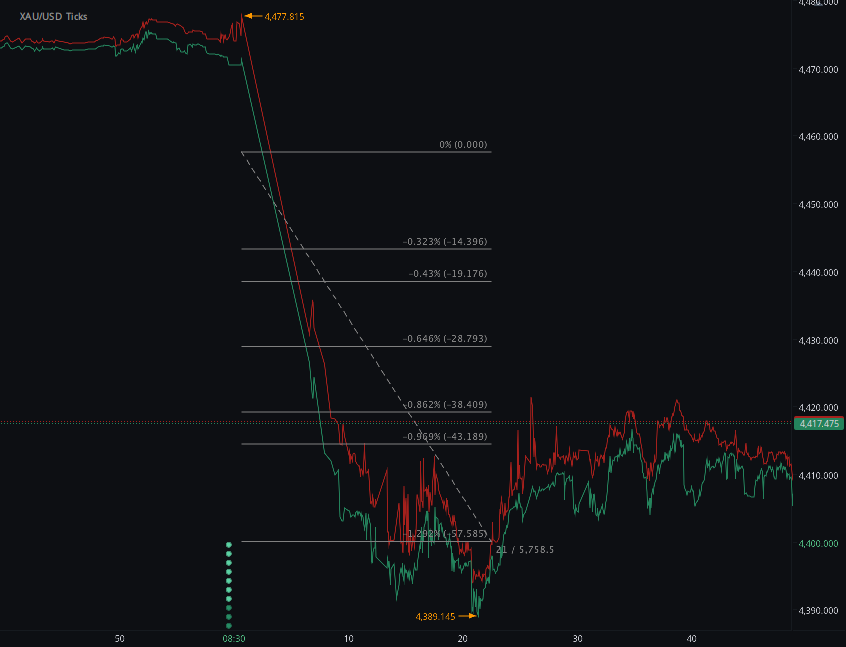
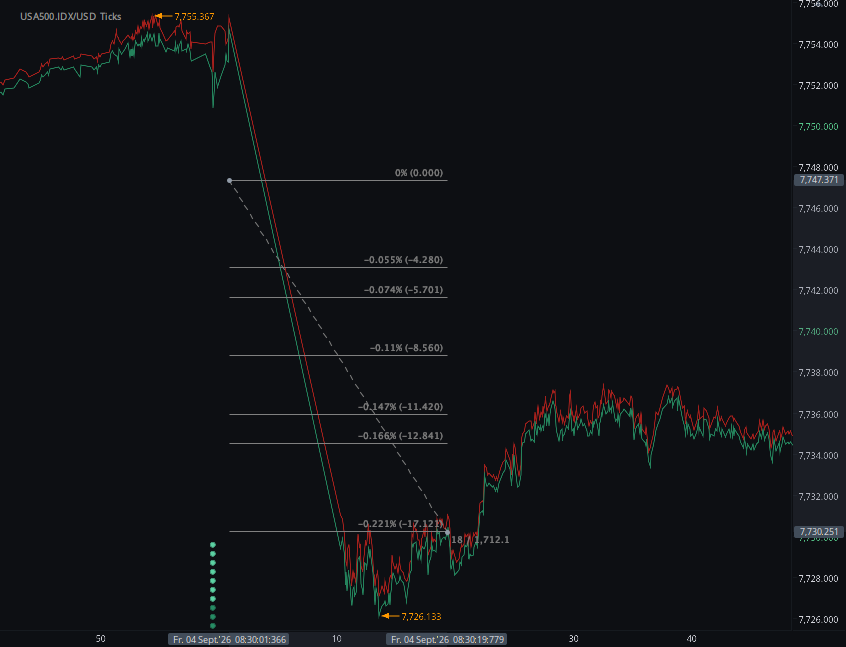
According to our analysis XAUUSD (spot gold) moved 57 points and US500 moved 68 ticks on US Employment Situation (Non-farm payrolls / NFP) data on 4 September 2026.
XAUUSD (57 points)
US500 (68 ticks)
Charts are exported from JForex (Dukascopy).
August NFP Surprise Sends US500 Down 68 Ticks and Gold Down 57 Points
U.S. payroll growth nearly tripled expectations, triggering a rapid hawkish repricing across rate-sensitive markets as traders increased expectations for a September Federal Reserve rate hike.
The August 2026 U.S. Employment Situation delivered a major upside surprise for news traders. Nonfarm payroll employment increased by 162,000, almost three times the 56,000 consensus forecast.
The unemployment rate remained unchanged at 4.1%, while labor-force participation recovered to 61.6%. Previous payroll estimates were also revised higher, strengthening the overall labor-market signal.
The immediate market response was notably different from the weak July jobs report. Instead of falling yields, dollar weakness and stronger gold, the August data prompted traders to price a greater probability of tighter Federal Reserve policy.
August NFP: Estimates vs. Actual
| Labor Indicator | Expectation / Prior | Actual | HAAWKS News-Trader Read |
|---|---|---|---|
| Nonfarm Payrolls | +56K expected | +162K | A 106K upside surprise and the strongest headline component of the release. |
| Unemployment Rate | 4.1% expected | 4.1% | Unchanged and in line with consensus. |
| Labor Force Participation | 61.4% prior | 61.6% | Participation rebounded while the labor force expanded, strengthening the quality of the headline result. |
| Average Hourly Earnings MoM | — | +0.3% | Wage growth remained moderate despite the payroll surge. |
| Average Hourly Earnings YoY | 3.0% expected | 3.1% | Slightly above consensus, but slower than July's 3.2%. |
| June + July Revisions | Previously reported levels | +55K | Upward revisions reinforced the stronger current-month signal. |
The Revisions Added to the Surprise
The payroll headline was already substantially stronger than expected, but the revisions made the release more hawkish.
June payroll growth was revised up by 11,000, from +20,000 to +31,000. July was revised up by 44,000, transforming the previously reported −23,000 decline into a +21,000 increase.
Together, the two prior months contained 55,000 more jobs than previously reported.
HAAWKS view: this was not simply a +162K headline. News traders received a large upside surprise in current payrolls, an increase in participation and positive revisions to both prior months. Several important employment fields therefore reinforced the same stronger-labor-market signal.
Immediate Market Reaction
HAAWKS tick-chart analysis captured a sharp downside reaction in both U.S. equities and gold immediately following the 8:30 a.m. ET release.
| Market | Measured Reaction | Direction | News-Trader Interpretation |
|---|---|---|---|
| US500 | 68 ticks | Lower | The stronger jobs report increased expectations that the Fed could tighten monetary policy, creating a "good news is bad news" response in equities. |
| XAU/USD | 57 points | Lower | Higher Treasury yields, a stronger dollar and increased Fed hike expectations reduced demand for non-yielding gold. |
Why Did US500 and Gold Fall?
Payrolls Beat by 106K
Economists expected only 56,000 new jobs. The 162,000 actual result created a very large upside surprise for algorithmic and discretionary news traders to process.
Prior Months Were Revised Higher
June and July payroll growth was revised up by 55,000 combined. That reduced concerns that the previous slowdown represented a rapidly deteriorating labor market.
Participation Improved
Labor-force participation rose from 61.4% to 61.6% while unemployment remained at 4.1%. The labor force increased substantially during the month.
Fed Hike Expectations Increased
The strong labor data gave policymakers more room to focus on inflation. Rate markets increased the probability of a September Federal Reserve rate hike after the release.
Where the Jobs Came From
The employment rebound was concentrated in several areas that had been weak in previous months.
| Industry | August Employment Change | HAAWKS Read-Through |
|---|---|---|
| Food Services & Drinking Places | +59K | The largest highlighted source of employment growth. |
| Local Government Education | +42K | Largely reversed the prior month's decline. |
| Construction | +22K | BLS characterized overall construction employment as little changed, with strength in nonresidential specialty trades. |
| Manufacturing | +16K | Continued an upward employment trend. |
| Health Care | +13K | Continued to add jobs, although below its prior 12-month average pace. |
| Information | −23K | The principal highlighted sector showing employment losses. |
Strong Jobs, but Wage Inflation Stayed Moderate
One feature prevented the report from being uniformly inflationary. Average hourly earnings increased by 0.3% month over month and 3.1% year over year.
Annual wage growth therefore slowed slightly from July's 3.2%. That distinction mattered because the report showed stronger employment without a corresponding acceleration in wage inflation.
For news traders, this created an important second layer to the release. The payroll and revision fields were clearly hawkish, while the wage data provided a modest counterweight.
The Fed Repricing
Before the report, markets were already debating whether persistent inflation could force the Federal Reserve to raise rates at its September meeting.
The stronger employment data increased the probability of a rate hike. Reuters reported that short-term rate futures moved to imply roughly a 59% probability of a September increase immediately after the report, compared with approximately 55% beforehand.
Treasury yields rose and the U.S. dollar strengthened. Those moves created a difficult combination for both gold and rate-sensitive equities.
News-trader takeaway: the market was not trading +162K jobs in isolation. It was trading the impact of +162K payrolls, +55K in revisions, stronger participation and steady unemployment on the expected path of Federal Reserve policy.
What This Release Shows News Traders
Consensus Matters as Much as the Actual Number
A +162K payroll result means little without knowing that the market expected only +56K. The surprise relative to expectations was the immediate trading catalyst.
Revisions Can Strengthen or Reverse a Signal
July had originally been reported as a 23,000 employment decline. The September release revised that result to a 21,000 increase. That 44,000 adjustment materially changed the historical employment picture.
Multiple Fields Need to Be Processed Together
Payrolls, unemployment, participation, wages and prior-month revisions arrived as part of the same release. Professional news-trading systems therefore benefit from receiving the complete data set rather than only the headline NFP number.
Good Economic News Can Be Bad Market News
Stronger employment would normally be supportive for economic growth, but in an environment where traders are focused on inflation and monetary policy, stronger data can increase expected interest rates and pressure equities and gold.
Execution Risk Remains Critical
The 68-tick US500 and 57-point XAU/USD figures represent measured historical price movement, not guaranteed executable profit. Spreads, liquidity, slippage, order type, venue and data latency can materially affect actual trading results.
What Comes Next?
Following the strong employment report, attention shifted immediately toward U.S. inflation data and the September Federal Reserve meeting. With labor-market weakness becoming less of a constraint, inflation readings gained even greater importance for the policy decision.
The next U.S. Employment Situation, covering September 2026, is scheduled for Friday, October 2, 2026 at 8:30 a.m. ET.
HAAWKS Conclusion
The August 2026 Employment Situation delivered a substantially stronger U.S. labor-market signal than traders had expected.
Nonfarm payrolls increased by 162,000 against a consensus forecast of only 56,000. The unemployment rate remained at 4.1%, participation increased to 61.6%, and June and July payroll growth was revised higher by a combined 55,000 jobs.
The release strengthened expectations that the Federal Reserve could tighten policy in September. Treasury yields and the dollar moved higher, while rate-sensitive assets came under immediate pressure.
HAAWKS measured approximately 68 ticks of downside movement in US500 and 57 points in XAU/USD following the release.
For professional news traders, the event demonstrates why low-latency access to both the headline number and the supporting data fields is important. Payrolls, expectations, revisions, wages, unemployment and participation combined to determine the market interpretation within seconds.
Trade smart. Stay informed. Stay ahead.
Built for Professional News Traders
HAAWKS G4A provides low-latency machine-readable data for U.S. macroeconomic and commodity releases, together with macroeconomic data from Norway, Sweden, Switzerland and Turkey, as well as ECB interest-rate decisions and statements.
All data is machine readable and available via API access in Chicago, New York and London. Free trials are available for qualified professionals.
Explore HAAWKS G4A Low-Latency DataSources
-
U.S. Bureau of Labor Statistics — Employment Situation,
August 2026
Official source for payroll employment, unemployment, participation, wages, industry employment and payroll revisions. -
Reuters — U.S. job growth expected to rebound in August
Used for the pre-release economist consensus of +56K payrolls, 4.1% unemployment and 3.0% annual wage growth. -
Reuters — U.S. nonfarm payrolls surge in August
Used for post-release labor-market and Federal Reserve context. -
Reuters — Strong August jobs report sends yields higher
Used for immediate rates, dollar, equities and gold market reaction. -
Reuters — Gold slides after robust U.S. payrolls
Used for gold-market and Federal Reserve rate-expectation context. -
HAAWKS internal tick-chart analysis — September 4, 2026
Used for the measured release-window movements in US500 and XAU/USD.
Built for traders who compete on speed. HAAWKS G4A delivers low-latency, machine-readable macroeconomic and commodity data via API infrastructure in Chicago, New York and London. Explore the feed, share your feedback, or contact us to request a free trial for qualified professionals.
