
According to our analysis natural gas moved 19 ticks on DOE Natural Gas Storage Report (WNGSR) data on 23 April 2026.
Natural gas (19 ticks)
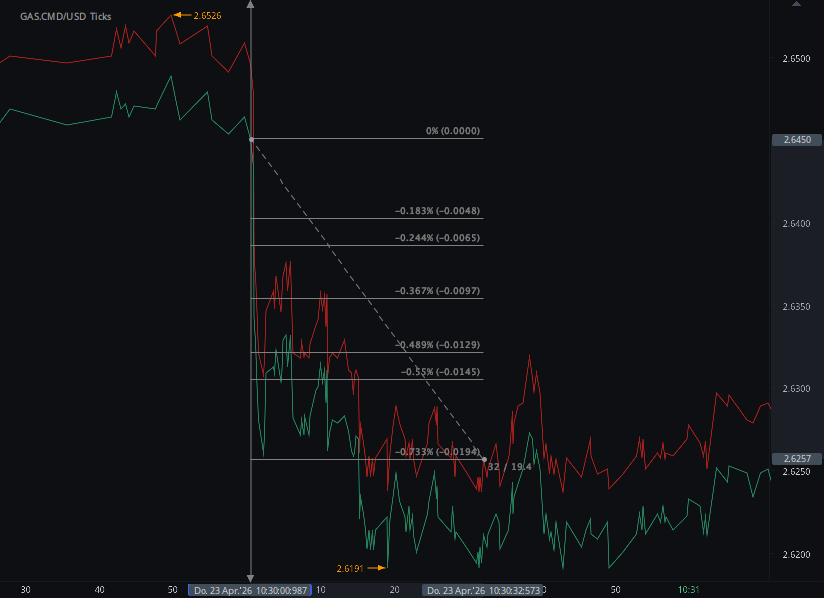
Charts are exported from JForex (Dukascopy).
U.S. Natural Gas Storage Builds Strongly as Injection Season Gains Momentum
The latest Weekly Natural Gas Storage Report from the U.S. Energy Information Administration (EIA) shows a robust start to the injection season, with storage levels rising sharply for the week ending April 17, 2026. The data signals a healthy supply position and offers important insights into regional dynamics and market balance heading into the warmer months.
A Triple-Digit Injection Surprises to the Upside
Working gas in underground storage increased by 103 billion cubic feet (Bcf) compared to the previous week, bringing total inventories to 2,063 Bcf. This sizable build exceeds typical seasonal norms and reflects a combination of moderate demand and steady production.
The latest injection pushes storage levels:
142 Bcf above the same time last year
137 Bcf above the five-year average of 1,926 Bcf
Despite the strong surplus, total inventories remain comfortably within the historical five-year range, suggesting no immediate imbalance but a clear cushion forming early in the season.
Regional Contributions: Broad-Based Growth
All regions reported net injections, with particularly strong contributions from the South Central and Midwest regions:
South Central: +40 Bcf
Midwest: +33 Bcf
East: +26 Bcf
Mountain: +2 Bcf
Pacific: +2 Bcf
The South Central region—home to key storage hubs and salt caverns—continues to play a central role in balancing supply, accounting for nearly 40% of the weekly build.
Storage Levels vs. Historical Benchmarks
A closer look at regional storage reveals mixed positioning relative to historical norms:
The Mountain and Pacific regions stand significantly above their five-year averages, up 59.1% and 46.2%, respectively.
The East and Midwest regions remain slightly below their five-year averages, indicating room for further injections.
The South Central region sits modestly above average, reflecting stable conditions.
Overall, the national surplus suggests a market that is well-supplied but not excessively saturated.
Data Revisions: Minor but Noteworthy
The report also includes revisions to historical storage data covering late August 2025 through early April 2026. These adjustments were largely due to reclassifications of gas from working to base storage.
Key impacts:
Average downward revision of 10 Bcf per week
Minimal effect on weekly net changes
Prior week’s total (April 10) revised from 1,970 Bcf to 1,960 Bcf
While these revisions slightly alter historical comparisons, they do not materially change the broader supply outlook.
What This Means for the Market
The strong injection early in the refill season may have several implications:
Price pressure: Higher-than-average inventories can weigh on natural gas prices, especially if mild weather persists.
Supply confidence: Elevated storage levels provide a buffer against potential summer demand spikes or supply disruptions.
Injection pace: Continued builds at this rate could push inventories well above average by mid-summer.
However, much will depend on upcoming weather patterns, LNG export demand, and production trends.
Looking Ahead
The next storage report, scheduled for release on April 30, 2026, will offer further clues on whether this strong injection trend continues. Market participants will be watching closely to see if supply remains this resilient as seasonal demand begins to shift.
For now, the takeaway is clear: the U.S. natural gas market is entering the injection season in a position of strength, with inventories building faster than usual and supply comfortably exceeding historical benchmarks.
Disclaimer: This blog post is for informational purposes only and should not be construed as financial advice. Always conduct thorough research and consider seeking advice from a financial professional before making any investment decisions.
Source: https://ir.eia.gov/ngs/ngs.html
Start futures forex fx commodity news trading with Haawks G4A low latency machine-readable data, one of the fastest data feeds for DOE data.
Please let us know your feedback. If you are interested in timestamps, please send us an email to sales@haawks.com.