
According to our analysis XAUUSD (spot gold) moved 16 points and US500 moved 31 points on US Employment Situation (Non-farm payrolls / NFP) data on 6 March 2026.
XAUUSD (16 points)

US500 (31 points)
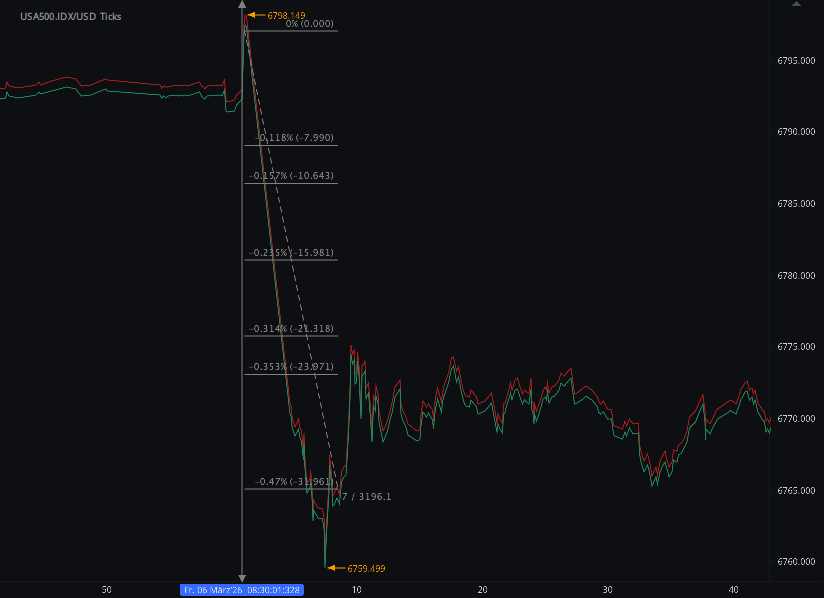
Charts are exported from JForex (Dukascopy).
U.S. Jobs Report – February 2026: Payrolls Slip While Unemployment Holds Steady
The U.S. labor market showed signs of cooling in February 2026, according to the latest Employment Situation report from the Bureau of Labor Statistics (BLS). While the unemployment rate remained relatively stable, total nonfarm payroll employment declined slightly, highlighting a labor market that is still resilient but facing pockets of weakness across certain industries.
Payroll Employment Declines Slightly
Total nonfarm payroll employment fell by 92,000 jobs in February, reversing part of January’s gain of 126,000 jobs. The drop was largely influenced by job losses in specific sectors, particularly health care, information, and federal government employment.
Despite the monthly decline, the broader labor market picture remains mixed rather than sharply negative. Job growth throughout 2025 had already slowed considerably, and February’s figures suggest a continuation of that gradual moderation.
Unemployment Rate Holds at 4.4%
The unemployment rate remained unchanged at 4.4%, with approximately 7.6 million people unemployed in February. Across demographic groups—including adult men, adult women, teenagers, and major racial and ethnic categories—unemployment rates showed little change during the month.
However, one area of concern is long-term unemployment. The number of individuals unemployed for 27 weeks or longer reached 1.9 million, up from 1.5 million a year ago. Long-term unemployed workers now account for 25.3% of all unemployed people.
Labor Force Participation Remains Flat
Labor force participation and employment ratios also showed minimal movement:
Labor force participation rate: 62.0%
Employment-population ratio: 59.3%
Both measures have remained relatively stable over the past year. However, new population estimates from the U.S. Census Bureau affected the underlying data, particularly due to demographic shifts such as fewer men aged 25–54 and more women aged 65 and older—groups that historically participate in the workforce at different rates.
Sector Breakdown: Where Jobs Were Lost and Gained
Several industries experienced notable changes in February:
Health Care
Employment declined by 28,000 jobs, largely due to strike activity affecting physicians’ offices, which lost 37,000 jobs. Hospitals, however, added 12,000 positions.
Information Sector
The information industry continued its downward trend, shedding 11,000 jobs in February and averaging monthly losses over the past year.
Federal Government
Federal employment fell by 10,000 jobs. Since October 2024, federal employment has declined by 330,000 positions, representing an 11% drop.
Social Assistance
One of the few areas of consistent growth, social assistance added 9,000 jobs, primarily in individual and family services.
Transportation and Warehousing
Employment was mostly unchanged overall but saw losses in courier and messenger services, partially offset by gains in air transportation.
Wage Growth Continues
Despite softer employment numbers, wage growth remained solid.
Average hourly earnings: $37.32 (up $0.15 in February)
Year-over-year wage growth: 3.8%
Production and nonsupervisory employees saw earnings rise to $32.03 per hour, reflecting steady—though not accelerating—income growth for workers.
Workweek and Hours
The average workweek remained stable:
All private employees: 34.3 hours
Manufacturing: 40.1 hours (slightly lower)
Overtime in manufacturing: 3.0 hours
Stable hours suggest that employers are maintaining current staffing levels rather than significantly expanding or cutting back.
Data Revisions
The BLS also revised previous job numbers:
December 2025: Revised from +48,000 to –17,000
January 2026: Revised from +130,000 to +126,000
These revisions mean employment for those two months combined is 69,000 lower than previously reported.
Population Data Adjustments
February’s report also incorporated updated population estimates based on the 2020 Census. These revisions affected measures like labor force participation but did not change the unemployment rate.
The updated data indicates:
A decline in the number of men aged 25–54
An increase in women aged 65 and older
Changes in the racial composition of the population, including increases in Asian and multiracial populations
These demographic shifts slightly lowered overall labor force participation estimates.
What It Means for the Economy
February’s employment report paints a picture of a labor market that is stable but slowing. Unemployment remains low by historical standards, and wages continue to rise. However, job growth is weakening, certain industries are contracting, and long-term unemployment is creeping upward.
Economists will be watching closely to see whether February’s job losses represent temporary disruptions—such as strike activity—or the beginning of a more pronounced labor market slowdown.
The next Employment Situation report, covering March 2026, will be released on April 3, 2026.
Disclaimer: This blog post is for informational purposes only and should not be construed as financial advice. Always conduct thorough research and consider seeking advice from a financial professional before making any investment decisions.
Start forex fx futures news trading with Haawks G4A low latency machine-readable data today, one of the fastest news data feeds for US macro-economic and commodity data.
Please let us know your feedback. If you are interested in timestamps, please send us an email to sales@haawks.com.