
According to our analysis natural gas moved 41 ticks on DOE Natural Gas Storage Report (WNGSR) data on 19 February 2026.
Natural gas (41 ticks)
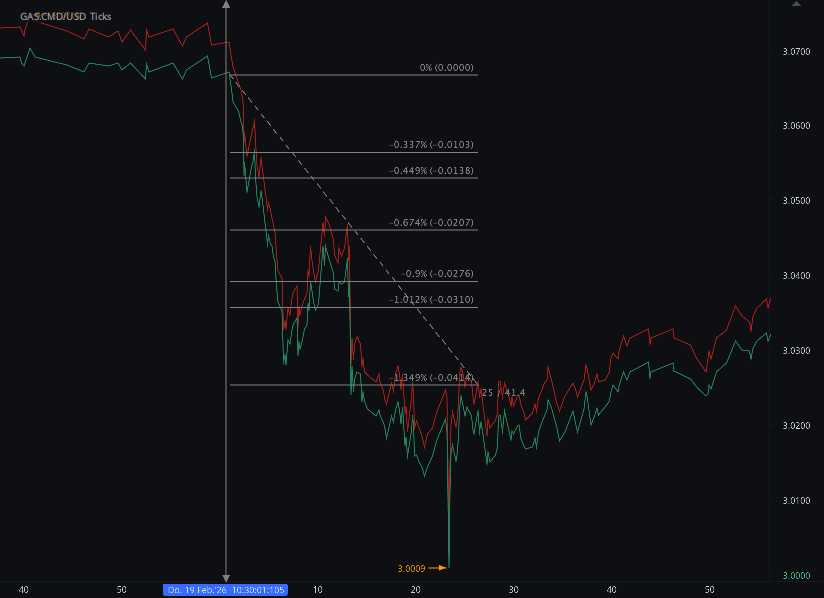
Charts are exported from JForex (Dukascopy).
Weekly Natural Gas Storage Update: Inventories Fall 144 Bcf as Winter Withdrawals Continue
The latest Weekly Natural Gas Storage Report released February 19, 2026, by the U.S. Energy Information Administration (EIA) shows a substantial drawdown in natural gas inventories for the week ending February 13, 2026. As winter demand remains elevated, working gas in underground storage across the Lower 48 states declined by 144 billion cubic feet (Bcf).
Total Storage Snapshot
As of February 13, total working gas in storage stands at 2,070 Bcf, down from 2,214 Bcf the previous week. Key comparisons include:
59 Bcf below the same week in 2025
123 Bcf below the five-year average (2,193 Bcf)
Still within the five-year historical range
While inventories are trailing both last year and the five-year average, they remain within normal seasonal boundaries—suggesting that, despite strong withdrawals, storage levels are not yet in concerning territory.
Regional Breakdown
East Region
Current stocks: 388 Bcf
Weekly change: –50 Bcf
8.9% below last year
16.9% below five-year average
The East posted one of the largest weekly withdrawals, reflecting persistent heating demand in densely populated markets.
Midwest
Current stocks: 457 Bcf
Weekly change: –53 Bcf
9.1% below last year
18.4% below five-year average
The Midwest experienced the largest regional draw, consistent with colder seasonal temperatures and strong residential and commercial demand.
South Central
Current stocks: 747 Bcf
Weekly change: –37 Bcf
7.4% below last year
10.2% below five-year average
Salt facilities: 168 Bcf (–8 Bcf week over week)
Nonsalt facilities: 579 Bcf (–29 Bcf week over week)
Salt storage facilities, often used for high-deliverability needs during peak demand, continue to see steady withdrawals.
Mountain Region
Current stocks: 207 Bcf
Weekly change: –2 Bcf
12.5% above last year
44.8% above five-year average
The Mountain region remains notably stronger than historical norms, providing a relative buffer compared to other regions.
Pacific Region
Current stocks: 271 Bcf
Weekly change: –2 Bcf
29.0% above last year
41.1% above five-year average
The Pacific region continues to maintain comfortable inventory levels relative to both last year and the five-year average.
Market Context
A 144 Bcf withdrawal is a sizable weekly decline, typical of mid-February when winter demand often peaks. The cumulative deficit versus the five-year average has widened to 123 Bcf, but overall inventories remain within seasonal norms.
From a market perspective, traders and analysts will closely monitor:
Late-season cold weather risks
Production trends
LNG export demand
End-of-season storage projections
If withdrawals continue at an above-average pace, the market could enter injection season with tighter inventories than desired, potentially supporting upward price pressure.
Statistical Reliability
The EIA reports a coefficient of variation of 0.5% for total stocks, indicating a high level of statistical reliability. The standard error for the net change is 0.9 Bcf, suggesting that the reported 144 Bcf draw is well outside the margin of sampling variability.
Looking Ahead
The next storage report will be released February 26, 2026. With only a few weeks remaining in the traditional withdrawal season, attention is shifting toward:
End-of-March storage levels
Early injection season dynamics
Summer supply-demand balance
For now, inventories remain adequate but leaner than historical norms—a dynamic that could shape market sentiment heading into spring.
As always, natural gas storage remains one of the most closely watched indicators of U.S. energy market health.
Disclaimer: This blog post is for informational purposes only and should not be construed as financial advice. Always conduct thorough research and consider seeking advice from a financial professional before making any investment decisions.
Source: https://ir.eia.gov/ngs/ngs.html
Start futures forex fx commodity news trading with Haawks G4A low latency machine-readable data, one of the fastest data feeds for DOE data.
Please let us know your feedback. If you are interested in timestamps, please send us an email to sales@haawks.com.