
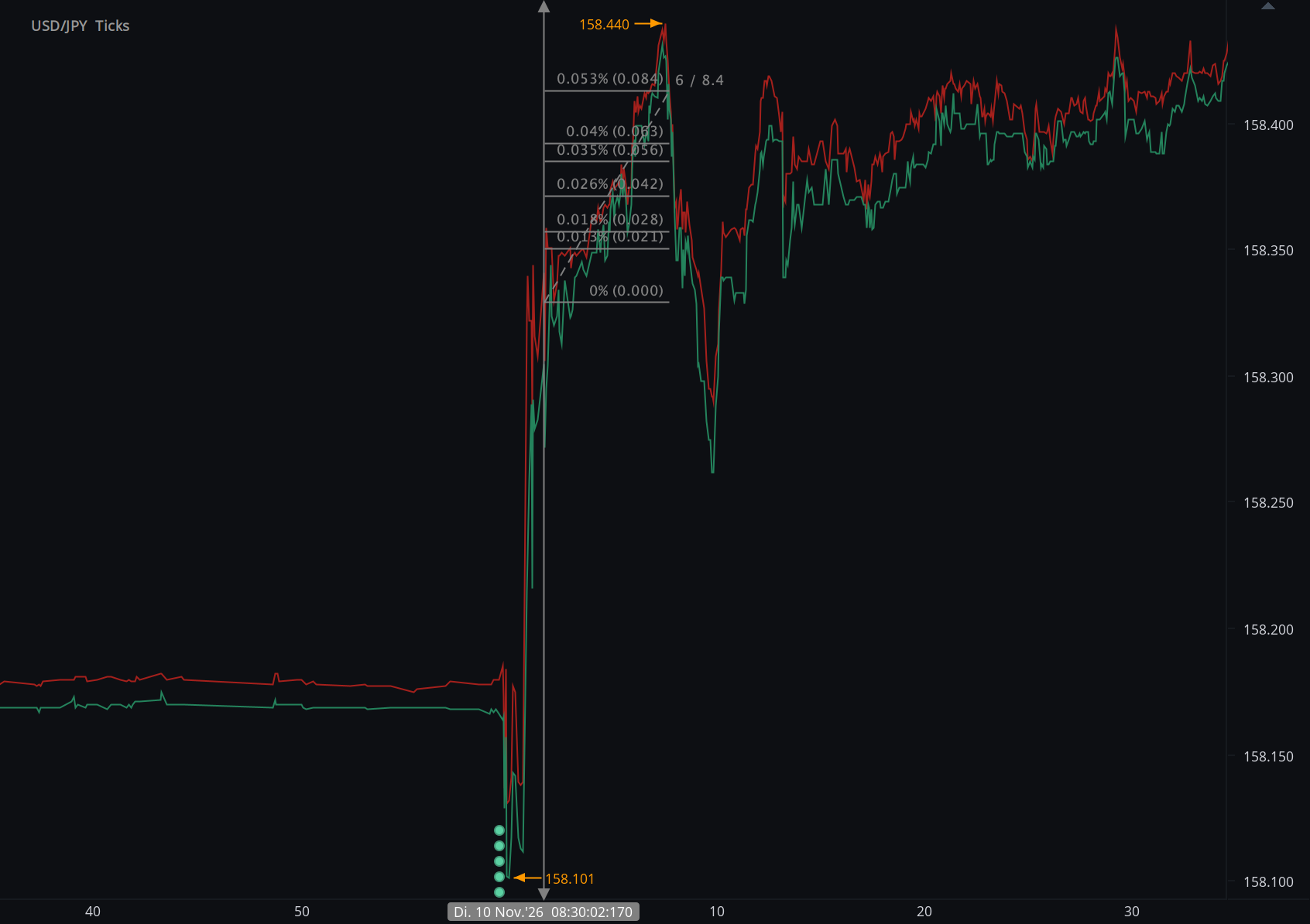
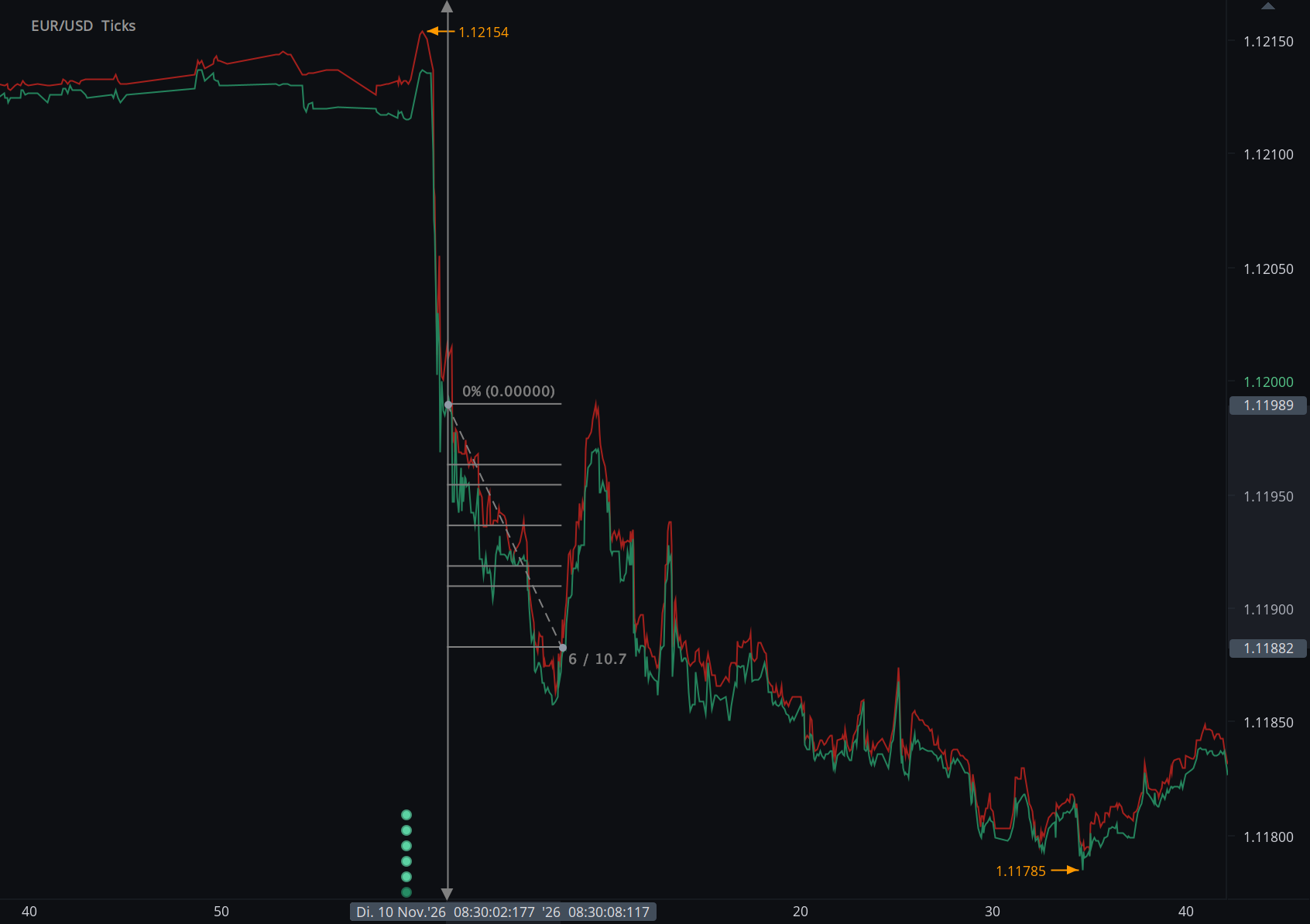
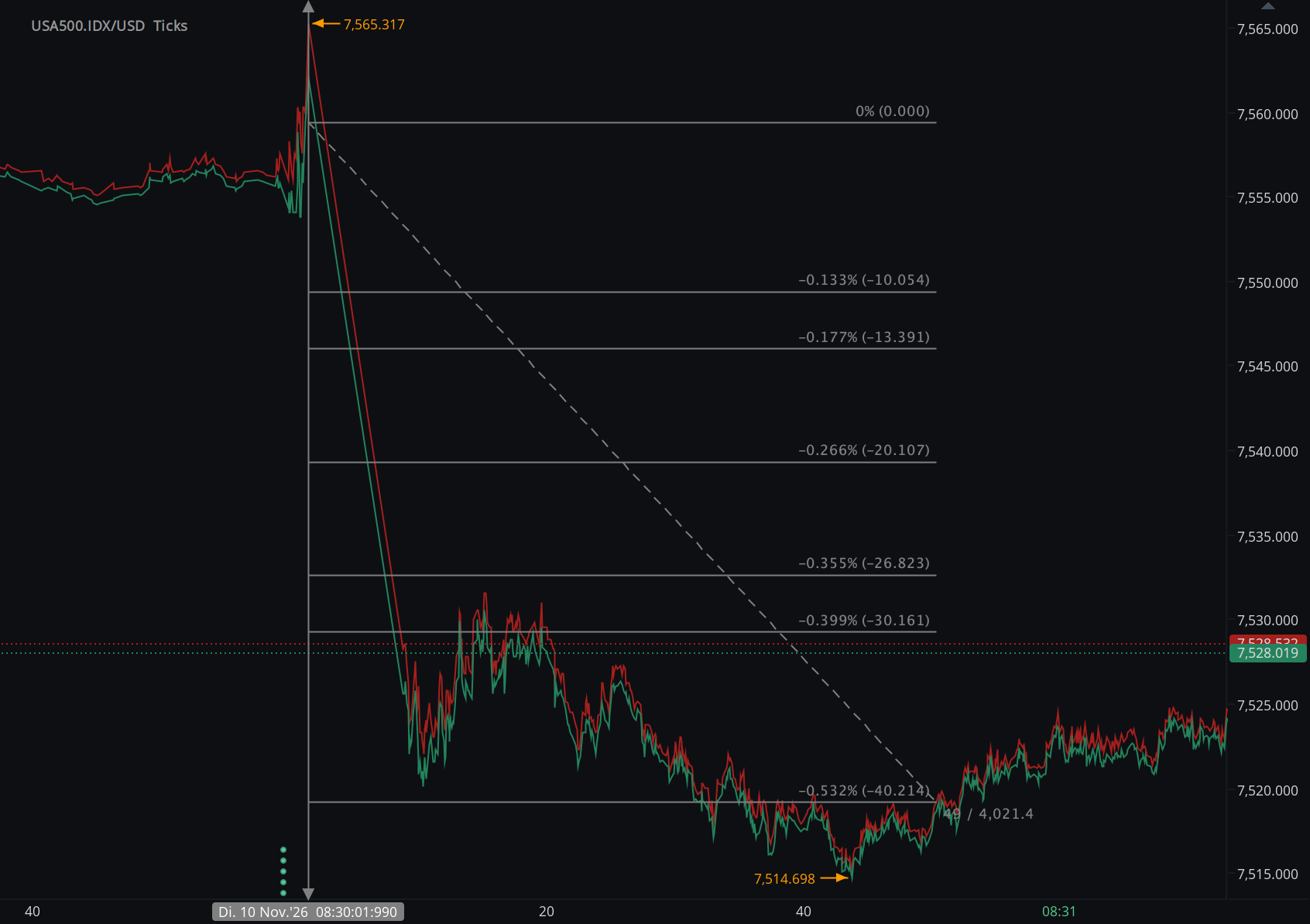
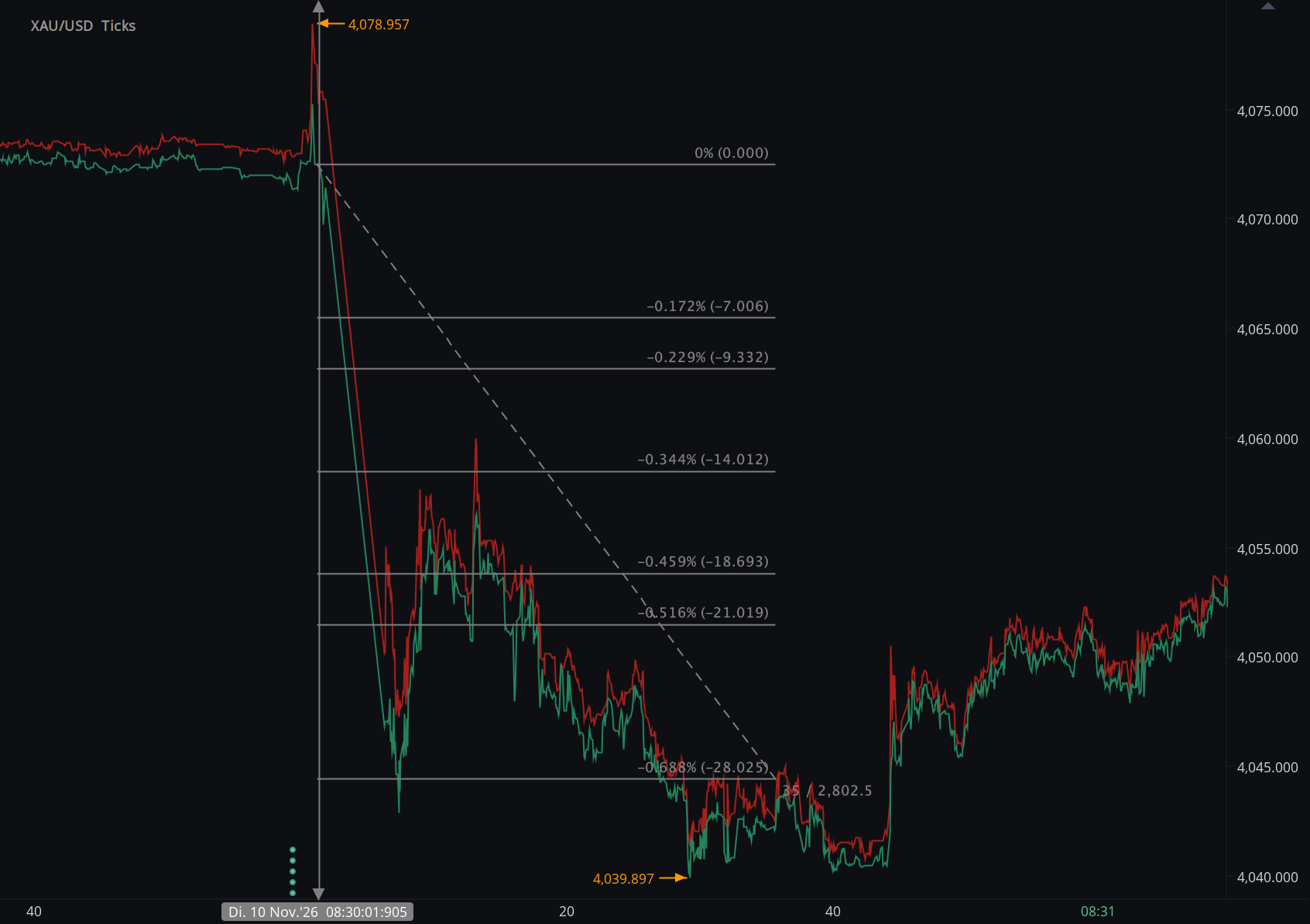
According to our analysis USD/JPY went up 8 pips, EUR/USD went down 10 pips, US500 went down 160 ticks and XAUUSD also went down 28 points on US BLS Consumer Price Index (CPI) data on 10 November 2026.
USD/JPY (8 pips)
EUR/USD (10 pips)
US500 (160 ticks)
XAU/USD (28 points)
Charts are exported from JForex (Dukascopy).
October 2026 CPI: Hotter Inflation Drives Dollar Strength, S&P 500 and Gold Lower
Headline and core U.S. consumer inflation both exceeded consensus, prompting an immediate cross-asset repricing across foreign exchange, U.S. equities, Treasury yields and precious metals.
The October 2026 U.S. Consumer Price Index delivered a stronger-than-expected inflation signal across both the headline and core measures, triggering rapid repricing across U.S. rates, the dollar, equities and gold.
The Bureau of Labor Statistics reported that the CPI for All Urban Consumers increased 0.4% month over month in October, following a 0.6% increase in September.
Economists surveyed by Reuters had expected a 0.3% monthly increase.
Core CPI, excluding food and energy, increased 0.3% month over month, compared with the Reuters consensus forecast of 0.2%.
Immediate Cross-Asset Market Response
The cross-asset pattern was internally consistent with a stronger inflation signal.
The dollar strengthened against both the euro and Japanese yen, equity prices moved lower and gold declined as markets incorporated the possibility of a more restrictive Federal Reserve policy path.
Reuters reported that the U.S. two-year Treasury yield rose sharply after publication, while the benchmark 10-year yield also moved higher.
The higher-rate response reinforced the move in the dollar and increased the opportunity cost of holding non-yielding gold.
October CPI vs. Pre-Release Expectations
| Indicator | September | Reuters Consensus | October Actual | Surprise |
|---|---|---|---|---|
| Headline CPI MoM | +0.6% | +0.3% | +0.4% | +0.1 ppt |
| Core CPI MoM | +0.3% | +0.2% | +0.3% | +0.1 ppt |
| Headline CPI YoY | 3.7% | — | Not published | October 2025 comparison unavailable |
HAAWKS view: both principal monthly inflation measures exceeded consensus. That distinction matters because the upside surprise was not confined to volatile food or energy components: core CPI also exceeded the pre-release forecast.
An Unusual Release: No October Year-Over-Year CPI Rate
The October 2026 report contained an important statistical complication.
BLS did not publish most 12-month inflation rates for October because CPI survey data were not collected in October 2025 during the federal government lapse in appropriations.
Without an October 2025 index level, BLS did not have the standard comparison base required to calculate most October 2026 year-over-year changes.
The most recent published annual headline CPI reading therefore remained September's 3.7%.
Data-infrastructure implication: real-time systems must be capable of distinguishing a legitimately unavailable field from zero, stale data or a processing error. Missing-value handling is particularly important for automated strategies that normally expect both monthly and annual CPI fields at the release timestamp.
Inside the October Inflation Report
Price increases were broad enough to reinforce the stronger headline and core readings.
| Component | October MoM | September MoM | Interpretation |
|---|---|---|---|
| All Items | +0.4% | +0.6% | Above +0.3% consensus |
| Core CPI | +0.3% | +0.3% | Above +0.2% consensus |
| Shelter | +0.3% | +0.4% | More than 30% of headline monthly increase |
| Food | +0.5% | 0.0% | Broad acceleration |
| Energy | +0.7% | +5.2% | Continued increase, slower than September |
| Gasoline | +1.0% | +9.1% | Energy pressure persisted |
| Transportation Services | +0.8% | +0.6% | Strong service-price increase |
| Medical Care | +0.3% | +0.1% | Accelerated |
| Used Cars & Trucks | −1.2% | +0.7% | Important offset to core goods inflation |
Shelter Remains an Important Inflation Contributor
The shelter index increased 0.3% in October, following a 0.4% increase in September.
BLS reported that shelter accounted for more than 30% of the monthly increase in the all-items CPI.
Shelter therefore remained an important source of underlying inflation even as the monthly rate moderated slightly.
For policy-sensitive market analysis, this composition is relevant because a CPI surprise driven exclusively by energy can carry different implications from a release in which service and shelter inflation remain firm.
Food Accelerates While Energy Pressure Moderates
Food prices increased 0.5% in October after being unchanged in September.
Food at home increased 0.4%, while food away from home increased 0.5%.
Within grocery prices, meats, poultry, fish and eggs increased 0.5%, fruits and vegetables increased 0.6%, and dairy products also increased 0.6%.
Energy prices rose 0.7%, considerably slower than September's 5.2% increase.
Gasoline increased 1.0%, electricity rose 0.9% and fuel oil increased 2.0%, while utility piped natural gas declined 0.8%.
Core Inflation Was the More Important Policy Signal
The headline CPI surprise was important, but the 0.3% core CPI increase arguably carried greater information for monetary-policy expectations.
The Reuters consensus had called for core prices to rise only 0.2%.
Core inflation therefore exceeded expectations even after removing the volatile food and energy categories.
Services excluding energy services increased 0.3%, while transportation services rose 0.8% and medical care services increased 0.3%.
Used-car prices provided an offset, falling 1.2% during the month.
Federal Reserve Expectations Reprice
The inflation data immediately affected expectations for the Federal Reserve's December policy meeting.
Reuters reported that markets fully priced at least a 25-basis-point December rate increase following the CPI release.
The probability assigned to a larger 50-basis-point increase also rose after the data.
U.S. Treasury yields moved sharply higher, with the two-year yield rising roughly 18 basis points and the 10-year yield moving toward 5%.
The cross-asset transmission was consistent: higher expected policy rates supported the dollar while placing pressure on equities and non-yielding gold.
Reading the Cross-Asset Response
EUR/USD Lower
The dollar strengthened as U.S. short-term rate expectations moved higher. HAAWKS measured EUR/USD approximately 10 ticks lower during the immediate release window.
USD/JPY Higher
USD/JPY moved approximately 8 ticks higher as the U.S. yield response reinforced the relative-rate advantage of the dollar.
S&P 500 Lower
HAAWKS measured approximately 160 ticks of downside movement as the stronger inflation data increased the expected discount rate applied to U.S. risk assets.
Gold Lower
XAU/USD declined approximately 28 points in the HAAWKS release window as both the dollar and Treasury yields strengthened.
Implications for Real-Time Market Intelligence
Headline and Core Must Be Processed Together
Both headline and core CPI exceeded expectations. A system processing only the headline field would miss the fact that underlying inflation also surprised to the upside.
Consensus Is Part of the Information Set
A 0.4% headline CPI reading has different information content when the market expects 0.3% than when it expects 0.4%.
The same applies to the 0.3% core result relative to the 0.2% consensus.
Missing Fields Require Explicit Handling
October 2026 provided an unusual example because most year-over-year CPI readings could not be calculated.
Automated infrastructure needs to represent unavailable values explicitly rather than substituting a previous value or treating missing data as zero.
Component-Level Data Adds Context
Shelter, food, energy, transportation services, medical care, vehicle prices and other fields help distinguish the structure of the inflation surprise.
Cross-Asset Confirmation Matters
The simultaneous strengthening of the dollar and decline in equities and gold provided broader confirmation that markets were processing the report primarily through a more restrictive U.S. rate outlook.
Release-Window Analysis Is Not Full-Session Analysis
HAAWKS measurements isolate the immediate repricing around the scheduled 8:30 a.m. ET publication.
Subsequent session performance incorporates additional information, liquidity, positioning, Federal Reserve commentary and other market developments.
HAAWKS Conclusion
The October 2026 Consumer Price Index delivered an upside inflation surprise across both headline and core measures.
Headline CPI increased 0.4% month over month against a 0.3% Reuters consensus, while core CPI increased 0.3% against a 0.2% expectation.
Shelter increased 0.3%, food rose 0.5% and energy advanced 0.7%. Transportation services increased 0.8%, while used cars and trucks provided a partial offset with a 1.2% decline.
BLS could not publish most October year-over-year inflation rates because October 2025 CPI survey data were unavailable. That feature made the monthly actual-versus-consensus comparison even more important for real-time interpretation.
HAAWKS measured EUR/USD −10 ticks, USD/JPY +8 ticks, S&P 500 −160 ticks and XAU/USD −28 points during the immediate release response.
The synchronized move across currencies, equities and precious metals was consistent with a higher expected U.S. policy-rate path following the stronger inflation data.
Real-Time Data. Structured Intelligence. Professional Markets.
Real-Time U.S. Macroeconomic Data
HAAWKS G4A provides low-latency, machine-readable macroeconomic and commodity data covering the United States, Canada and Europe.
The feed supports systematic strategies, professional trading desks and latency-sensitive applications requiring field-level economic data as official releases become public.
API infrastructure is available in Chicago, New York and London. Free trials are available for qualified financial institutions.
Explore HAAWKS G4ASources
-
U.S. Bureau of Labor Statistics —
Consumer Price Index, October 2026
Official source for headline CPI, core CPI and detailed component-level inflation data. -
U.S. Bureau of Labor Statistics —
Consumer Price Index Summary
Current official CPI publication page. -
Reuters — Hot October Inflation Report Rattles Markets
Source for headline and core consensus estimates, rate-market reaction and initial cross-asset context. -
Reuters — U.S. Yields Climb, Stocks Fall After Inflation Data
Source for Treasury-yield, dollar, equity and broader market response. -
Reuters — Gold Falls as CPI Tops Forecasts
Additional source for gold and rate-expectation context. -
HAAWKS internal tick-level market analysis —
10 November 2026
Source for the measured immediate release-window movements: EUR/USD −10 ticks, USD/JPY +8 ticks, S&P 500 −160 ticks and XAU/USD −28 points.
Built for traders who compete on speed. HAAWKS G4A delivers low-latency, machine-readable macroeconomic and commodity data via API infrastructure in Chicago, New York and London. Explore the feed, share your feedback, or contact us to request a free trial for financial institutions.
