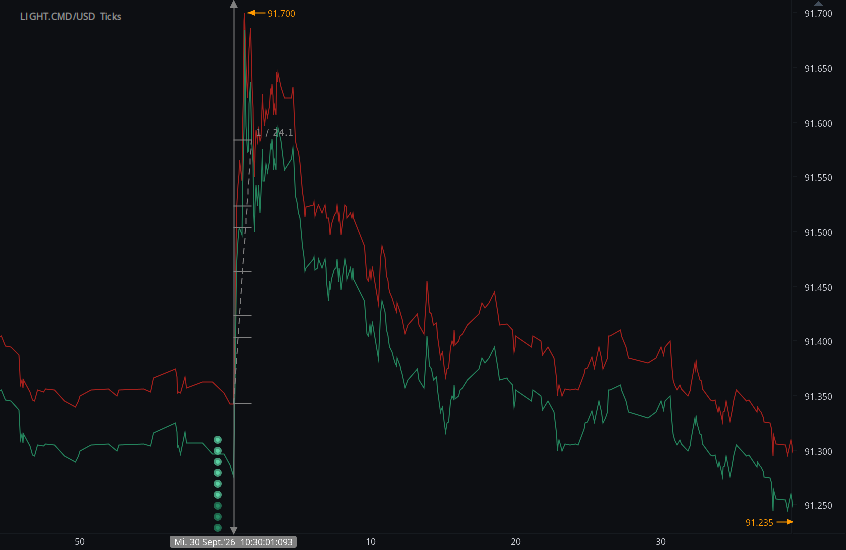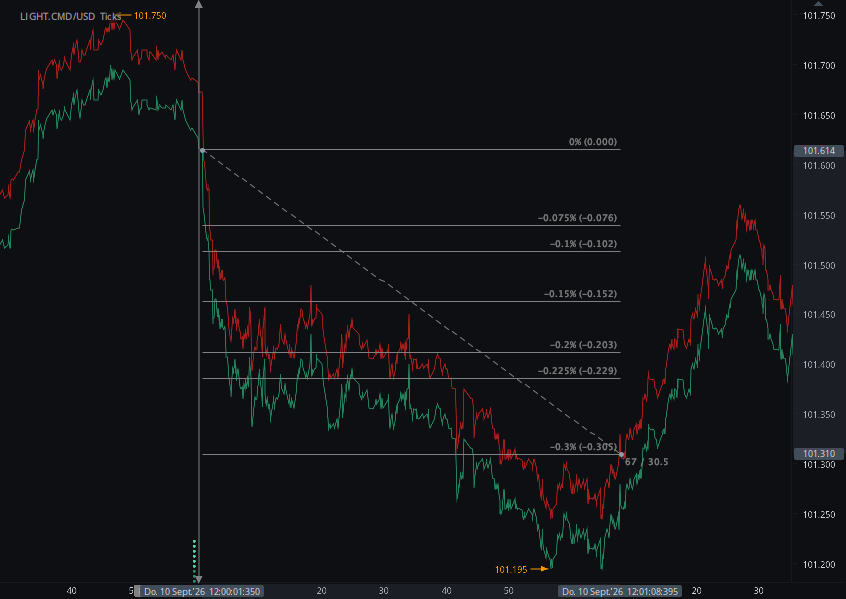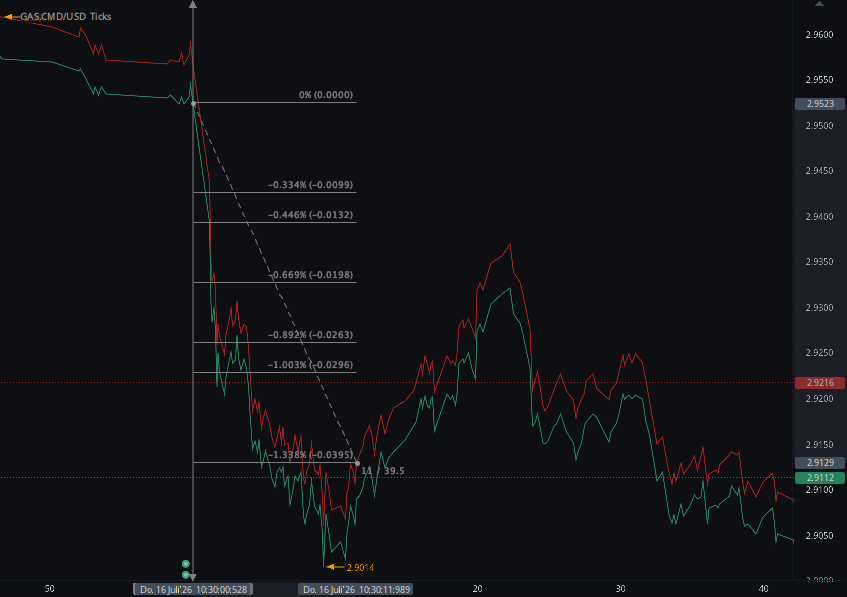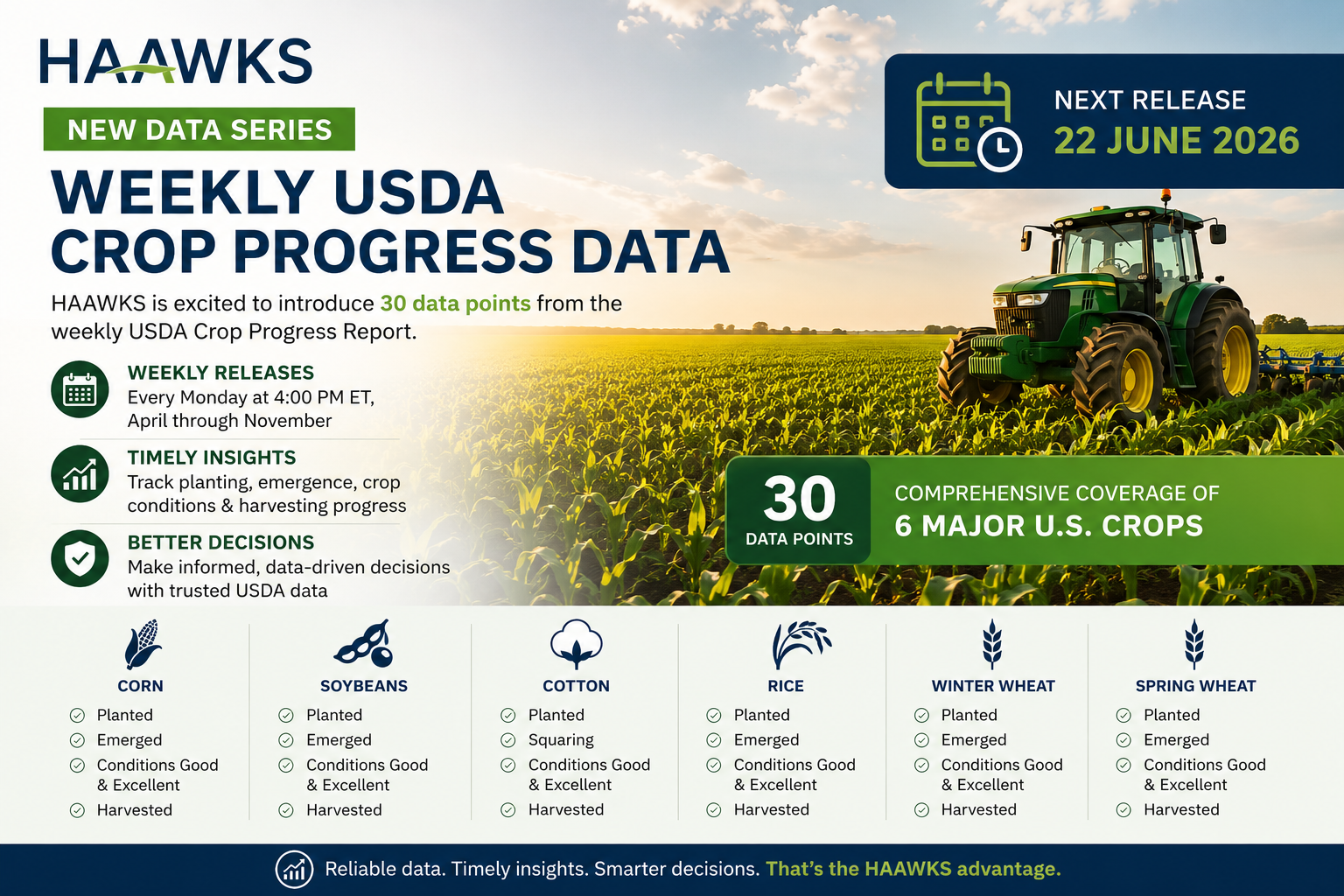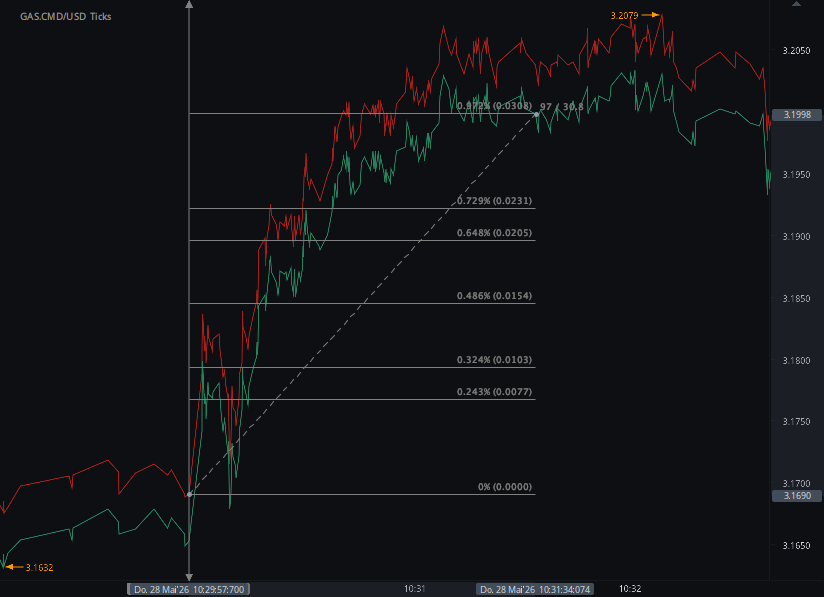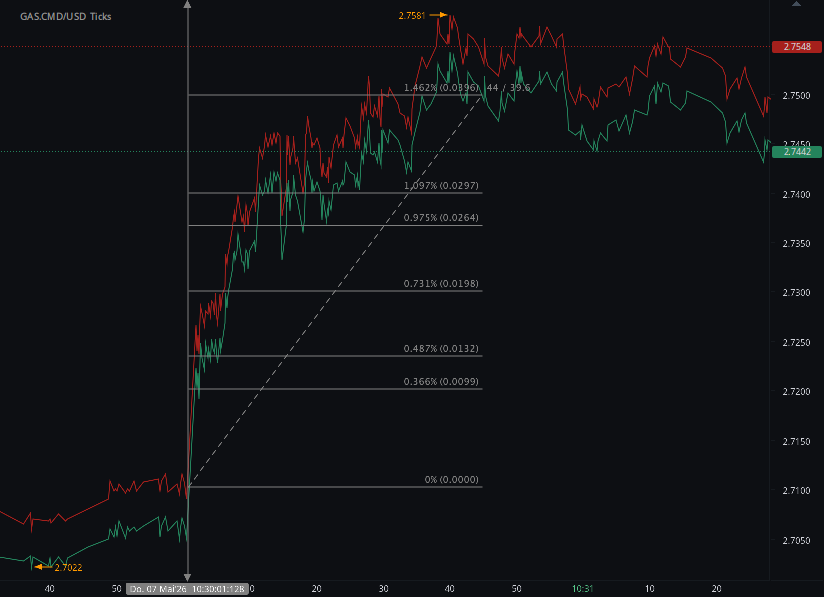
Viewing entries tagged
commodities

Comment

41 ticks potential profit in 25 seconds on 19 February 2026, analysis on futures news trading natural gas on DOE Natural Gas Storage Report (WNGSR) data

According to our analysis natural gas moved 41 ticks on DOE Natural Gas Storage Report (WNGSR) data on 19 February 2026.

Natural gas (41 ticks)

Charts are exported from JForex (Dukascopy).


Weekly Natural Gas Storage Update: Inventories Fall 144 Bcf as Winter Withdrawals Continue

The latest Weekly Natural Gas Storage Report released February 19, 2026, by the U.S. Energy Information Administration (EIA) shows a substantial drawdown in natural gas inventories for the week ending February 13, 2026. As winter demand remains elevated, working gas in underground storage across the Lower 48 states declined by 144 billion cubic feet (Bcf).

Total Storage Snapshot

As of February 13, total working gas in storage stands at 2,070 Bcf, down from 2,214 Bcf the previous week. Key comparisons include:

  • 59 Bcf below the same week in 2025

  • 123 Bcf below the five-year average (2,193 Bcf)

  • Still within the five-year historical range

While inventories are trailing both last year and the five-year average, they remain within normal seasonal boundaries—suggesting that, despite strong withdrawals, storage levels are not yet in concerning territory.

Regional Breakdown

East Region

  • Current stocks: 388 Bcf

  • Weekly change: –50 Bcf

  • 8.9% below last year

  • 16.9% below five-year average

The East posted one of the largest weekly withdrawals, reflecting persistent heating demand in densely populated markets.

Midwest

  • Current stocks: 457 Bcf

  • Weekly change: –53 Bcf

  • 9.1% below last year

  • 18.4% below five-year average

The Midwest experienced the largest regional draw, consistent with colder seasonal temperatures and strong residential and commercial demand.

South Central

  • Current stocks: 747 Bcf

  • Weekly change: –37 Bcf

  • 7.4% below last year

  • 10.2% below five-year average

    • Salt facilities: 168 Bcf (–8 Bcf week over week)

    • Nonsalt facilities: 579 Bcf (–29 Bcf week over week)

Salt storage facilities, often used for high-deliverability needs during peak demand, continue to see steady withdrawals.

Mountain Region

  • Current stocks: 207 Bcf

  • Weekly change: –2 Bcf

  • 12.5% above last year

  • 44.8% above five-year average

The Mountain region remains notably stronger than historical norms, providing a relative buffer compared to other regions.

Pacific Region

  • Current stocks: 271 Bcf

  • Weekly change: –2 Bcf

  • 29.0% above last year

  • 41.1% above five-year average

The Pacific region continues to maintain comfortable inventory levels relative to both last year and the five-year average.

Market Context

A 144 Bcf withdrawal is a sizable weekly decline, typical of mid-February when winter demand often peaks. The cumulative deficit versus the five-year average has widened to 123 Bcf, but overall inventories remain within seasonal norms.

From a market perspective, traders and analysts will closely monitor:

  • Late-season cold weather risks

  • Production trends

  • LNG export demand

  • End-of-season storage projections

If withdrawals continue at an above-average pace, the market could enter injection season with tighter inventories than desired, potentially supporting upward price pressure.

Statistical Reliability

The EIA reports a coefficient of variation of 0.5% for total stocks, indicating a high level of statistical reliability. The standard error for the net change is 0.9 Bcf, suggesting that the reported 144 Bcf draw is well outside the margin of sampling variability.

Looking Ahead

The next storage report will be released February 26, 2026. With only a few weeks remaining in the traditional withdrawal season, attention is shifting toward:

  • End-of-March storage levels

  • Early injection season dynamics

  • Summer supply-demand balance

For now, inventories remain adequate but leaner than historical norms—a dynamic that could shape market sentiment heading into spring.

As always, natural gas storage remains one of the most closely watched indicators of U.S. energy market health.

Disclaimer: This blog post is for informational purposes only and should not be construed as financial advice. Always conduct thorough research and consider seeking advice from a financial professional before making any investment decisions.

Source: https://ir.eia.gov/ngs/ngs.html


Start futures forex fx commodity news trading with Haawks G4A low latency machine-readable data, one of the fastest data feeds for DOE data.

Please let us know your feedback. If you are interested in timestamps, please send us an email to sales@haawks.com.

Comment

Comment

23 ticks potential profit in 26 seconds on 12 February 2026, analysis on futures news trading natural gas on DOE Natural Gas Storage Report (WNGSR) data

According to our analysis natural gas moved 23 ticks on DOE Natural Gas Storage Report (WNGSR) data on 12 February 2026.

Natural gas (23 ticks)

Charts are exported from JForex (Dukascopy).


Weekly Natural Gas Storage Update

Week Ending February 6, 2026

The latest data from the U.S. Energy Information Administration (EIA) shows a substantial withdrawal from U.S. natural gas storage as winter demand continues to impact inventories nationwide.

As of Friday, February 6, 2026, working gas in underground storage totaled 2,214 billion cubic feet (Bcf). This represents a net decrease of 249 Bcf from the previous week — one of the larger withdrawals typical of peak winter demand season.

Storage Levels at a Glance

Here’s how current inventories compare:

  • 97 Bcf lower than this time last year

  • 130 Bcf below the five-year average (2021–2025) of 2,344 Bcf

  • Still within the five-year historical range

While inventories are trailing both last year’s level and the five-year average, total working gas remains within the normal seasonal range, suggesting supply conditions are tight but not abnormal.

Regional Breakdown

East Region

  • Current stocks: 438 Bcf

  • Weekly change: -64 Bcf

  • 7.6% below last year

  • 13.4% below five-year average

The East region saw a significant draw as heating demand remained elevated.

Midwest Region

  • Current stocks: 510 Bcf

  • Weekly change: -74 Bcf

  • 9.9% below last year

  • 16.5% below five-year average

The Midwest experienced one of the largest withdrawals of the week, consistent with sustained cold temperatures across major population centers.

Mountain Region

  • Current stocks: 209 Bcf

  • Weekly change: -4 Bcf

  • 7.7% above last year

  • 37.5% above five-year average

The Mountain region remains comparatively well-supplied, with inventories well above historical norms.

Pacific Region

  • Current stocks: 273 Bcf

  • Weekly change: +1 Bcf

  • 21.3% above last year

  • 35.1% above five-year average

The Pacific region recorded a slight net injection and continues to hold comfortable inventory levels.

South Central Region

  • Current stocks: 784 Bcf

  • Weekly change: -107 Bcf

Breakdown:

  • Salt facilities: -52 Bcf

  • Nonsalt facilities: -55 Bcf

The South Central region posted the largest regional withdrawal, reflecting strong residential demand and ongoing LNG export activity along the Gulf Coast.

Data Reliability

The EIA reports a 0.5% coefficient of variation for total stocks, indicating high statistical confidence in overall inventory estimates. The standard error for the weekly net change was 1.7 Bcf, small relative to the 249 Bcf withdrawal.

Market Implications

Large winter withdrawals are typical in early February, but inventories running below both last year and the five-year average can add upward pressure to natural gas prices — particularly if:

  • Cold weather persists,

  • LNG exports remain strong,

  • Or late-season winter storms increase heating demand.

For now, storage levels remain within historical norms, which helps reduce concerns about supply shortages. However, the pace of withdrawals over the next several weeks will be critical in shaping market expectations as winter progresses.

The next storage report is scheduled for release on February 19, 2026.

Disclaimer: This blog post is for informational purposes only and should not be construed as financial advice. Always conduct thorough research and consider seeking advice from a financial professional before making any investment decisions.

Source: https://ir.eia.gov/ngs/ngs.html


Start futures forex fx commodity news trading with Haawks G4A low latency machine-readable data, one of the fastest data feeds for DOE data.

Please let us know your feedback. If you are interested in timestamps, please send us an email to sales@haawks.com.

Comment

Comment

17 ticks potential profit in 7 seconds on 29 January 2026, analysis on futures news trading natural gas on DOE Natural Gas Storage Report (WNGSR) data

According to our analysis natural gas moved 17 ticks on DOE Natural Gas Storage Report (WNGSR) data on 29 January 2026.

Natural gas (17 ticks)

Charts are exported from JForex (Dukascopy).


Natural Gas Storage Update: A Big Winter Draw, But Still Comfortable

The latest Weekly Natural Gas Storage Report from the U.S. Energy Information Administration (EIA) delivers a headline-grabbing number: a 242 billion cubic feet (Bcf) withdrawal for the week ending January 23, 2026. That’s a hefty pull from storage—but zooming out, the U.S. gas market remains in a relatively solid position for late January.

Let’s break down what’s happening and why it matters.

The Big Picture: Where Storage Stands

As of January 23, working gas in underground storage totaled 2,823 Bcf across the Lower 48 states. That’s:

  • 206 Bcf higher than this time last year

  • 143 Bcf above the five-year average of 2,680 Bcf

  • Within the historical five-year range, despite the large weekly draw

In short: winter demand is clearly doing its thing, but inventories are still comfortably padded.

Regional Breakdown: Who Pulled the Most?

Every region saw withdrawals last week, with cold-driven demand leaving a visible mark.

South Central Leads the Way

  • −89 Bcf on the week

  • Total storage now at 1,050 Bcf

  • Still 14.1% above last year and 8.6% above the five-year average

Salt caverns accounted for a sizable portion of the draw, which is typical during periods of high, short-term demand.

Midwest Feels the Chill

  • −76 Bcf weekly change

  • Storage sits at 676 Bcf

  • Nearly flat versus last year, but 6.4% below the five-year average

This suggests the Midwest is leaning more heavily on storage relative to recent norms.

East Region Stays Balanced

  • −55 Bcf withdrawal

  • Ending the week at 577 Bcf

  • Slightly above last year, slightly below the five-year average

West Holds Strong

  • Mountain: −14 Bcf, but a striking 34% above the five-year average

  • Pacific: −9 Bcf, nearly 33% above the five-year average

The West continues to stand out for its strong inventory cushion.

A Large Draw—But Not a Red Flag

A 242 Bcf withdrawal is significant, especially compared with milder winters in recent years. Still, context matters:

  • Storage levels remain well above normal

  • Sampling variability is low (total coefficient of variation just 0.4%)

  • There’s no immediate signal of supply stress

Unless colder-than-normal weather persists deep into February or production falters, the market appears well-positioned to ride out the remainder of winter.

What to Watch Next

Looking ahead to the next EIA release on February 5, key questions include:

  • Will withdrawals stay this large, or ease with moderating temperatures?

  • Can storage remain above the five-year average through peak winter demand?

  • How will regional imbalances—especially in the Midwest—evolve?

For now, the takeaway is clear: winter is biting, but storage is holding up.

Stay tuned—February is often where the real storage story gets written.

Disclaimer: This blog post is for informational purposes only and should not be construed as financial advice. Always conduct thorough research and consider seeking advice from a financial professional before making any investment decisions.

Source: https://ir.eia.gov/ngs/ngs.html


Start futures forex fx commodity news trading with Haawks G4A low latency machine-readable data, one of the fastest data feeds for DOE data.

Please let us know your feedback. If you are interested in timestamps, please send us an email to sales@haawks.com.

Comment

Comment

103 ticks potential profit in 7 seconds on 22 January 2026, analysis on futures news trading natural gas on DOE Natural Gas Storage Report (WNGSR) data

According to our analysis natural gas moved 103 ticks on DOE Natural Gas Storage Report (WNGSR) data on 22 January 2026.

Natural gas (103 ticks)

Charts are exported from JForex (Dukascopy).


U.S. Natural Gas Storage Remains Well Above Normal Despite Large Weekly Draw

U.S. natural gas inventories posted a significant weekly draw in mid-January, yet overall storage levels remain comfortably above historical norms—a key signal for winter market dynamics.

According to the latest Weekly Natural Gas Storage Report from the U.S. Energy Information Administration, working gas in underground storage across the Lower 48 states totaled 3,065 billion cubic feet (Bcf) for the week ending January 16, 2026.

That figure represents a net withdrawal of 120 Bcf from the prior week, reflecting stronger winter demand. Even so, inventories remain 141 Bcf higher than the same week last year and 177 Bcf above the five-year average, underscoring a well-supplied market.

Regional Breakdown: Broad-Based Withdrawals

Every major storage region reported declines during the week, with the largest draws concentrated in traditional heating-demand centers:

  • South Central: −39 Bcf

  • Midwest: −38 Bcf

  • East: −32 Bcf

  • Mountain: −9 Bcf

  • Pacific: −2 Bcf

Within the South Central region, salt cavern storage fell by 12 Bcf, while nonsalt facilities declined by 27 Bcf—both consistent with seasonal withdrawal patterns.

Still Above Normal Across Most Regions

Despite the sizable draw, inventories remain above both year-ago and five-year average levels in nearly every region:

  • Total U.S. storage: +4.8% vs. last year, +6.1% vs. five-year average

  • Mountain region: +34.4% vs. five-year average

  • Pacific region: +31.6% vs. five-year average

  • South Central: nearly 9% above historical norms

At 3,065 Bcf, total working gas remains above the five-year historical range, providing a cushion against late-season cold weather risks.

What This Means for the Market

The data tells a clear story:

  • Demand is real—winter withdrawals are accelerating

  • Supply is ample—storage remains elevated

  • Price pressure may stay muted unless colder-than-normal weather persists

For traders and analysts, the combination of strong draws and high absolute storage levels suggests a market that is responding to seasonal demand without signaling structural tightness.

As winter progresses, attention will shift to weather forecasts, withdrawal pace, and whether inventories begin converging toward historical averages—or continue to defy them.

Disclaimer: This blog post is for informational purposes only and should not be construed as financial advice. Always conduct thorough research and consider seeking advice from a financial professional before making any investment decisions.

Source: https://ir.eia.gov/ngs/ngs.html


Start futures forex fx commodity news trading with Haawks G4A low latency machine-readable data, one of the fastest data feeds for DOE data.

Please let us know your feedback. If you are interested in timestamps, please send us an email to sales@haawks.com.

Comment

Comment

66 ticks potential profit in 67 seconds on 15 January 2026, analysis on futures news trading natural gas on DOE Natural Gas Storage Report data

According to our analysis natural gas moved 66 ticks on DOE Natural Gas Storage Report data on 15 January 2026.

Natural gas (66 ticks)

Charts are exported from JForex (Dukascopy).


U.S. Natural Gas Storage Update: A Comfortable Cushion Heading Into Mid-January

The latest Weekly Natural Gas Storage Report from the U.S. Energy Information Administration (EIA) shows that U.S. natural gas inventories remain solidly above normal as the winter heating season continues.

As of Friday, January 9, 2026, working gas in underground storage across the Lower 48 states totaled 3,185 billion cubic feet (Bcf). That represents a weekly withdrawal of 71 Bcf, in line with typical winter demand but notably less aggressive than what might be expected during periods of severe cold.

Big Picture: Above Average and Within Range

Despite the weekly draw, storage levels continue to offer a strong buffer:

  • 33 Bcf higher than this time last year

  • 106 Bcf above the five-year average of 3,079 Bcf

  • Firmly within the historical five-year range

This positioning suggests that, nationally, the market remains well supplied, reducing the risk of near-term shortages even if colder weather emerges later in the season.

Regional Breakdown: Where the Gas Moved

Most regions saw withdrawals during the week, reflecting seasonal heating demand:

  • East:
    Stocks fell by 33 Bcf, leaving inventories 2.2% below last year and 5.8% below the five-year average—a sign of tighter conditions in the region most sensitive to winter heating loads.

  • Midwest:
    A 31 Bcf draw pushed inventories 3.4% below last year and 6.2% under the five-year norm, continuing a trend of stronger winter usage.

  • Mountain & Pacific:
    Smaller declines of 5 Bcf and 2 Bcf, respectively. Both regions remain well above historical averages, with the Mountain region more than 30% above its five-year average.

  • South Central:
    Notably, no net change week over week. Salt storage increased by 12 Bcf, while nonsalt facilities declined by the same amount—keeping total inventories steady and comfortably above both last year and the five-year average.

What This Means for the Market

The data paints a picture of a well-balanced natural gas market:

  • Storage remains ample despite winter withdrawals

  • Regional tightness exists, particularly in the East and Midwest

  • Producing and storage hubs in the South Central region continue to provide stability

Unless prolonged extreme cold materializes, inventories appear sufficient to carry the market through the remainder of winter without major stress.

Looking Ahead

The next EIA storage report will be released on January 22, 2026. With winter far from over, traders and consumers alike will be watching whether withdrawals accelerate—or if above-average storage continues to keep prices and supply risks in check.

For now, the message is clear: the U.S. entered mid-January with a healthy natural gas safety net.

Disclaimer: This blog post is for informational purposes only and should not be construed as financial advice. Always conduct thorough research and consider seeking advice from a financial professional before making any investment decisions.

Source: https://ir.eia.gov/ngs/ngs.html


Start futures forex fx commodity news trading with Haawks G4A low latency machine-readable data, one of the fastest data feeds for DOE data.

Please let us know your feedback. If you are interested in timestamps, please send us an email to sales@haawks.com.

Comment

Comment

19 ticks potential profit in 35 seconds on 7 August 2025, analysis on futures news trading natural gas on DOE Natural Gas Storage Report data

According to our analysis natural gas moved 19 ticks on DOE Natural Gas Storage Report data on 7 August 2025.

Natural gas (19 ticks)

Charts are exported from JForex (Dukascopy).


Weekly Natural Gas Storage Update – August 7, 2025

Slight Build in Storage as Total Remains Above Five-Year Average

The U.S. Energy Information Administration (EIA) released its Weekly Natural Gas Storage Report today, covering storage levels as of August 1, 2025. The data reveals a modest net increase of 7 billion cubic feet (Bcf) in working natural gas storage across the Lower 48 states, bringing the total to 3,130 Bcf.

While this weekly increase is relatively small, the total stock remains 173 Bcf above the five-year average and 137 Bcf below the level at the same time last year.

Regional Highlights

  • East Region: Added 5 Bcf, now at 656 Bcf

  • Midwest Region: Increased by 10 Bcf to 775 Bcf

  • Mountain Region: Rose 6 Bcf to 249 Bcf

  • Pacific Region: Added 3 Bcf, reaching 305 Bcf

  • South Central Region: Notably drew down 17 Bcf, dropping to 1,145 Bcf

    • Salt facilities led this decrease with a 20 Bcf draw

    • Nonsalt facilities added 3 Bcf

Despite the overall increase, the South Central region’s withdrawal stands out, likely influenced by elevated cooling demand or shifting regional market dynamics.

Year-Over-Year and Historical Comparisons

  • Total working gas is 4.2% below the level from this time last year (3,267 Bcf in 2024)

  • However, storage remains 5.9% above the five-year average of 2,957 Bcf (2020–2024)

  • All regional storage levels remain within historical five-year ranges

What This Means

Natural gas storage is a critical indicator for energy markets, especially heading into the fall shoulder season. While we're seeing slight weekly builds, the below-average year-over-year total suggests tighter supply compared to 2024, possibly impacting prices if demand spikes due to weather or market shifts.

However, the continued surplus over the five-year average provides a buffer against potential volatility.

Looking Ahead

The next Weekly Natural Gas Storage Report will be released on August 14, 2025, and will cover storage data through August 8, 2025. Traders, utilities, and analysts will be closely monitoring updates to assess storage sufficiency ahead of the upcoming winter season.

Disclaimer: This blog post is for informational purposes only and should not be construed as financial advice. Always conduct thorough research and consider seeking advice from a financial professional before making any investment decisions.

Source: https://ir.eia.gov/ngs/ngs.html


Start futures forex fx commodity news trading with Haawks G4A low latency machine-readable data, one of the fastest data feeds for DOE data.

Please let us know your feedback. If you are interested in timestamps, please send us an email to sales@haawks.com.

Comment

Comment

42 ticks potential profit in 87 seconds on 21 May 2025, analysis on futures news trading crude oil on DOE Petroleum Status Report data

According to our analysis crude oil moved 42 ticks on DOE Petroleum Status Report data on 21 May 2025.

Light sweet crude oil (42 ticks)

Charts are exported from JForex (Dukascopy).


U.S. Weekly Petroleum Update: Refinery Activity Rises, Inventories Continue to Build

Published: May 21, 2025

The U.S. Energy Information Administration’s (EIA) latest weekly petroleum data, covering the week ending May 16, 2025, reveals a modest uptick in refinery operations and a continued rise in inventories across several fuel categories, even as product demand shows year-over-year declines.

Refinery Inputs and Production

U.S. crude oil refinery inputs averaged 16.5 million barrels per day, an increase of 89,000 barrels per day compared to the previous week. Refineries operated at 90.7% capacity, maintaining a strong operational pace heading into the summer driving season.

Fuel production also saw gains:

  • Gasoline production rose to an average of 9.6 million barrels per day.

  • Distillate fuel production increased significantly, up 131,000 barrels per day to an average of 4.7 million barrels per day.

Imports on the Rise

Crude oil imports increased notably, averaging 6.1 million barrels per day, up 247,000 barrels per day from the week prior. Despite the weekly increase, the four-week average of 5.9 million barrels per day still lags 13.5% behind the same period last year.

Other key import figures:

  • Motor gasoline imports averaged 747,000 barrels per day.

  • Distillate fuel imports averaged 141,000 barrels per day.

Inventory Levels Continue to Climb

Commercial petroleum inventories grew across the board last week:

  • Crude oil inventories (excluding the Strategic Petroleum Reserve) rose by 1.3 million barrels, totaling 443.2 million barrels. This places current stockpiles about 6% below the five-year seasonal average.

  • Motor gasoline inventories increased by 0.8 million barrels, now standing about 2% below the five-year average.

  • Distillate fuel inventories rose by 0.6 million barrels, though they remain 16% below the seasonal norm.

  • Propane/propylene inventories surged by 2.7 million barrels, but still sit 7% below average levels.

In total, commercial petroleum inventories rose by 4.9 million barrels.

Product Demand Trends

Despite the increases in production and inventory, product demand remains soft:

  • Total products supplied averaged 19.6 million barrels per day over the past four weeks, a 2.8% decrease from the same period last year.

  • Motor gasoline demand dipped by 1%, averaging 8.8 million barrels per day.

  • Distillate fuel demand saw a sharper drop of 4.2%, averaging 3.6 million barrels per day.

  • On a brighter note, jet fuel demand climbed 4% year-over-year.

Takeaway

The latest data points to a petroleum market that is stabilizing in supply but facing persistent demand headwinds. With refinery utilization high and inventories rising, the market may be well-positioned for summer travel season, but muted year-over-year product demand could temper price pressures in the near term.

Stay tuned for more updates and analysis as the season progresses.

Disclaimer: This blog post is for informational purposes only and should not be construed as financial advice. Always conduct thorough research and consider seeking advice from a financial professional before making any investment decisions.

Source: https://ir.eia.gov/wpsr/wpsrsummary.pdf


Start futures forex fx commodity news trading with Haawks G4A low latency machine-readable data, one of the fastest data feeds for DOE data.

Please let us know your feedback. If you are interested in timestamps, please send us an email to sales@haawks.com.

Comment

Comment

19 ticks potential profit in 17 seconds on 15 May 2025, analysis on futures news trading natural gas on DOE Natural Gas Storage Report data

According to our analysis natural gas moved 19 ticks on DOE Natural Gas Storage Report data on 15 May 2025.

Natural gas (19 ticks)

Charts are exported from JForex (Dukascopy).


U.S. Natural Gas Storage Sees Strong Build Amid Seasonal Demand Shifts

The latest report from the U.S. Energy Information Administration (EIA) reveals a significant weekly injection into underground natural gas storage, marking an important trend as the industry transitions from the heating season toward summer cooling demand.

Key Highlights

  • Total U.S. working gas in storage: 2,255 billion cubic feet (Bcf)

  • Weekly change: +110 Bcf

  • Compared to one year ago: 375 Bcf lower

  • Compared to five-year average (2020–2024): 57 Bcf higher

This 110 Bcf net injection reflects robust storage activity, exceeding typical mid-May seasonal expectations. Despite being significantly below last year’s levels, total inventories are now 2.6% above the five-year average, providing some cushion ahead of the peak summer demand season.

What This Means for the Market

Natural gas prices may remain relatively stable or even soften in the short term due to this above-average injection and healthy storage buffer. However, the year-over-year deficit—particularly in major demand regions like the East and Midwest—could become a concern if summer heat drives stronger cooling-related demand or if supply disruptions occur.

The market will also be closely watching for shifts in LNG export volumes, production growth from shale regions, and any early-season heat waves, all of which could influence injection rates in the coming months.

A Closer Look at Historical Context

  • Year-Ago Storage (May 9, 2024): 2,630 Bcf

  • Five-Year Average: 2,198 Bcf

  • Current Storage: 2,255 Bcf

Despite being well below last year’s unusually high levels, current stocks remain comfortably within the historical range, as noted in the EIA's shaded graph data.

Final Thoughts

As we progress further into the 2025 injection season, the pace of storage builds and demand pressures from the power generation sector will be critical indicators for summer gas market dynamics. This week’s data suggests solid fundamentals, but with a lingering note of caution due to year-over-year deficits.

Stay tuned for the next release on May 22, 2025, which will offer further insights into how the storage trend is shaping up ahead of the high-demand summer period.

Disclaimer: This blog post is for informational purposes only and should not be construed as financial advice. Always conduct thorough research and consider seeking advice from a financial professional before making any investment decisions.

Source: https://ir.eia.gov/ngs/ngs.html


Start futures forex fx commodity news trading with Haawks G4A low latency machine-readable data, one of the fastest data feeds for DOE data.

Please let us know your feedback. If you are interested in timestamps, please send us an email to sales@haawks.com.

Comment

Comment

55 ticks potential profit in 42 seconds on 1 May 2025, analysis on futures news trading natural gas on DOE Natural Gas Storage Report data

According to our analysis natural gas moved 55 ticks on DOE Natural Gas Storage Report data on 1 May 2025.

Natural gas (55 ticks)

Charts are exported from JForex (Dukascopy).


Natural Gas Storage Inches Upward as Spring Builds Continue

May 2, 2025

The U.S. Energy Information Administration (EIA) released its latest Weekly Natural Gas Storage Report on May 1, 2025, revealing a notable build in underground natural gas stocks as the country transitions deeper into spring. For the week ending April 25, 2025, working gas in storage across the Lower 48 states rose by 107 billion cubic feet (Bcf), bringing total inventories to 2,041 Bcf.

This increase keeps gas storage slightly ahead of the five-year average of 2,036 Bcf and narrows the year-on-year deficit, although stocks still trail last year's levels by 435 Bcf, a decline of 17.6%.

Regional Storage Trends

Breaking it down by region:

  • East: Added 36 Bcf, reaching 331 Bcf—down 21.7% from last year.

  • Midwest: Increased by 29 Bcf to 425 Bcf, 24.4% lower than a year ago.

  • Mountain: Saw a modest build of 3 Bcf to 174 Bcf, only 3.9% off from 2024 levels.

  • Pacific: Added 5 Bcf to hit 226 Bcf, down 5.4% from last year but still 19.6% above the five-year average.

  • South Central: Gained 34 Bcf to reach 885 Bcf, with the Salt component up 15 Bcf and Nonsalt up 20 Bcf.

Despite the year-over-year deficit, this week's build puts national storage comfortably within the five-year historical range—an encouraging sign for market stability heading into the summer months.

A Closer Look at Variability

The EIA also provided sampling variability estimates. The total coefficient of variation for stocks was just 0.4%, suggesting high reliability in this week's numbers. Standard error for the net change was only ±1.0 Bcf, reinforcing confidence in the reported 107 Bcf injection.

Outlook

With injection season ramping up, attention turns to weather forecasts, LNG export trends, and domestic demand as key drivers of storage trajectories in the weeks ahead. If moderate builds like this week’s continue, the market could see a more balanced setup heading into the heating season later this year, despite the current shortfall relative to 2024.

Stay tuned for the next report on May 8, 2025, for updates on how U.S. storage levels are evolving.

Disclaimer: This blog post is for informational purposes only and should not be construed as financial advice. Always conduct thorough research and consider seeking advice from a financial professional before making any investment decisions.

Source: https://ir.eia.gov/ngs/ngs.html


Start futures forex fx commodity news trading with Haawks G4A low latency machine-readable data, one of the fastest data feeds for DOE data.

Please let us know your feedback. If you are interested in timestamps, please send us an email to sales@haawks.com.

Comment

Comment

28 ticks potential profit in 48 seconds on 24 April 2025, analysis on futures news trading natural gas on DOE Natural Gas Storage Report data

According to our analysis natural gas moved 28 ticks on DOE Natural Gas Storage Report data on 24 April 2025.

Natural gas (28 ticks)

Charts are exported from JForex (Dukascopy).


Natural Gas Market Update: Week Ending April 23, 2025

The U.S. natural gas market experienced a broad decline in prices and demand this past week, influenced primarily by unseasonably warm weather and lower residential consumption across key regions. Here's a snapshot of the major trends driving the market, based on data from the U.S. Energy Information Administration (EIA) and S&P Global Commodity Insights.

Price Movements

National Benchmarks:

  • Henry Hub Spot Price dropped by 28 cents, from $3.21/MMBtu to $2.93/MMBtu.

  • May 2025 NYMEX Futures fell by 23 cents, ending at $3.022/MMBtu.

  • The 12-month strip (May 2025–April 2026) averaged $3.756/MMBtu, down 17 cents from the prior week.

Regional Highlights:

  • Northeast prices saw sharp declines due to warming temperatures. Boston’s Algonquin Citygate fell 68 cents to $2.19/MMBtu, while Transco Zone 6 NY dropped 65 cents to $2.08/MMBtu.

  • Waha Hub in the Permian Basin saw the largest regional decline, falling $1.33.

  • Houston Ship Channel stood out with an 11-cent increase.

Weather and Demand Impacts

Temperature swings significantly reduced heating demand in the Northeast:

  • Boston: Avg. temperature rose from 45°F to 56°F, leading to 72 fewer heating degree days.

  • New York (Central Park): Avg. temperature climbed 14°F to 62°F.

This warming trend led to a 51% drop in residential and commercial natural gas consumption in the Northeast, down 4.6 Bcf/d week-over-week.

Supply and Demand Overview

  • Total supply of natural gas fell by 1.0 Bcf/d (0.9%), mainly due to a 16.3% drop in net imports from Canada.

  • Dry gas production remained flat at 106.3 Bcf/d.

  • Total U.S. consumption dropped by 6.3 Bcf/d (8.7%), driven by a:

    • 31.7% decline in residential and commercial use (-6.7 Bcf/d),

    • 2.6% decline in industrial consumption (-0.6 Bcf/d),

    • Slight 3.3% increase in power generation use (+0.9 Bcf/d).

LNG Exports and Pipeline Activity

  • LNG pipeline receipts averaged 16.1 Bcf/d, down 0.7 Bcf/d from the previous week.

    • South Louisiana terminals led the drop, down 6.7% (0.7 Bcf/d).

    • South Texas and other U.S. terminals held steady.

  • 27 LNG vessels departed U.S. ports, carrying a combined 102 Bcf of natural gas.

Rig Activity

  • Natural gas rig count increased by 1 rig to 98.

    • Gains were noted in the Marcellus (+1) and Utica (+2).

    • Two rigs were dropped in unspecified regions.

  • Oil-directed rigs also rose by 1, bringing the total U.S. rig count to 585, still 34 rigs fewer than the same time last year.

Storage Update

  • Net injections into storage totaled 88 Bcf, above both the five-year average (58 Bcf) and last year’s injections (86 Bcf) for this week.

  • Working gas stocks stood at 1,934 Bcf, which is:

    • 2% below the five-year average,

    • 20% below last year’s level at this time.

Key Takeaway:
Warmer weather across the U.S. has significantly reduced natural gas consumption, especially in the Northeast, leading to falling prices and a slight build in storage. While supply has held relatively steady, the combination of reduced imports, softening demand, and flat production paints a picture of a well-supplied market under less pressure—at least for now.

Disclaimer: This blog post is for informational purposes only and should not be construed as financial advice. Always conduct thorough research and consider seeking advice from a financial professional before making any investment decisions.

Source: https://www.eia.gov/naturalgas/weekly/archivenew_ngwu/2025/04_24/


Start futures forex fx commodity news trading with Haawks G4A low latency machine-readable data, one of the fastest data feeds for DOE data.

Please let us know your feedback. If you are interested in timestamps, please send us an email to sales@haawks.com.

Comment