Viewing entries tagged
USDJPY

Comment

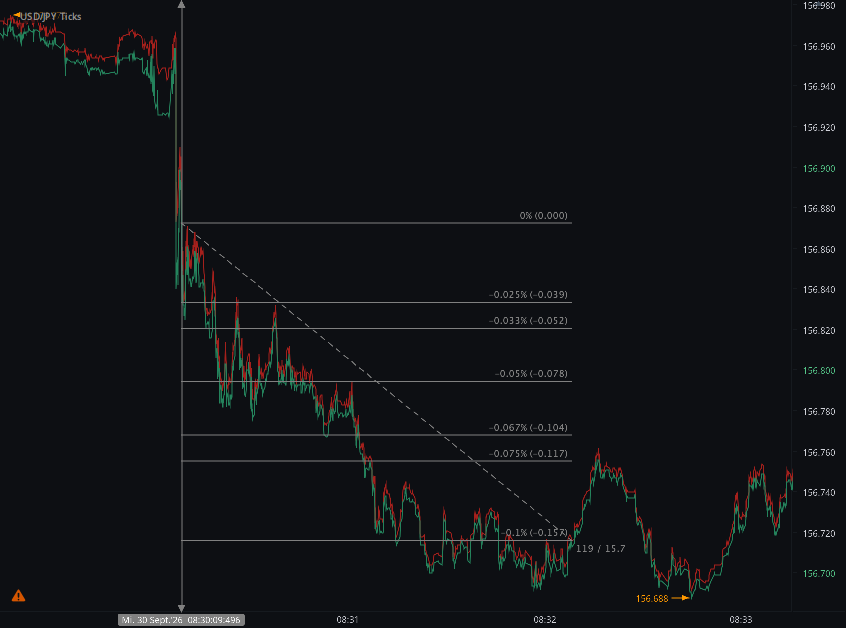
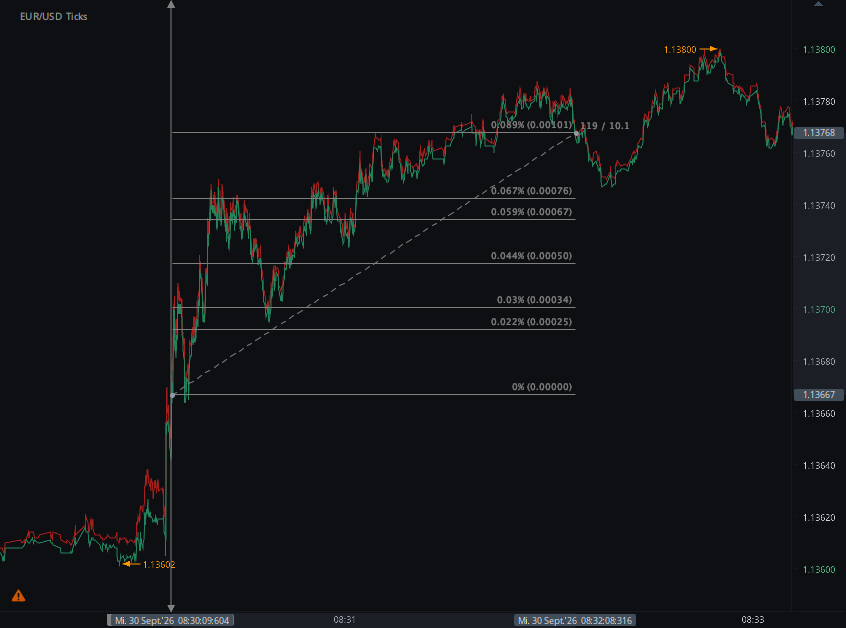
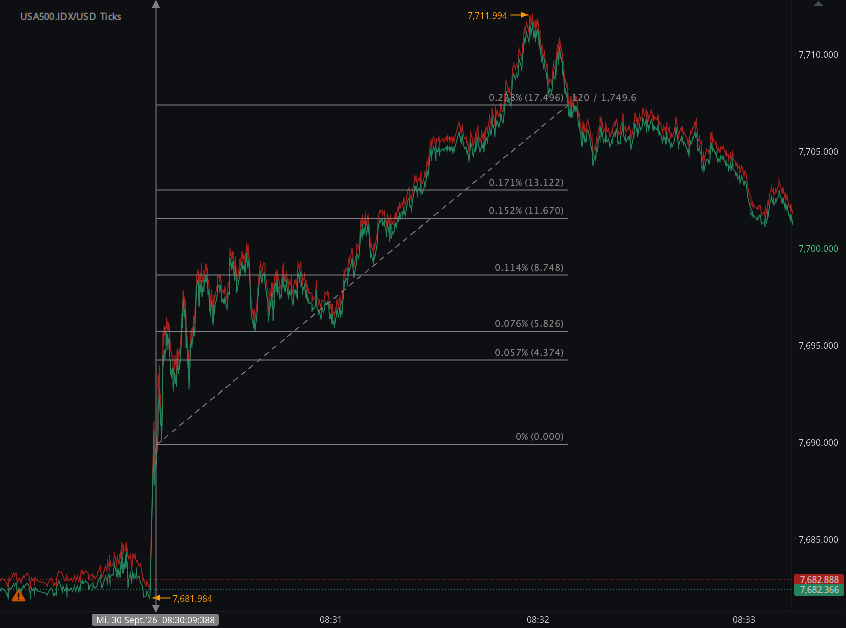
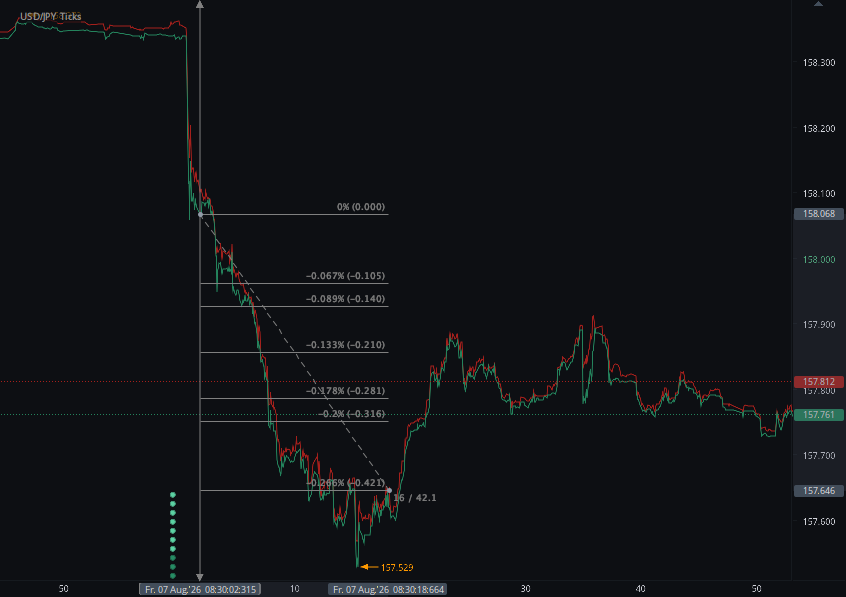
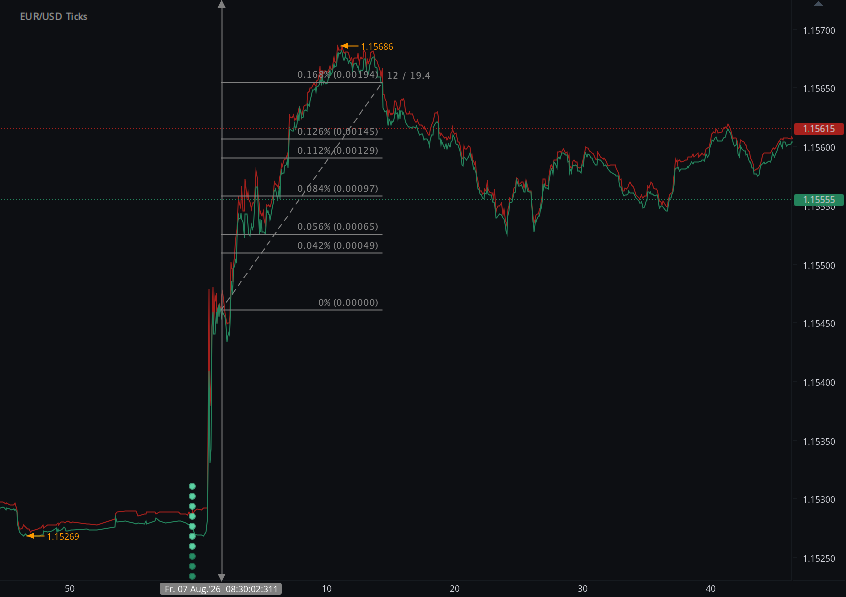
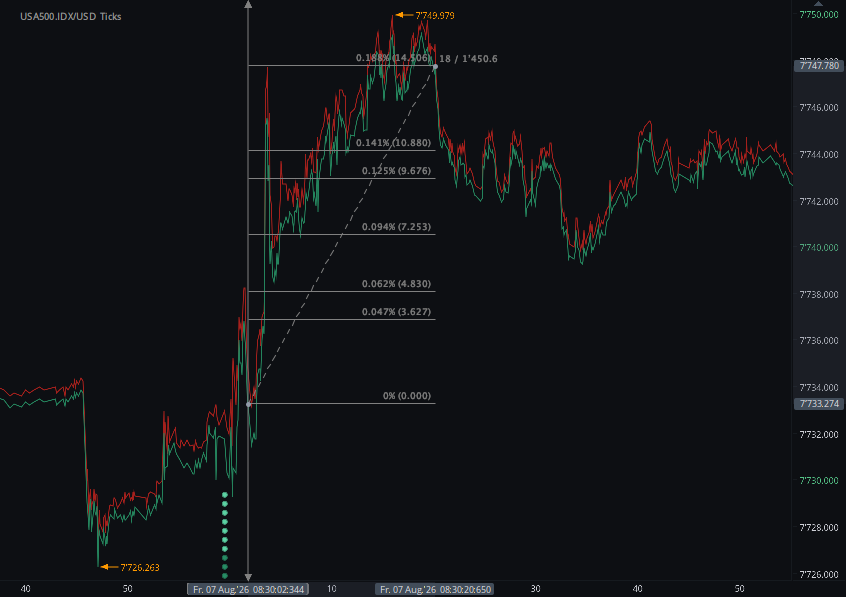
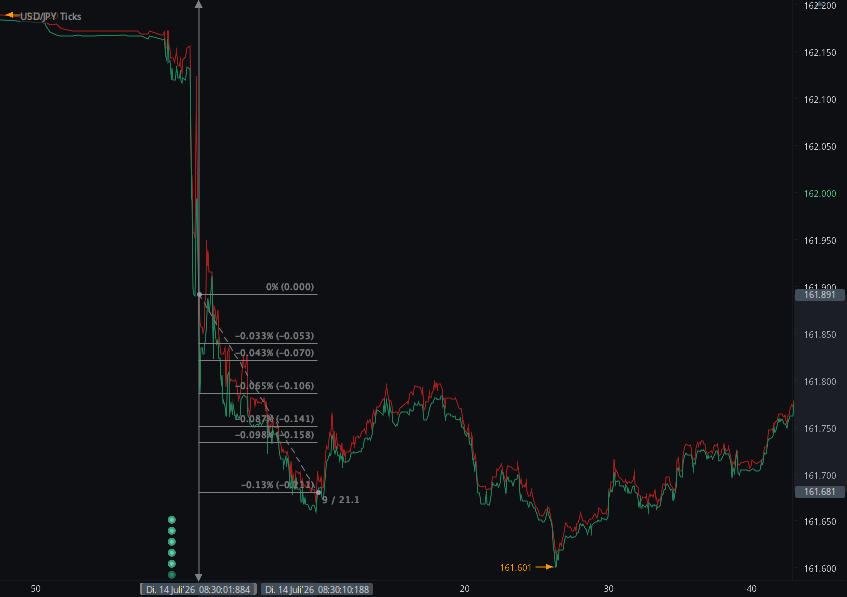
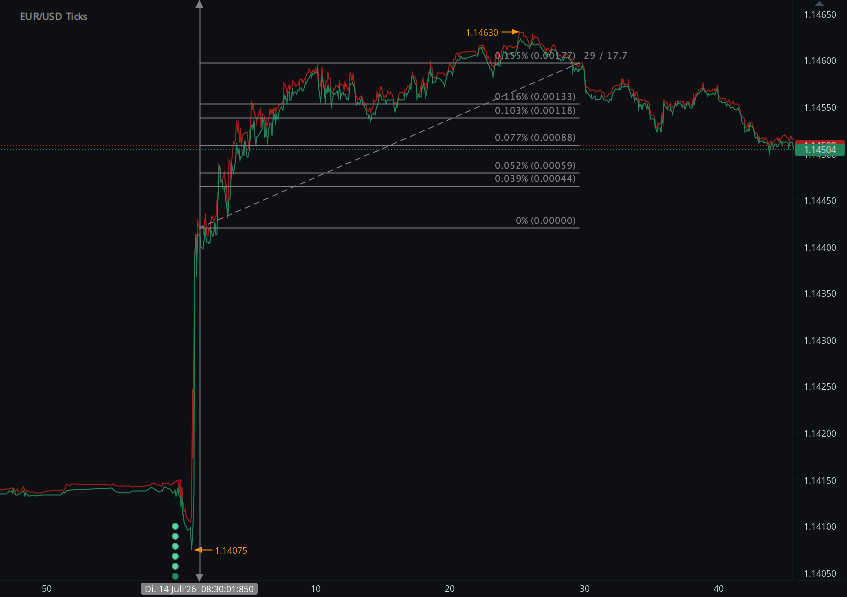
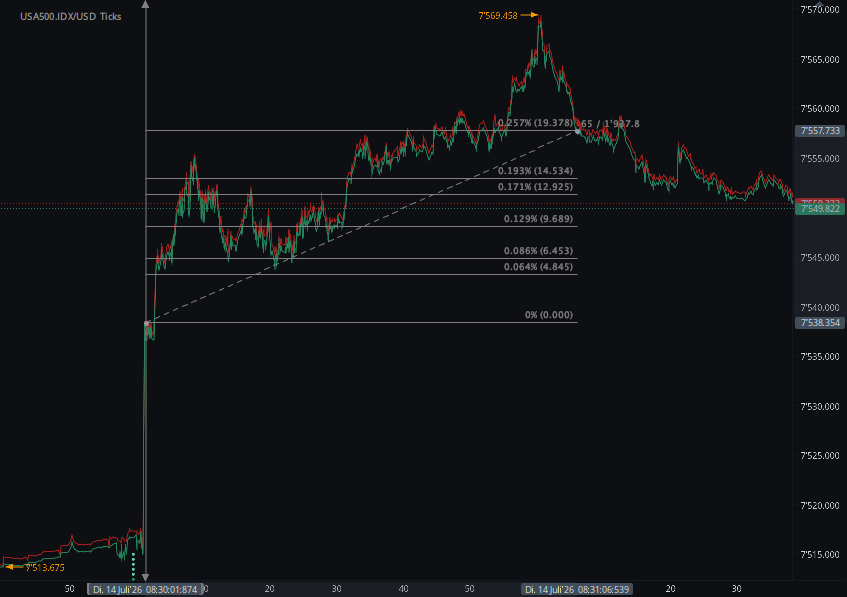
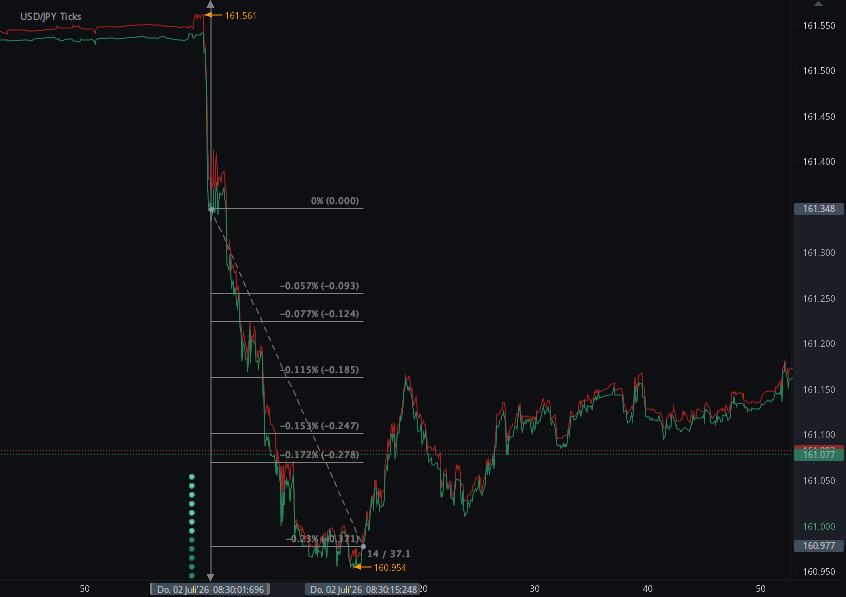
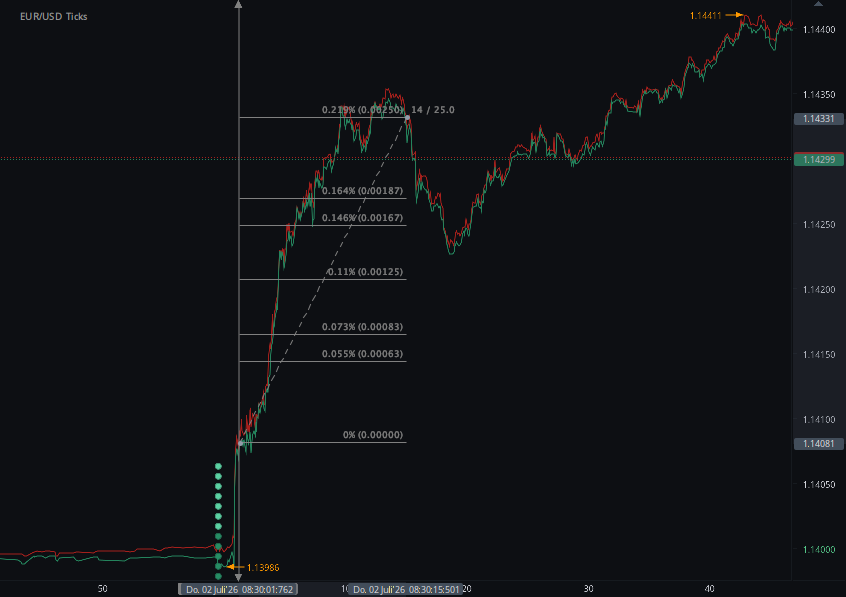
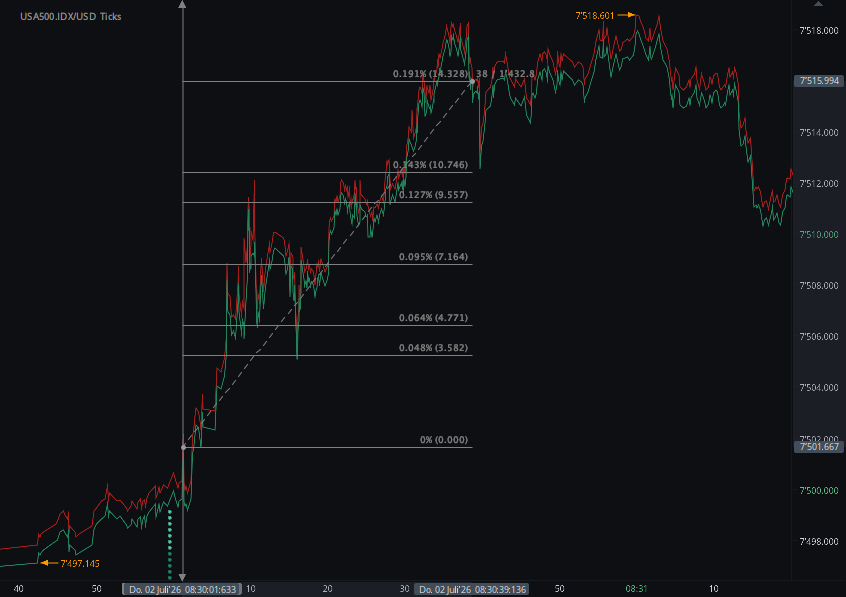
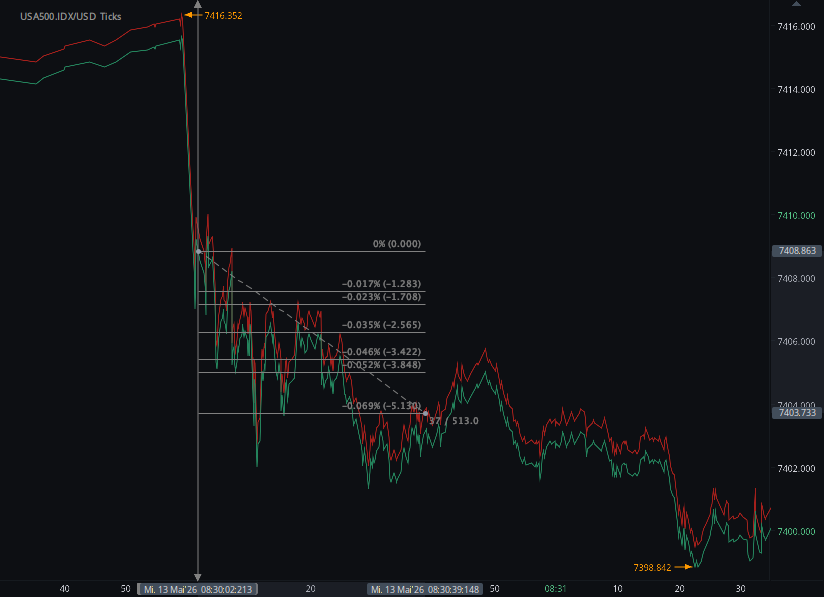
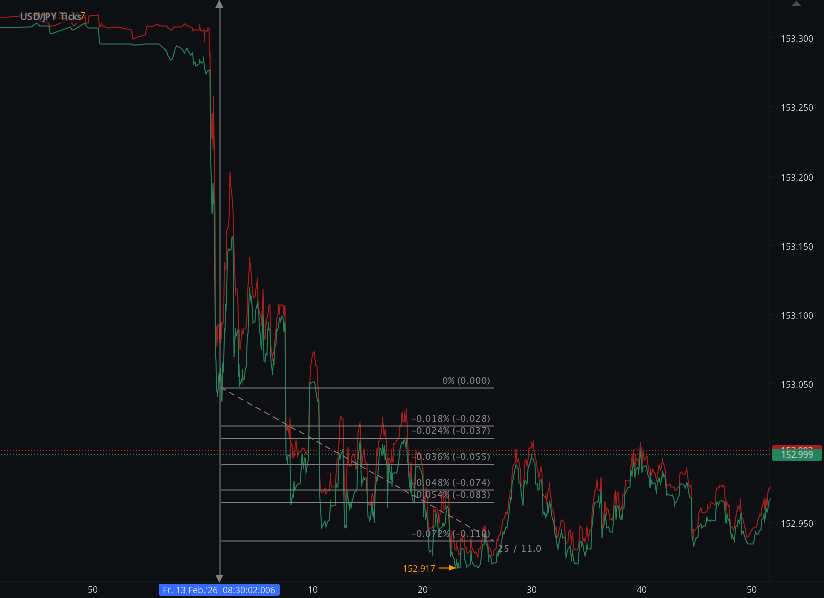
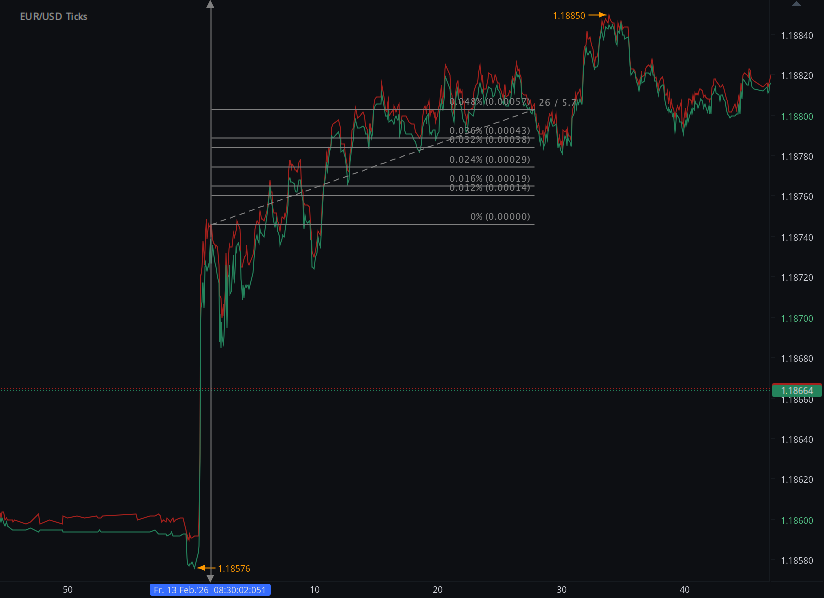
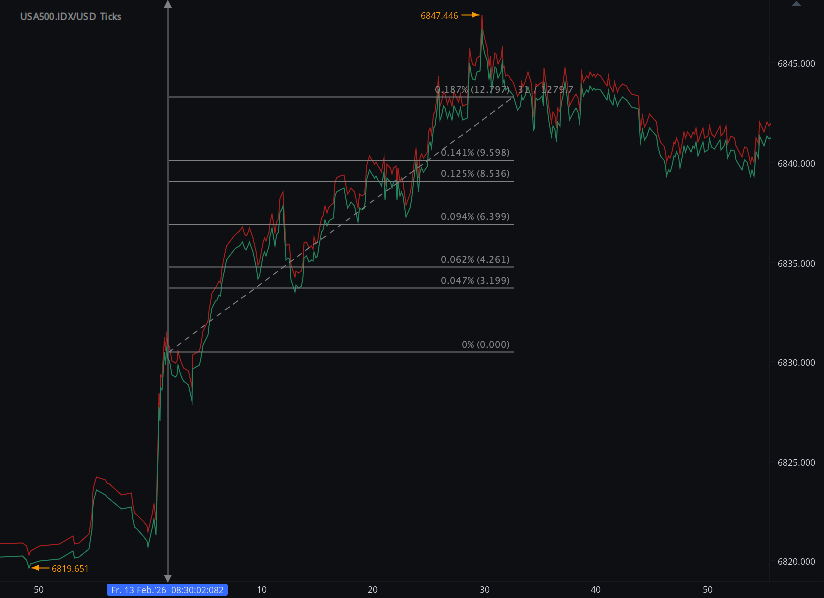
16 pips, US500 12 points points potential profit in 31 seconds on 13 February 2026, analysis on futures forex fx low latency news trading USDJPY, EURUSD and US500 on US Consumer Price Index (CPI)

According to our analysis USDJPY and EURUSD moved 16 pips and US500 moved 12 points on US BLS Consumer Price Index (CPI) data on 13 February 2026.

USDJPY (11 pips)

EURUSD (5 pips)

US500 (12 points)

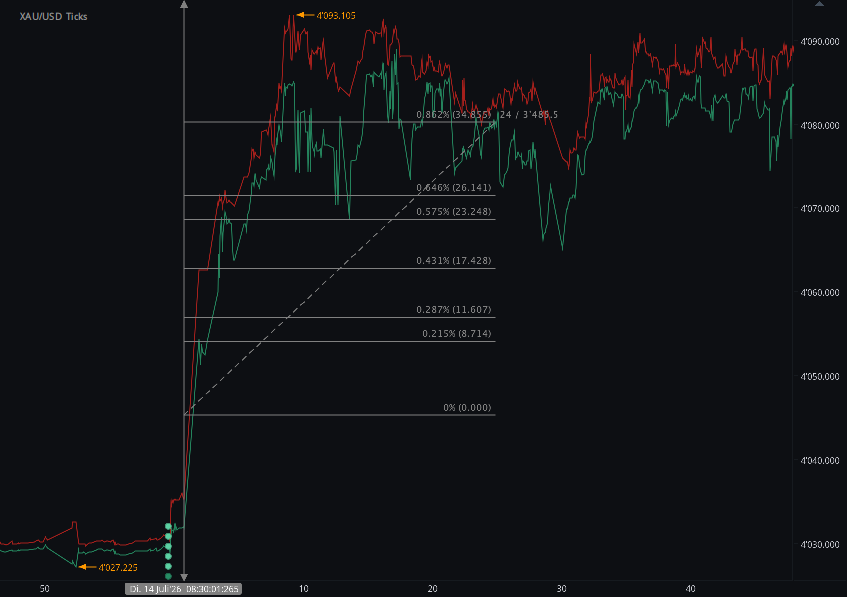
Charts are exported from JForex (Dukascopy).


Inflation Cools Further in January 2026 as Energy Prices Fall

The latest data from the U.S. Bureau of Labor Statistics show that inflation continued to moderate in January 2026, with overall price growth easing on both a monthly and annual basis.

Headline Inflation: Modest Monthly Increase

The Consumer Price Index for All Urban Consumers (CPI-U) rose 0.2 percent in January (seasonally adjusted). Over the past 12 months, prices increased 2.4 percent, down from 2.7 percent in December.

This marks continued progress toward price stability, with year-over-year inflation now firmly in the mid-2 percent range.

What Drove January’s Increase?

Several categories contributed to the monthly increase:

  • Shelter: +0.2%

  • Food: +0.2%

  • Core inflation (all items less food and energy): +0.3%

However, falling energy prices helped offset some of the upward pressure.

Energy Prices: A Key Relief Factor

Energy prices declined 1.5 percent in January, providing a notable offset to increases elsewhere.

  • Gasoline: −3.2% (−7.5% over the past year)

  • Electricity: −0.1% (but +6.3% over the past year)

  • Natural gas: +1.0% (+9.8% over the past year)

Over the last 12 months, overall energy prices are down 0.1 percent, largely due to the steep annual decline in gasoline.

Food Prices: Gradual but Persistent Growth

Food prices increased 0.2 percent in January.

Grocery Prices (Food at Home): +0.2%

Five of six major grocery categories rose:

  • Cereals and bakery products: +1.2%

  • Dairy products: +0.8%

  • Meats, poultry, fish, and eggs: +0.2%

  • Fruits and vegetables: +0.1%

  • Nonalcoholic beverages: +0.1%

On a 12-month basis, grocery prices are up 2.1 percent.

Dining Out (Food Away from Home): +0.1%

Restaurant prices rose more modestly in January but are still up 4.0 percent over the past year, with:

  • Full service meals: +4.7%

  • Limited service meals: +3.2%

Restaurant inflation continues to outpace grocery inflation.

Core Inflation: Services Still Firm

Core CPI (excluding food and energy) rose 0.3 percent in January and is up 2.5 percent year-over-year.

Key contributors:

Shelter

  • +0.2% in January

  • +3.0% over the past year

Owners’ equivalent rent and rent both rose 0.2% for the month.

Transportation Services

  • +1.4% in January

  • Airline fares surged 6.5% for the month.

Medical Care

  • +0.3% in January

  • +3.9% over the past year

  • Hospital services: +0.9% in January

Used Cars

  • −1.8% in January

  • −2.0% over the past year

Vehicle prices continue to normalize after earlier volatility.

Big Picture: Inflation Is Cooling, But Not Gone

Here’s where inflation stands:

Category12-Month ChangeAll Items2.4%Core (less food & energy)2.5%Food2.9%Energy−0.1%Shelter3.0%

The overall trend shows:

  • Energy prices helping moderate inflation.

  • Core services (especially shelter and medical care) continuing to rise.

  • Restaurant inflation remaining elevated.

  • Goods prices (like used vehicles) generally softening.

Additional Notes

  • The CPI index level now stands at 325.252 (1982–84 = 100).

  • CPI-W (Urban Wage Earners and Clerical Workers) rose 2.2% year-over-year.

  • The Chained CPI (C-CPI-U) increased 2.2% year-over-year.

  • October and November 2025 data were unavailable due to the 2025 lapse in appropriations.

  • Seasonal adjustment factors were revised, affecting data back five years.

What to Watch Next

The February 2026 CPI report will be released on March 11, 2026.

Markets and policymakers will be watching closely to see:

  • Whether energy continues to ease pressure,

  • If shelter inflation continues to moderate,

  • And whether core services remain sticky.

For now, January’s data suggest inflation is gradually stabilizing, though certain categories—particularly services—remain areas of persistent upward pressure.

Disclaimer: This blog post is for informational purposes only and should not be construed as financial advice. Always conduct thorough research and consider seeking advice from a financial professional before making any investment decisions.

Source: https://www.bls.gov/news.release/cpi.nr0.htm


Start futures forex fx news trading with Haawks G4A low latency machine-readable data, one of the fastest machine-readable news trading feed for US macro-economic and commodity data.

Please let us know your feedback. If you are interested in timestamps, please send us an email to sales@haawks.com.

Comment

Comment

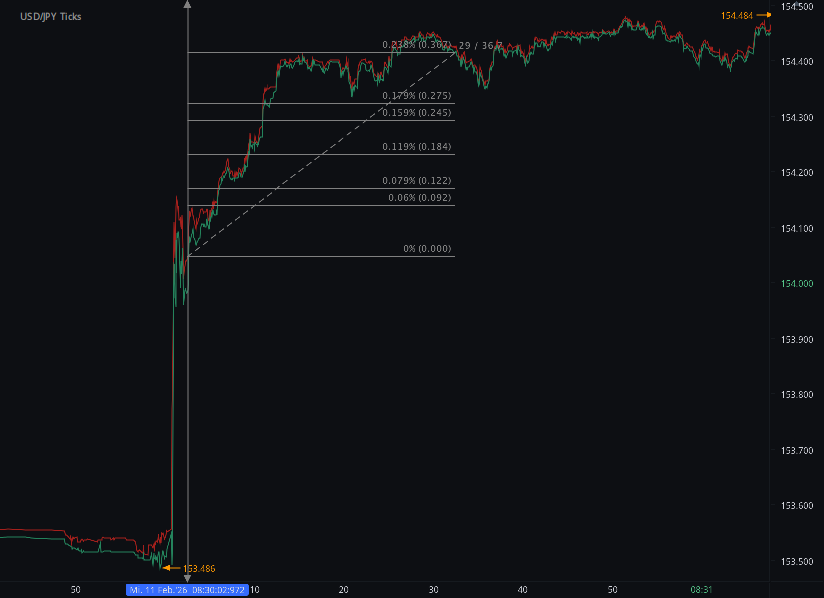
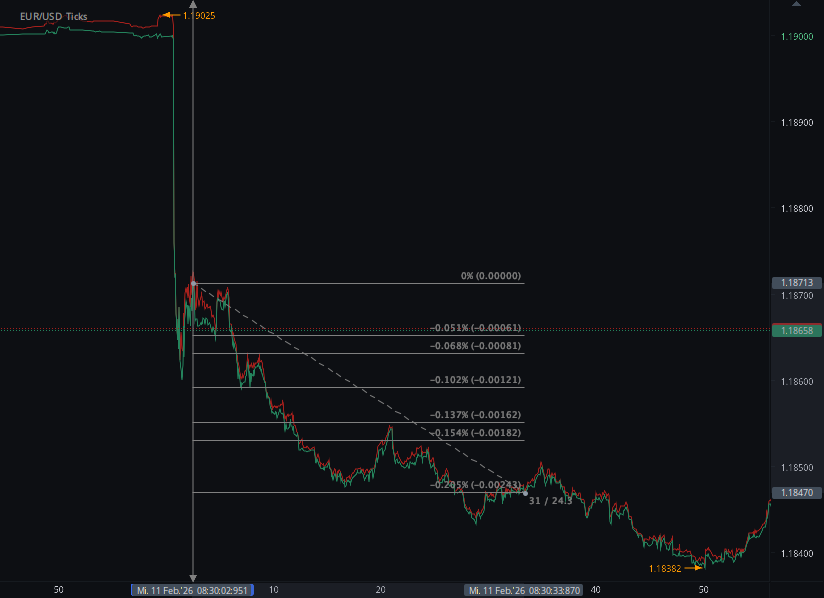
60 pips potential profit in 31 seconds on 11 February 2026, analysis on forex fx futures news trading USDJPY and EURUSD on US Employment Situation (NFP)

According to our analysis USDJPY and EURUSD moved 60 pips on US Employment Situation (Non-farm payrolls / NFP) data on 11 February 2026.

USDJPY (36 pips)

EURUSD (24 pips)

Charts are exported from JForex (Dukascopy).


U.S. Jobs Report – January 2026

Payrolls Rise by 130,000; Unemployment Rate Steady at 4.3%

The latest Employment Situation report from the U.S. Bureau of Labor Statistics shows a modest start to 2026. In January, total nonfarm payroll employment increased by 130,000 jobs, while the unemployment rate held steady at 4.3%.

Here’s what the numbers reveal about the current state of the labor market.

The Big Picture

  • 130,000 jobs added in January

  • Unemployment rate: 4.3% (unchanged)

  • Average hourly earnings: Up 0.4% to $37.17

  • Year-over-year wage growth: 3.7%

  • Labor force participation rate: 62.5% (little change)

While job growth continues, it remains moderate compared with historical expansion periods. The unemployment rate is slightly higher than a year ago (4.0% in January 2025), suggesting some cooling compared to last year.

Where Jobs Are Growing

Health Care Leads

Health care added 82,000 jobs in January:

  • +50,000 in ambulatory health care services

  • +18,000 in hospitals

  • +13,000 in nursing and residential care facilities

Health care averaged 33,000 jobs per month in 2025, making January’s increase notably strong.

Social Assistance Expands

Employment in social assistance rose by 42,000 jobs, primarily in individual and family services, reflecting continued demand for community-based support services.

Construction Rebounds

Construction added 33,000 jobs, largely in nonresidential specialty trade contractors (+25,000). After being essentially flat in 2025, the sector showed renewed momentum in January.

Sectors Losing Jobs

Not all industries expanded:

  • Federal government employment declined by 34,000, continuing a downward trend that began after a peak in October 2024. Since then, federal payrolls are down 327,000 jobs (−10.9%).

  • Financial activities fell by 22,000 jobs, including losses in insurance carriers.

These declines partially offset gains in health care and construction.

Household Survey Highlights

The household survey shows a largely stable labor market:

  • 7.4 million unemployed Americans

  • Long-term unemployed (27+ weeks): 1.8 million

  • Long-term unemployed account for 25% of all unemployed

Teen unemployment declined to 13.6%, while unemployment rates for adult men (3.8%), adult women (4.0%), and major racial and ethnic groups were largely unchanged.

The number of people working part time for economic reasons fell by 453,000 in January, though it remains higher than a year ago.

Wages and Hours

Wage growth remains steady:

  • Average hourly earnings: $37.17

  • Up 15 cents (0.4%) in January

  • Up 3.7% over the past year

For production and nonsupervisory workers:

  • $31.95 per hour

  • Also up 0.4% over the month

The average workweek edged up to 34.3 hours, suggesting stable labor demand.

Revisions and Benchmarking

The January release includes annual benchmark revisions:

  • March 2025 total nonfarm employment was revised down by 898,000 (seasonally adjusted).

  • 2025 job growth was revised from +584,000 to +181,000.

These revisions reflect updated payroll data from unemployment insurance records and improved seasonal adjustments — a standard statistical process designed to enhance accuracy.

Weather Impact?

Major winter storms affected large parts of the country in January. According to the BLS, they had no discernible impact on national payroll employment or unemployment rates, though survey response rates were slightly below average.

What This Means

January’s report shows:

  • Continued but moderate job growth

  • Stable unemployment

  • Solid wage gains

  • Sector-specific strength in health care and services

  • Ongoing weakness in federal government and financial activities

Overall, the labor market remains resilient but is expanding at a measured pace. The next Employment Situation report, due in early March, will provide further insight into whether this steady trend continues.

Disclaimer: This blog post is for informational purposes only and should not be construed as financial advice. Always conduct thorough research and consider seeking advice from a financial professional before making any investment decisions.

Source: https://www.bls.gov/news.release/empsit.nr0.htm


Start forex fx futures news trading with Haawks G4A low latency machine-readable data today, one of the fastest news data feeds for US macro-economic and commodity data.

Please let us know your feedback. If you are interested in timestamps, please send us an email to sales@haawks.com.

Comment

Comment

5 pips, US500 13 points, BTC 177 points potential profit in 62 seconds on 13 January 2026, analysis on futures forex fx low latency news trading EURUSD, US500 and BTC on US CPI

According to our analysis EURUSD moved 5 pips, US500 moved 13 points and BTC moved 177 points on US BLS Consumer Price Index (CPI) data on 13 January 2026.

EURUSD (5 pips)

US500 (13 points)

BTC (177 points)

Charts are exported from JForex (Dukascopy).


Inflation Ends 2025 Steady: What the December CPI Report Tells Us

The latest Consumer Price Index (CPI) report from the U.S. Bureau of Labor Statistics offers a clear snapshot of how inflation wrapped up 2025—and what it means for households heading into the new year.

Released on January 13, 2026, the report shows that inflation remains moderate but persistent, with price pressures still concentrated in essentials like housing, food, and certain services.

Headline Numbers at a Glance

  • Monthly CPI (December 2025): +0.3% (seasonally adjusted)

  • 12-month inflation rate: 2.7%, unchanged from November

  • Core inflation (excluding food & energy): 2.6% year over year

These figures suggest inflation is no longer accelerating, but it also hasn’t fully cooled back to pre-pandemic norms.

Housing: Still the Biggest Driver

Shelter costs were once again the largest contributor to December’s increase:

  • Shelter index: +0.4% in December

  • 12-month shelter inflation: +3.2%

Rent and owners’ equivalent rent both rose, while lodging away from home jumped sharply (+2.9% for the month). Housing remains the stickiest part of inflation—and the hardest for consumers to avoid.

Food Prices Pick Up Speed

Food prices rose faster than overall inflation in December:

  • Food (overall): +0.7% in December

  • Food at home: +2.4% year over year

  • Food away from home: +4.1% year over year

Notable details:

  • Grocery staples like dairy, cereals, fruits, and vegetables all increased.

  • Egg prices fell sharply (-8.2%), offering rare relief.

  • Restaurant prices continue to climb, especially for full-service meals.

For many households, food remains one of the most noticeable inflation pressures.

Energy: Mixed Signals

Energy prices edged higher overall, but the details matter:

  • Energy index: +0.3% in December, +2.3% over the year

  • Gasoline: -0.5% in December, -3.4% year over year

  • Electricity: +6.7% year over year

  • Natural gas: +10.8% year over year

Drivers benefited from cheaper gasoline, but utility bills—especially heating—continued to rise.

Services Inflation Remains Firm

Core services showed broad-based increases:

  • Medical care: +0.4% in December, +3.2% year over year

  • Recreation: +1.2% in December (largest monthly jump on record)

  • Airline fares: +5.2% in December

  • Personal care & education: continued steady increases

On the flip side:

  • Used cars and trucks: -1.1% in December

  • Communication services: -1.9%

What This Means for 2026

As 2025 closed:

  • Inflation appears stable, not surging—but not fully subdued.

  • Housing and services remain the key inflation risks.

  • Goods inflation (like vehicles and gasoline) continues to ease.

With the January 2026 CPI report scheduled for February 11, 2026, policymakers and consumers alike will be watching closely to see whether inflation finally drifts closer to the Federal Reserve’s long-term comfort zone.

Bottom Line

Inflation ended 2025 steady but uneven. While energy and goods offered some relief, everyday essentials—housing, food, and services—kept upward pressure on household budgets. The battle against inflation isn’t over, but it’s no longer spiraling out of control either.

Disclaimer: This blog post is for informational purposes only and should not be construed as financial advice. Always conduct thorough research and consider seeking advice from a financial professional before making any investment decisions.

Source: https://www.bls.gov/news.release/cpi.nr0.htm


Start futures forex fx news trading with Haawks G4A low latency machine-readable data, one of the fastest machine-readable news trading feed for US macro-economic and commodity data.

Please let us know your feedback. If you are interested in timestamps, please send us an email to sales@haawks.com.

Comment

Comment

12 pips, US500 6 points, BTC 678 points potential profit in 43 seconds on 18 December 2025, analysis on futures forex fx news trading EURUSD, US500 and BTC on US CPI and US Jobless Claims data

According to our analysis EURUSD moved 12 pips and US500 moved 6 points and BTC 678 points on US CPI and US Jobless Claims data on 18 December 2025.

EURUSD (12 points)

US500 (6 points)

BTC (678 points)

Charts are exported from JForex (Dukascopy).


Unemployment Claims, CPI, and the Macro Signal Going into 2026
A more technical read on the December 18, 2025 UI & CPI releases

The December 18, 2025 data dump gives us a fairly coherent macro picture:

  • Labor market: still tight by historical standards, with some sectoral and regional softening but no broad deterioration.

  • Inflation: headline and core running in the high-2% range, drifting down from 3%, with housing and services still doing most of the work on the “sticky” side.

Below is a more policy-wonk breakdown of what these releases are actually saying.

1. Labor Market: Claims Still at “Expansion” Levels

1.1 Initial claims: well within “normal” range

  • Initial claims (SA), week ending Dec 13:

    • 224k (-13k w/w from a revised 237k).

    • 4-week moving average: 217.5k (+0.5k).

In a labor force north of 165–170 million, claims in the low 200k range are typically associated with continuing expansion, not recession onset. This is consistent with past cycles where recessionary conditions usually show up with claims closer to 300k+ and/or a persistently rising 4-week average.

The November 29 print at 192k now looks like a bit of an outlier to the low side, and the December 6 spike to 237k looks like noise rather than the start of a trend.

1.2 Continued claims and IUR: mild firming, but no spike

  • Insured unemployment (SA), week ending Dec 6:

    • 1.897 million (+67k w/w from a revised 1.83 million).

    • Insured unemployment rate (IUR): 1.2% (unchanged).

    • 4-week average: 1.902 million (-14k).

Insured unemployment is oscillating in a pretty narrow band: 1.83–1.95 million over much of 2025. The fact that the IUR is flat at 1.2% while levels move around is a reminder that this is mostly noise around a tight steady state, not a structural shift.

You also see divergence between SA and NSA:

  • NSA insured unemployment: 1.88 million (week of Dec 6), down 75k w/w, rate down from 1.3% to 1.2%.

  • Seasonal factors had expected a larger decline, so relative to expectations, the labor market is slightly weaker than the NSA drop alone suggests—but not dramatically.

1.3 State-level patterns: sectoral and regional pockets

Highest insured unemployment rates (week ending Nov 29):

  • Washington 2.5%, New Jersey 2.4%, California 2.3%, Minnesota 2.2%, Massachusetts 2.1%, and Puerto Rico / Rhode Island 2.0%, with Alaska, Oregon 1.9% and Nevada, New York 1.8% close behind.

This is a familiar pattern: elevated IUR in states with:

  • Higher exposure to tech / services / high-wage sectors (CA, WA, MA).

  • Historically higher baseline UI recipiency rates and more generous programs (NJ, RI).

  • Structural or cyclical sectoral exposure (e.g., construction and logistics on the West Coast).

For the week ending Dec 6, the largest NSA increases in initial claims were:

  • CA +14,258

  • IL +11,074

  • NY +10,346

  • TX +8,206

  • GA +6,333

State comments attribute this largely to layoffs in construction, manufacturing, transportation/warehousing, and admin/support/waste management plus some health care and accommodation/food services.

Policy-relevant point: These look like sectoral adjustments, not broad-based, demand-driven layoffs. Construction and manufacturing are classic late-cycle cyclicals; seeing choppiness here doesn’t, on its own, scream “recession.”

1.4 Federal programs and total UI usage

On a not-seasonally adjusted basis:

  • Total continued weeks claimed in all programs, week ending Nov 29:

    • 1,993,823 (up 262,500 w/w; versus 1,960,319 a year earlier).

  • Extended Benefits (EB) is basically inactive:

    • Only 9 continued weeks claimed, and no state is triggered “on” EB.

  • STC/workshare: ~22.7k continued weeks, slightly below the prior year’s 23.2k.

From a macro/financial-stability lens, the fact that EB is not triggered anywhere is a strong indicator that labor market weakness is not yet systemic.

2. Inflation: A Controlled Downshift toward 2–3%

2.1 Headline vs. core

For November 2025 (12-month changes):

  • All items CPI-U: +2.7% (down from +3.0% for 12 months ending September).

  • Core CPI (all items less food and energy): +2.6%.

From September to November (2-month SA changes, because October is missing):

  • Headline CPI: +0.2% total over 2 months.

  • Core CPI: +0.2% over the same period.

  • Shelter: +0.2% over 2 months.

  • Energy: +1.1%, food: +0.1% (both over 2 months).

If you roughly annualize that 2-month +0.2% move, you’re getting something in the ballpark of 1–2% annualized, i.e., softer than the 12-month headline figure. You don’t want to over-interpret two months (especially with a measurement gap), but the direction is clearly disinflationary.

2.2 Shutdown-related measurement caveat

BLS did not collect survey data for October 2025 due to a lapse in appropriations, and could only retroactively acquire most non-survey data.

Implications:

  • Standard month-over-month time-series analysis is noisier than usual.

  • The 2-month percent changes (September–November) are a workaround, not a model change.

  • 12-month figures (e.g., +2.7% headline, +2.6% core) still serve as the main anchor for trend inflation.

For policy analysis, you basically discount very fine-grained inferences about October but still treat the broader trajectory as valid.

2.3 Decomposing headline inflation

Food (12-month changes):

  • Food overall: +2.6%

    • Food at home: +1.9%

      • Meats/poultry/fish/eggs: +4.7%

      • Nonalcoholic beverages: +4.3%

      • Cereals/bakery: +1.9%

      • Fruits/vegetables: +0.1%

      • Dairy and related products: -1.6%

    • Food away from home: +3.7%

      • Full-service meals: +4.3%

      • Limited service: +3.0%

Interpretation:

  • Grocery inflation is sub-3% and clustered mostly around protein and beverages.

  • Restaurant inflation remains notably hotter than food-at-home, reflecting labor and overhead costs—a classic “services stickiness” story.

Energy (12-month changes):

  • Energy overall: +4.2%

    • Gasoline: +0.9%

    • Fuel oil: +11.3%

    • Electricity: +6.9%

    • Utility (piped) gas: +9.1%

So energy is still a positive contributor, but the gasoline component is comparatively mild; the bigger story is household energy (utilities and fuel oil), both of which have direct cost-of-living and political salience.

Core components (12-month):

  • Core CPI: +2.6%

    • Shelter: +3.0%

    • Services less energy: +3.0%

    • Used cars and trucks: +3.6%

    • Household furnishings/operations: +4.6%

    • Medical care services: +3.3%

This is a services-heavy inflation profile with goods not doing much damage except in a handful of categories (used vehicles, furnishings). The shelter component is still running above 2%, but at levels much closer to pre-pandemic “normal high” than the 6–8% rates seen in the earlier inflation spike.

3. Policy Implications

3.1 Monetary policy: This is what “orderly disinflation” looks like

From a central bank perspective, this combination is about as close as you get to “soft landing” conditions:

  • Inflation has drifted down from 3.0% to 2.7%, with core at 2.6%, i.e., slightly above typical 2% targets but trending down.

  • Labor market is still tight: low initial claims, low insured unemployment, no EB triggers, and only modest increases in continued claims.

Key angles for policymakers:

  1. Output gap / NAIRU context

    • Claims and IUR at these levels are not consistent with a large positive unemployment gap. Labor markets still appear close to or slightly above most estimates of NAIRU.

    • Yet, inflation is not accelerating; it’s easing, which reinforces the idea that the post-pandemic inflation burst may have been driven more by supply shocks and sectoral imbalances than by persistent overheating alone.

  2. Wage-price dynamics

    • With services inflation still around 3% and restaurant prices up 3–4% YoY, underlying wage growth is likely still above 2–2.5%, but not clearly incompatible with a medium-term glide path to 2%.

    • The Fed will view the moderation in goods inflation and slowing shelter inflation as evidence that pass-through from earlier cost shocks is fading.

  3. Risk balance for rate decisions

    • Data like this tends to lower the urgency of further tightening.

    • It does not yet justify aggressive easing, given that core is still above target and services/shelter remain sticky.

    • Translation: it’s the kind of setup that supports a “hold for longer, cut cautiously later” stance rather than “hike again” or “slash now.”

3.2 Fiscal & labor-market policy: No crisis, but some micro hot spots

From a fiscal / labor-programs lens:

  • No sign of a UI-driven emergency:

    • EB is off everywhere.

    • Total UI usage is up only modestly year-over-year.

  • Sectoral and regional shocks are present:

    • Concentrated in construction, manufacturing, transportation/warehousing, and some services.

    • These are classic cases where targeted adjustment assistance, retraining, or infrastructure/green capex could absorb displaced workers rather than broad UI expansions.

The high IUR in states like WA, CA, NJ, MA, and OR suggests watching:

  • Tech and high-skill services exposure.

  • Local housing and cost-of-living issues that interact with labor mobility.

But nothing in the data screams “we’re about to blow through automatic stabilizers and need emergency discretionary intervention.”

3.3 Distributional and political economy angles

  • Shelter and utilities are still rising faster than headline, which hits renters and lower-income households hardest.

  • Food-at-home inflation is manageable, but restaurant prices remain elevated—visible to households and politically salient.

  • The shutdown-driven data gaps will likely become part of the “governance risk” discussion: if recurring shutdowns degrade data quality, it complicates real-time macro management.

4. How to Read This Going Forward

If you’re thinking about these releases in a policy-wonk framework, a few takeaways:

  • Trend inflation: High-2% and drifting down, not stuck in a 4–5% range.

  • Labor market: Still tight, but with normal late-cycle churn concentrated in cyclical sectors.

  • Policy stance: Data-dependent central bank can credibly stay on hold, lean dovish later if this disinflation trend persists, without immediate pressure to either re-tighten or pivot hard.

Disclaimer: This blog post is for informational purposes only and should not be construed as financial advice. Always conduct thorough research and consider seeking advice from a financial professional before making any investment decisions.

Source: https://www.dol.gov/ui/data.pdf, https://www.bls.gov/news.release/cpi.nr0.htm


Please let us know your feedback. If you are interested in timestamps, please send us an email to sales@haawks.com.

Start futures forex fx news trading with Haawks G4A low latency machine-readable data today, one of the fastest news data feeds for US macro-economic and commodity data.

Comment

Comment

45 pips potential profit in 48 seconds on 10 December 2025, analysis on futures forex fx low latency news trading USDJPY and EURUSD on FOMC Interest Rate Decision data

According to our analysis USDJPY and EURUSD moved 45 pips on FOMC Interest Rate Decision and Projections data on 10 December 2025.

USDJPY (26 pips)

EURUSD (19 pips)

Charts are exported from JForex (Dukascopy).


The Fed Just Cut Rates: What the December 2025 Decision Really Means

On December 10, 2025, the Federal Reserve did something markets had been debating for months: it cut interest rates again.

The Federal Open Market Committee (FOMC) lowered the target range for the federal funds rate by 0.25 percentage point, to 3.50–3.75%, and released a fresh set of economic projections that stretch out to 2028. Alongside that, they gave us a pretty clear message:

Growth looks okay, inflation is still a bit too high, the labor market is softening, and the risks around the outlook are uncomfortably elevated.

Let’s unpack what was just announced, what the Fed is signaling about the future, and why the internal disagreements on the Committee really matter this time.

1. The Big Move: A 25bp Cut with Rising Concerns

The FOMC statement paints an economy that’s still growing, but more fragile:

  • “Economic activity has been expanding at a moderate pace.”

  • Job gains have slowed, and unemployment has edged up through September.

  • Inflation has moved up since earlier in the year and “remains somewhat elevated.”

Despite that uptick in inflation, the Fed chose to ease policy:

“The Committee decided to lower the target range for the federal funds rate by 1/4 percentage point to 3-1/2 to 3-3/4 percent.”

Why cut when inflation is higher than earlier in the year?
Because the Fed is increasingly worried about the downside risks to employment. The statement explicitly notes that downside risks to employment have risen in recent months, and that’s a big shift in emphasis. The Fed’s dual mandate (maximum employment and price stability) is now facing pressure from both sides at once.

2. The New Forecasts: Slightly Stronger Growth, Gradual Disinflation

The Summary of Economic Projections (SEP) lays out the Fed participants’ median forecasts for the economy from 2025–2028.

Real GDP Growth (Q4/Q4)

Median forecast:

  • 2025: 1.7%

  • 2026: 2.3%

  • 2027: 2.0%

  • 2028: 1.9%

  • Longer run: 1.8%

Compared with the September projections, growth is now expected to be a touch stronger in 2026 and 2027. The story: a soft-ish landing narrative is still alive—modest growth now, slightly firmer growth later, then easing back to the long-run trend.

Unemployment Rate (Q4 average)

Median forecast:

  • 2025: 4.5%

  • 2026: 4.4%

  • 2027: 4.2%

  • 2028: 4.2%

  • Longer run: 4.2%

Unemployment is projected to stay above the pre-pandemic lows and settle around what the Fed views as its longer-run normal. Compared to September, changes are small, but the message is that the labor market is no longer “red hot”—it’s moving closer to equilibrium, but with heightened risk it could weaken more than desired.

Inflation: PCE and Core PCE

Headline PCE inflation (Q4/Q4):

  • 2025: 2.9%

  • 2026: 2.4%

  • 2027: 2.1%

  • 2028: 2.0%

  • Longer run: 2.0%

Core PCE (excluding food & energy):

  • 2025: 3.0%

  • 2026: 2.5%

  • 2027: 2.1%

  • 2028: 2.0%

The Fed still expects a gradual glide path back to 2%, but:

  • Inflation in 2025 is now seen just a bit lower than September for headline (2.9% vs 3.0) and core (3.0% vs 3.1),

  • The journey back to 2% is long and uncertain, with inflation staying above target through 2026.

Put simply:

The Fed thinks inflation is heading in the right direction, but not fast enough to declare victory.

3. The Rate Path: Lower Now, but Still “Higher-for-Longer” Compared to Pre-2020

The “dot plot” (Figure 2 and the memo line in Table 1) shows where participants think the federal funds rate will be at year-end.

Median projected fed funds rate:

  • 2025: 3.6%

  • 2026: 3.4%

  • 2027: 3.1%

  • 2028: 3.1%

  • Longer run: 3.0%

Key takeaways:

  • The 2025 median is unchanged from September at 3.6%, even though the Fed has just cut to 3.5–3.75%. That implies only limited additional easing is currently envisioned for 2025.

  • Beyond 2025, rates are expected to drift lower but not plunge.

  • The longer-run neutral rate is still around 3.0%—a world where “normal” interest rates are structurally higher than the near-zero era of the 2010s.

So this is not a pivot back to ultra-easy money; it’s more like:

“We’re easing off the brakes, not slamming on the gas.”

4. Internal Divisions: The First Cut with Real Dissent

This meeting featured three dissents, underscoring real disagreement about what’s appropriate right now:

  • Stephen I. Miran voted for a bigger cut, preferring a 1/2 percentage point reduction.

  • Austan D. Goolsbee and Jeffrey R. Schmid voted against the cut, preferring no change in the target range this meeting.

So within the Committee you can see three camps:

  1. Easers (Miran & likely some others quietly sympathetic): worried enough about growth and employment that they want faster easing.

  2. “Mainstream” majority: sees a 25bp cut as the right compromise between still-elevated inflation and rising downside risks to jobs.

  3. Hawks (Goolsbee, Schmid and possibly others): focused more on stubborn inflation and concerned that easing too soon could reignite price pressures.

When you see this kind of three-way split, it usually means the data are sending mixed signals and the margin for error looks uncomfortably small.

5. Balance Sheet & Reserves: Quiet but Important

One line in the statement may fly under the radar but matters for markets:

“The Committee judges that reserve balances have declined to ample levels and will initiate purchases of shorter-term Treasury securities as needed to maintain an ample supply of reserves on an ongoing basis.”

Translation:

  • The Fed thinks the banking system is now at an “ample” level of reserves.

  • To keep it that way, it’s prepared to buy short-term Treasuries as needed to avoid liquidity strains.

This is not a return to crisis-era quantitative easing; it’s more of a technical adjustment to stabilize the plumbing of the financial system. But for money markets and short-term funding, it’s a big signal of a steady, supportive backdrop.

6. Risks & Uncertainty: Elevated Across the Board

The SEP includes detailed information on how uncertain policymakers feel and which way they think risks are tilted.

A few notable patterns:

  • Uncertainty is high for GDP, unemployment, and both measures of inflation.

    • Most participants rate uncertainty as “higher” than the historical average over the last 20 years.

  • Risks to GDP growth are tilted to the downside.

    • More participants see a greater chance that growth comes in weaker rather than stronger.

  • Risks to inflation (both headline and core) are still tilted to the upside.

    • That is, there’s a meaningful probability that inflation proves stickier than forecast.

Put together, the Fed’s message is:

They’re worried about slower growth and higher unemployment, but they still don’t fully trust that inflation is conquered.

That’s why you see a cautious rate cut, not a full-on easing cycle signal.

7. What This All Means Going Forward

Here’s the big-picture read of the December 2025 Fed package:

  1. The Fed is now in a rate-cutting phase, but not a panicked one.

    • A 25bp cut with a still-elevated rate path is consistent with a fine-tuning approach.

  2. Growth is expected to remain positive, not collapse.

    • Median GDP growth picks up somewhat in 2026, suggesting the Fed is trying to engineer a soft landing, not bracing for a deep recession.

  3. Labor markets are cooling, and that’s making the Fed nervous.

    • The explicit mention that downside risks to employment have risen is notable and politically important under their dual mandate.

  4. Inflation is still above target for a while.

    • The Fed isn’t ready to declare a clean victory on inflation, which limits how aggressive they’re willing to be on cuts.

  5. Dissent shows real tension in the Committee.

    • One member wants faster easing, two wanted no easing at all. Future meetings could be lively, especially if incoming data swing unexpectedly.

8. How to Think About This as an Investor, Business, or Household

Without giving specific investment advice, here are some conceptual implications:

  • Borrowing costs may drift lower, but not crash.
    Mortgage and corporate borrowing rates are likely to ease somewhat over time, but the Fed’s longer-run rate around 3% still implies a higher interest rate world than the pre-2020 decade.

  • Growth assets vs. safe assets:
    A gentle rate-cutting path with still-positive growth tends to support risk assets, but the elevated uncertainty and inflation risks mean volatility isn’t going away.

  • Jobs outlook:
    The Fed is very focused on the labor market. If unemployment rises more quickly than forecast, the Fed could cut faster than the current dots imply—but they will be looking over their shoulder at inflation the whole time.

Final Thought

This December 2025 meeting is not a dramatic pivot; it’s a delicate adjustment in an environment where both sides of the Fed’s mandate look fragile.

The Fed is saying:

  • “We’re easing a bit to support the labor market.”

  • “We still think inflation is too high.”

  • “And honestly, we’re not very confident how this all plays out.”

In other words: welcome to the age of cautious cuts and uncomfortable uncertainty.

Disclaimer: This blog post is for informational purposes only and should not be construed as financial advice. Always conduct thorough research and consider seeking advice from a financial professional before making any investment decisions.

Source: https://www.federalreserve.gov/newsevents/pressreleases/monetary20251210a.htm, https://www.federalreserve.gov/monetarypolicy/fomcprojtabl20251210.htm


Start futures forex fx news trading with Haawks G4A low latency machine-readable data, one of the fastest machine-readable news trading feeds for US macro-economic and commodity data.

Please let us know your feedback. If you are interested in timestamps, please send us an email to sales@haawks.com.

Comment

Comment

35 pips potential profit in 225 seconds on 25 September 2025, analysis on futures forex fx news trading USDJPY and EURUSD on US Jobless Claims data

According to our analysis USDJPY and EURUSD moved 35 pips on US Jobless Claims data on 25 September 2025.

USDJPY (22 pips)

EURUSD (13 points)

Charts are exported from JForex (Dukascopy).


U.S. Jobless Claims Fall to 218,000 as Labor Market Holds Steady

The U.S. labor market showed continued resilience last week, with unemployment insurance claims trending lower and insured unemployment remaining stable, according to the latest report from the Department of Labor.

Key Highlights from the Week Ending September 20, 2025

  • Initial jobless claims (seasonally adjusted) fell to 218,000, down 14,000 from the prior week’s revised level of 232,000.

  • The four-week moving average eased to 237,500, its lowest in over a month.

  • Insured unemployment—a measure of continued claims—stood at 1.93 million for the week ending September 13, virtually unchanged from the prior week.

  • The insured unemployment rate held steady at 1.3%, reflecting a tight labor market.

On an unadjusted basis, actual initial claims totaled 180,611, a decline of 14,822 (–7.6%) from the previous week. Seasonal factors had expected only a modest dip, underscoring stronger-than-expected labor demand.

State-Level Trends

Some states saw notable swings in claims:

  • Increases:

    • New York (+1,482) – layoffs in construction, healthcare, and professional services

    • South Carolina (+1,220) – no comment provided

  • Decreases:

    • Texas (–4,917)

    • Connecticut (–4,540)

    • Michigan (–3,944), driven by fewer manufacturing layoffs

    • Illinois (–1,153)

    • California (–1,139)

The highest insured unemployment rates were recorded in New Jersey (2.4%), California (2.0%), Connecticut (2.0%), and Washington (2.0%).

Federal and Special Program Activity

  • Claims filed by former federal civilian employees rose slightly to 635, while newly discharged veterans filed 420 claims.

  • Continued weeks claimed under all programs for the week ending September 6 totaled 1.79 million, down from 1.83 million the prior week.

  • No state triggered “on” the Extended Benefits program.

What It Means

With initial claims trending lower and insured unemployment stable, the labor market remains resilient despite pockets of weakness in certain industries and states. The steady insured unemployment rate at 1.3% indicates that while layoffs occur, most workers are finding jobs relatively quickly.

Barring major shocks, the labor market appears well-positioned heading into the final quarter of 2025.

Disclaimer: This blog post is for informational purposes only and should not be construed as financial advice. Always conduct thorough research and consider seeking advice from a financial professional before making any investment decisions.

Source: https://www.dol.gov/ui/data.pdf


Please let us know your feedback. If you are interested in timestamps, please send us an email to sales@haawks.com.

Start futures forex fx news trading with Haawks G4A low latency machine-readable data today, one of the fastest news data feeds for US macro-economic and commodity data.

Comment

Comment

16 pips potential profit in 11 seconds on 18 September 2025, analysis on futures forex fx news trading USDJPY and EURUSD on US Jobless Claims data

According to our analysis USDJPY and EURUSD moved 16 pips on US Jobless Claims data on 18 September 2025.

USDJPY (9 pips)

EURUSD (7 points)

Charts are exported from JForex (Dukascopy).


U.S. Jobless Claims Fall Sharply, Signaling Steady Labor Market

The U.S. Department of Labor reported that new unemployment insurance claims fell sharply in the latest week, underscoring resilience in the labor market despite recent fluctuations.

For the week ending September 13, 2025, the number of seasonally adjusted initial claims was 231,000, a decline of 33,000 from the prior week’s revised total of 264,000. This marks the lowest level in several weeks and comes as a positive sign following recent increases.

The four-week moving average, which smooths out weekly volatility, slipped to 240,000, down by 750 from the previous week.

Insured Unemployment Stable at 1.3%

The number of people continuing to receive unemployment benefits—known as insured unemployment—stood at 1.92 million for the week ending September 6, down 7,000 from the previous week. The insured unemployment rate held steady at 1.3%, suggesting relatively stable conditions for workers who remain on benefits.

The four-week moving average of continued claims also eased slightly, falling to 1.93 million.

State-Level Highlights

The latest data showed mixed patterns across states:

  • Largest increases in claims (week ending Sept. 6):

    • Texas (+15,346) — layoffs across multiple industries, including wholesale trade, health care, and manufacturing.

    • Michigan (+3,018) — layoffs in manufacturing.

    • Connecticut (+1,454).

  • Largest decreases in claims:

    • New York (-3,623) — fewer layoffs in transportation, health care, and food services.

    • Tennessee (-2,994).

    • California (-1,702).

States with the highest insured unemployment rates included New Jersey (2.7%), Rhode Island (2.1%), California (2.0%), Massachusetts (2.0%), and Washington (2.0%).

A Look at Unadjusted Claims

On an unadjusted basis, initial claims totaled 194,478, down about 10,000 from the previous week and slightly above the 186,835 recorded a year earlier. Insured unemployment (unadjusted) was 1.75 million, down nearly 51,000 week over week.

What This Means

While claims can be volatile from week to week, the decline in new filings suggests that layoffs remain relatively low compared with historical norms. Continued claims are holding steady, signaling that most displaced workers are still finding jobs without long delays.

The data continue to paint a picture of a labor market that is cooling modestly but remains fundamentally strong. Analysts will be watching in the coming weeks to see if the dip in claims reflects a sustained trend or a temporary correction after the early-September spike.

Disclaimer: This blog post is for informational purposes only and should not be construed as financial advice. Always conduct thorough research and consider seeking advice from a financial professional before making any investment decisions.

Source: https://www.dol.gov/ui/data.pdf


Please let us know your feedback. If you are interested in timestamps, please send us an email to sales@haawks.com.

Start futures forex fx news trading with Haawks G4A low latency machine-readable data today, one of the fastest news data feeds for US macro-economic and commodity data.

Comment

Comment

64 pips and US500 14 points potential profit in 58 seconds on 11 September 2025, analysis on futures forex fx news trading USDJPY, EURUSD and US500 on US CPI and US Jobless Claims data

According to our analysis USDJPY and EURUSD moved 64 pips and US500 moved 14 points on US CPI and US Jobless Claims data on 11 September 2025.

USDJPY (39 pips)

EURUSD (25 points)

US500 (14 points)

Charts are exported from JForex (Dukascopy).


US Economy Watch: Claims Jump to 263K, CPI Re-Accelerates to 2.9% YoY

Date: September 11, 2025 (8:30 a.m. ET releases)
Sources: U.S. Department of Labor (weekly jobless claims) & U.S. Bureau of Labor Statistics (CPI)

1) Labor market: initial claims pop to a 4-year high

  • Initial jobless claims (SA): 263,000 for the week ending Sept. 6, up 27,000 from the prior week’s revised 236,000.

    • This is the highest level since Oct. 23, 2021 (268,000).

  • 4-week moving average: 240,500 (+9,750), signaling a clear uptrend beyond weekly noise.

  • Continuing claims (SA): 1.939 million for the week ending Aug. 30, unchanged; insured unemployment rate steady at 1.3%.

Unadjusted detail (signals beneath the seasonal factors):

  • Initial claims (NSA): 204,581, up 7,869 week over week. Seasonal factors had expected a decrease, so the upside surprised.

  • Continuing claims (NSA): 1,814,469, down 77,729 from the prior week.

State color:

  • Biggest weekly increases in initial claims (NSA) for the week ending Aug. 30: Tennessee (+2,870; manufacturing layoffs), Connecticut (+2,270), New York (+1,683; transportation/warehousing, construction, arts & recreation), Illinois (+1,331; manufacturing, wholesale, retail, construction).

  • Biggest decline: Kentucky (-2,833; manufacturing layoffs).

  • Highest insured unemployment rates (week ending Aug. 23): New Jersey (2.8%), Rhode Island (2.5%), Massachusetts (2.2%), Washington (2.1%); California, Connecticut, Minnesota, Puerto Rico (2.0%).

How to read it:
The spike to 263K breaks the prior 220–240K range and lifts the trend (4-week avg 240.5K). Continuing claims are flat, so we’re not yet seeing broad, persistent job loss, but leading indicators are flashing cooling momentum.

2) Inflation: August CPI firmed, led by shelter and energy

  • Headline CPI (SA): +0.4% m/m in August (vs. +0.2% in July).
    Year-over-year: +2.9%, up from 2.7%.

  • Core CPI (ex-food & energy): +0.3% m/m (same as July); +3.1% YoY.

  • Key drivers (m/m):

    • Shelter: +0.4% (largest contributor).

    • Food: +0.5%; food at home +0.6% (broad-based, with fruits & vegetables +1.6%; beef +2.7%).

    • Energy: +0.7% with gasoline +1.9%.

    • Mixed core components: airline fares +5.9%, used vehicles +1.0%, new vehicles +0.3%; medical care -0.2%.

12-month lens:

  • Headline: 2.9%; Core: 3.1%.

  • Food: +3.2% YoY; Energy: +0.2% YoY with a split—gasoline -6.6% vs. electricity +6.2% and natural gas +13.8%.

  • Shelter: +3.6% YoY (still sticky).

What it means:
Inflation progress stalled modestly in August: headline ticked up and core stayed firm at 0.3% m/m. The stickiness in shelter plus rebounds in travel/vehicles kept disinflation from accelerating.

3) The combined picture: cooling jobs momentum + sticky core

  • A higher claims print alongside firmer CPI complicates the near-term policy read: labor is loosening at the margin, but price pressures—particularly in shelter and select services—remain not-quite-tame.

  • Markets and policymakers will watch whether claims stay above ~250K and whether core CPI can downshift below 0.2–0.25% m/m in coming months.

4) Fast facts & charts (text version)

  • Initial claims: 263K (highest since Oct. 2021)

  • 4-wk avg: 240.5K

  • Continuing claims (SA): 1.939M; IUR: 1.3%

  • CPI (Aug): +0.4% m/m, 2.9% YoY

  • Core CPI: +0.3% m/m, 3.1% YoY

  • Big movers: Shelter +0.4% m/m; Food at home +0.6%; Gasoline +1.9%; Airline fares +5.9%

  • State hotspot: TN manufacturing layoffs; CT, NY, IL saw sizable increases in new claims

5) What to watch next

  • Next CPI: Oct. 15, 2025 (Wed), 8:30 a.m. ET (September data)

  • Weekly claims: Every Thursday, 8:30 a.m. ET—watch for confirmation of the step-up above 250K.

  • Shelter measures: Any moderation here would meaningfully aid core disinflation.

Disclaimer: This blog post is for informational purposes only and should not be construed as financial advice. Always conduct thorough research and consider seeking advice from a financial professional before making any investment decisions.

Source: https://www.dol.gov/ui/data.pdf, https://www.bls.gov/news.release/cpi.nr0.htm


Please let us know your feedback. If you are interested in timestamps, please send us an email to sales@haawks.com.

Start futures forex fx news trading with Haawks G4A low latency machine-readable data today, one of the fastest news data feeds for US macro-economic and commodity data.

Comment

Comment

14 pips, BTC 674 points potential profit in 23 seconds on 10 September 2025, analysis on futures forex fx low latency news trading USDJPY, EURUSD and BTC on US BLS Producer Price Index (PPI) data

According to our analysis USDJPY and EURUSD moved 14 pips and BTC moved 674 points on US BLS Producer Price Index (PPI) data on 10 September 2025.

USDJPY (10 pips)

EURUSD (4 pips)

BTC (674 points)

Charts are exported from JForex (Dukascopy).


U.S. Producer Prices Slip in August; Core PPI (Ex-Food & Energy) Down 0.1%

The Bureau of Labor Statistics reported that headline PPI for final demand fell 0.1% in August 2025. Over the past year, producer prices are up 2.6%.

Key takeaways

  • Core PPI (ex food & energy) fell 0.1% m/m and is up 2.8% y/y.

  • Final demand services declined 0.2% m/m, led by a 1.7% drop in trade service margins (wholesalers/retailers).

  • Final demand goods edged +0.1% m/m: core goods rose +0.3%, foods +0.1%, while energy -0.4%.

  • Within services, margins for machinery & vehicle wholesaling -3.9%, while portfolio management +2.0% and freight +0.9% rose.

  • Intermediate stages were mixed: processed goods +0.4%, unprocessed goods -1.1%, and services +0.3%.

What’s moving underneath

  • Goods firmness came from tobacco (+2.3%), beef, processed poultry, electronics components, and electric power.

  • Offsets included utility natural gas (-1.8%), vegetables, eggs, and copper scrap.

  • On the pipeline side, stage 4 intermediate demand +0.5% (11th straight rise), while stage 2 -0.2%.

Why this matters

A negative core print (ex food & energy) at -0.1% m/m suggests some cooling in underlying producer-level inflation even as select core goods remain sticky. Combined with softer services margins, August points to easing pipeline pressures, though the y/y pace remains above pre-pandemic norms.

Next up: September PPI arrives October 16, 2025.

Disclaimer: This blog post is for informational purposes only and should not be construed as financial advice. Always conduct thorough research and consider seeking advice from a financial professional before making any investment decisions.

Source: https://www.bls.gov/news.release/ppi.nr0.htm


Start futures forex fx news trading with Haawks G4A low latency machine-readable data, one of the fastest machine-readable news trading feed for US economic and commodity data.

Please let us know your feedback. If you are interested in timestamps, please send us an email to sales@haawks.com.

Comment

Comment

68 pips and BTC 306 points potential profit in 17 seconds on 5 September 2025, analysis on forex fx futures news trading USDJPY, EURUSD and BTC on US Employment Situation (NFP)

According to our analysis USDJPY and EURUSD moved 68 pips and BTC moved 306 points on US Employment Situation (Non-farm payrolls / NFP) data on 5 September 2025.

USDJPY (42 pips)

EURUSD (26 pips)

BTC (306 points)

Charts are exported from JForex (Dukascopy).


U.S. Jobs Report: August 2025 Employment Situation

The U.S. labor market showed little momentum in August 2025, according to the latest report from the Bureau of Labor Statistics (BLS). Nonfarm payroll employment edged up by just 22,000 jobs, while the unemployment rate held steady at 4.3%. Since April, overall job growth has been subdued, with gains in health care tempered by losses in government and energy-related industries.

Key Highlights from the Household Survey

  • Unemployment rate: 4.3%, essentially unchanged for the month.

  • Number of unemployed people: 7.4 million.

  • Long-term unemployment: 1.9 million, accounting for 25.7% of all unemployed, and up 385,000 over the past year.

  • Labor force participation: 62.3%, down 0.4 percentage point over the year.

  • Employment-population ratio: 59.6%, unchanged from July but also down over the year.

  • Part-time for economic reasons: 4.7 million, little changed in August.

  • Not in the labor force but want a job: 6.4 million, up 722,000 compared to last year.

Unemployment rates across major demographic groups—adult men (4.1%), adult women (3.8%), teenagers (13.9%), Whites (3.7%), Blacks (7.5%), Asians (3.6%), and Hispanics (5.3%)—showed little or no movement.

Key Highlights from the Establishment Survey

  • Total payroll employment: +22,000 jobs in August.

  • Health care: +31,000 jobs, led by gains in ambulatory services, hospitals, and nursing/residential care.

  • Social assistance: +16,000 jobs, mainly in individual and family services.

  • Federal government: -15,000 jobs, continuing a steady decline since January (down 97,000 total).

  • Mining, quarrying, and oil & gas extraction: -6,000 jobs, the sharpest monthly drop in over a year.

  • Wholesale trade: -12,000 jobs, down 32,000 since May.

  • Manufacturing: -12,000 jobs, with a notable -15,000 decline in transportation equipment manufacturing, partly due to strike activity.

Other major sectors—including construction, retail trade, financial activities, leisure and hospitality—showed little change in August.

Wages and Work Hours

  • Average hourly earnings: $36.53, up 10 cents (0.3%) in August. Over the past year, wages increased by 3.7%.

  • Production and nonsupervisory employees: $31.46 per hour, up 12 cents (0.4%).

  • Average workweek: 34.2 hours for all employees, unchanged for the third straight month.

  • Manufacturing workweek: slipped slightly to 40.0 hours, with overtime steady at 2.9 hours.

Revisions to Prior Months

  • June 2025 revised down to -13,000 (from +14,000).

  • July 2025 revised up to +79,000 (from +73,000).

  • Combined revisions: net 21,000 fewer jobs than previously reported.

What’s Next?

The September Employment Situation Report will be released on Friday, October 3, 2025. In addition, the BLS will issue its 2025 preliminary benchmark revision to payroll data on September 9, 2025, aligning survey estimates with unemployment insurance records.

Takeaway

The August report underscores a cooling labor market: job gains remain concentrated in health and social services, while government, manufacturing, and energy sectors shed jobs. Wage growth continues at a moderate pace, but labor force participation remains historically low. With revisions showing weaker summer job growth than initially reported, policymakers and businesses alike may be watching closely for signs of whether this slowdown persists into the fall.

Disclaimer: This blog post is for informational purposes only and should not be construed as financial advice. Always conduct thorough research and consider seeking advice from a financial professional before making any investment decisions.

Source: https://www.bls.gov/news.release/empsit.nr0.htm


Start forex fx futures news trading with Haawks G4A low latency machine-readable data today, one of the fastest news data feeds for US macro-economic and commodity data.

Please let us know your feedback. If you are interested in timestamps, please send us an email to sales@haawks.com.

Comment