Viewing entries tagged
EURUSD

Comment

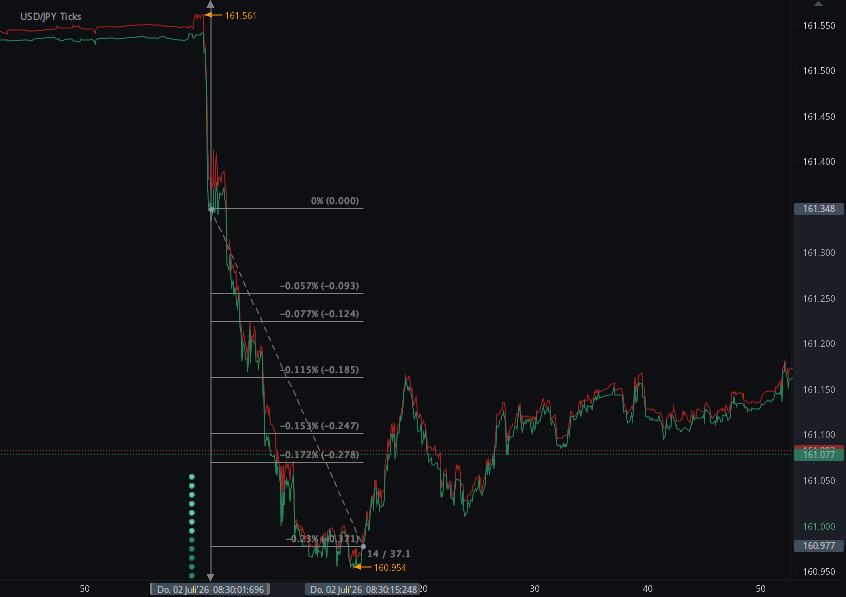
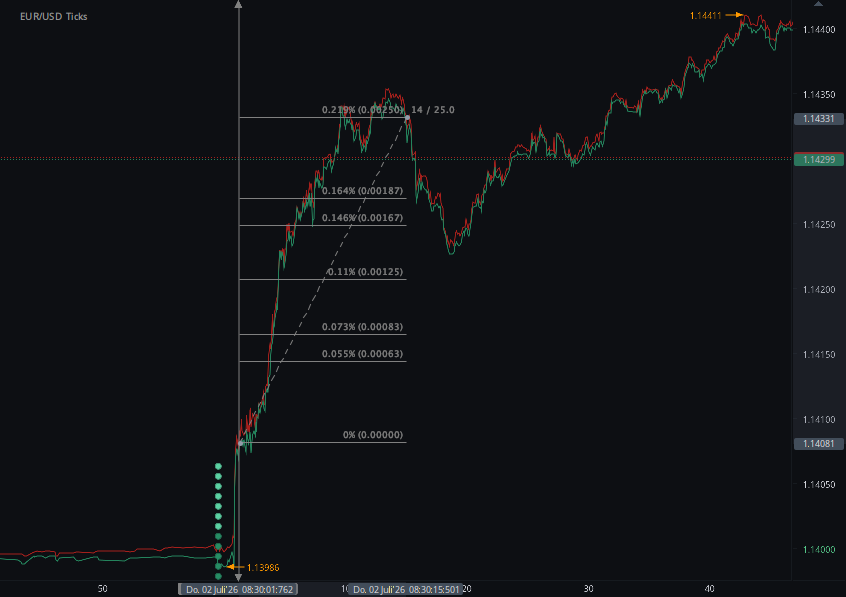
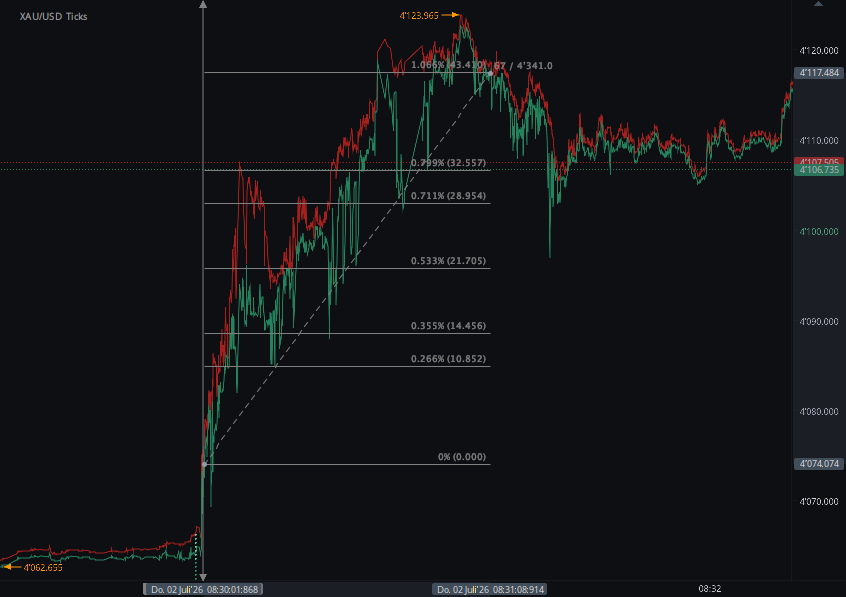
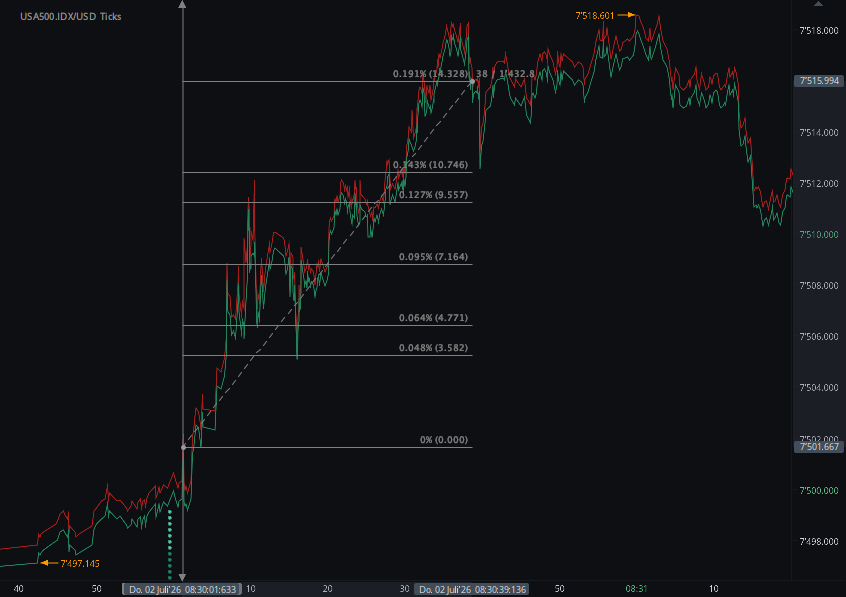
July 2026 NFP Shock: 23K Job Loss Triggers Sharp Moves in FX, Gold and US500

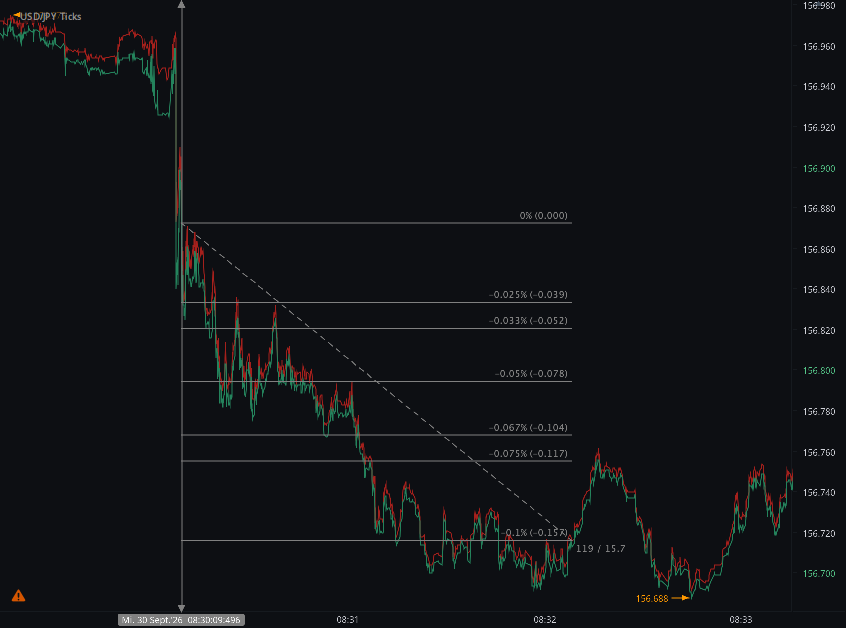
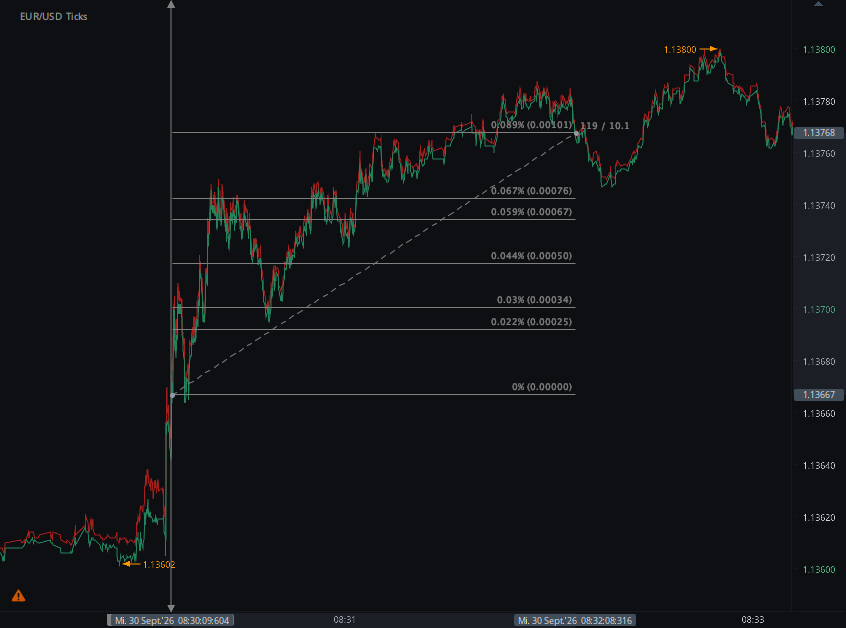
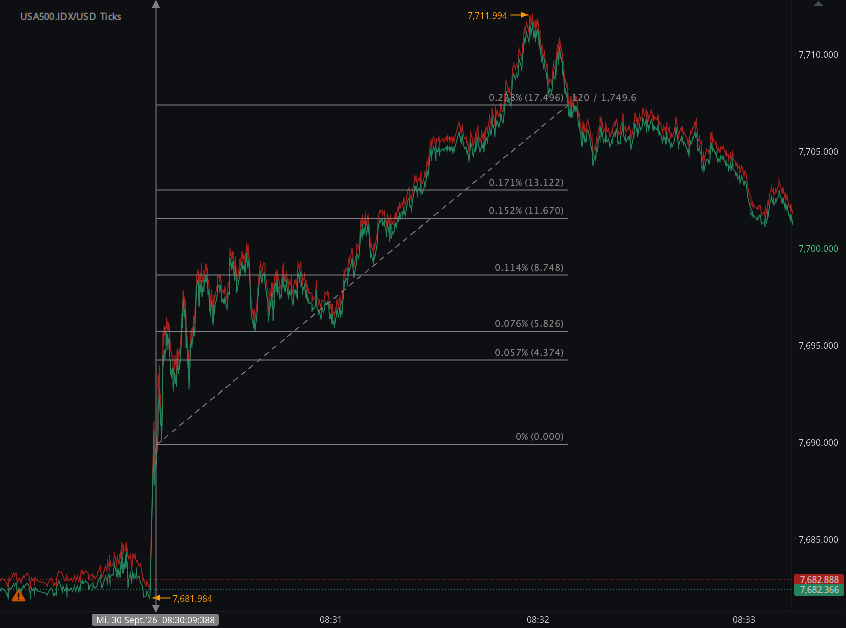
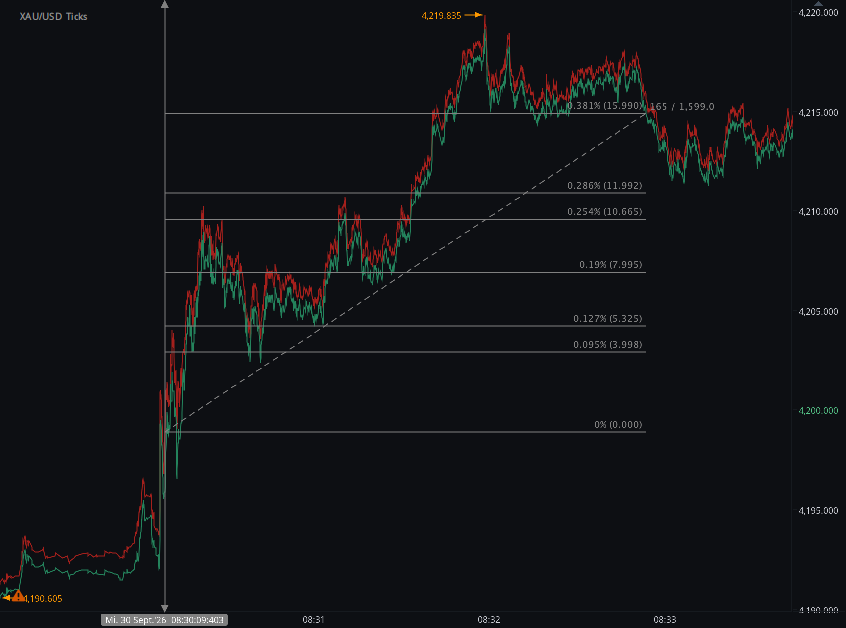
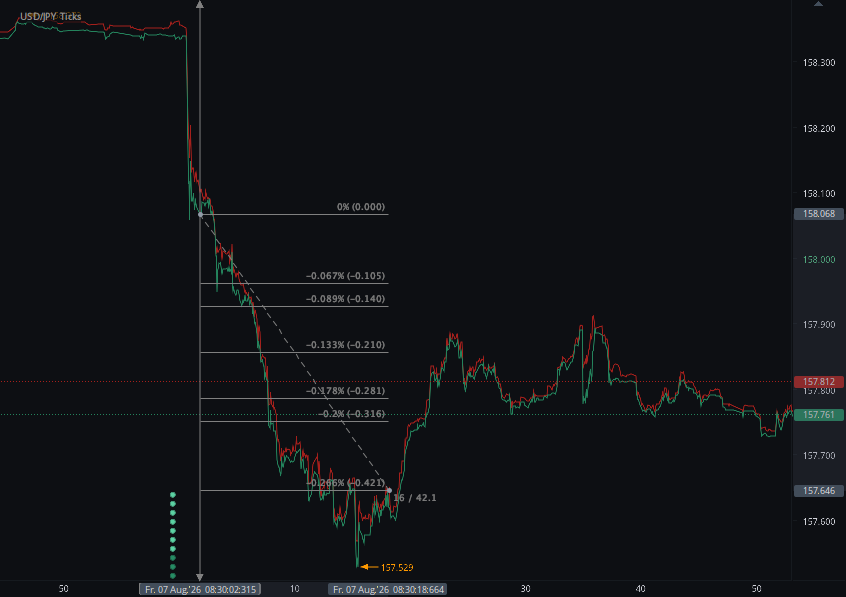
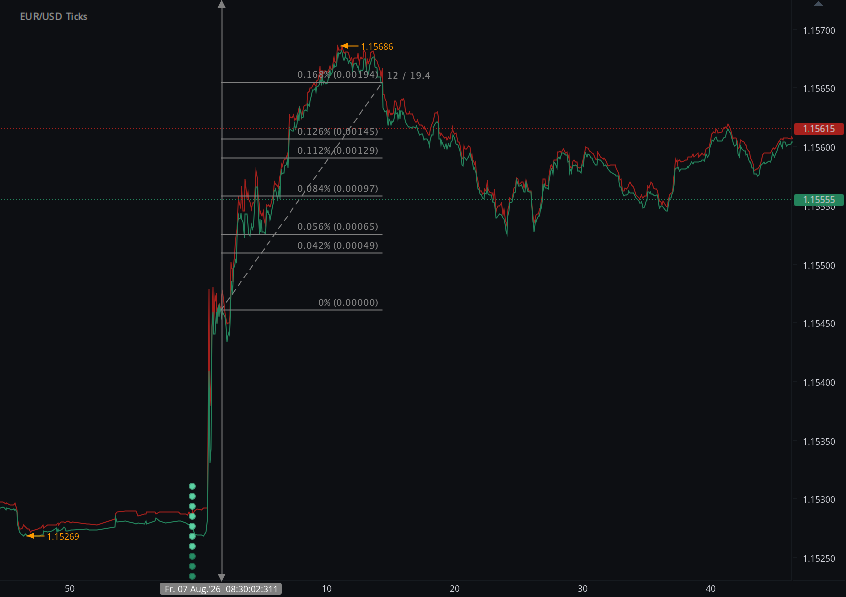
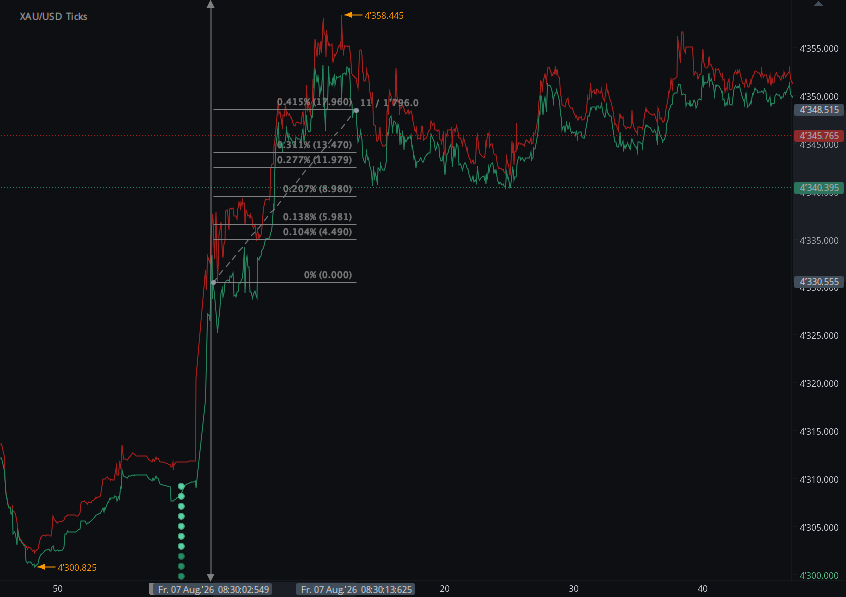
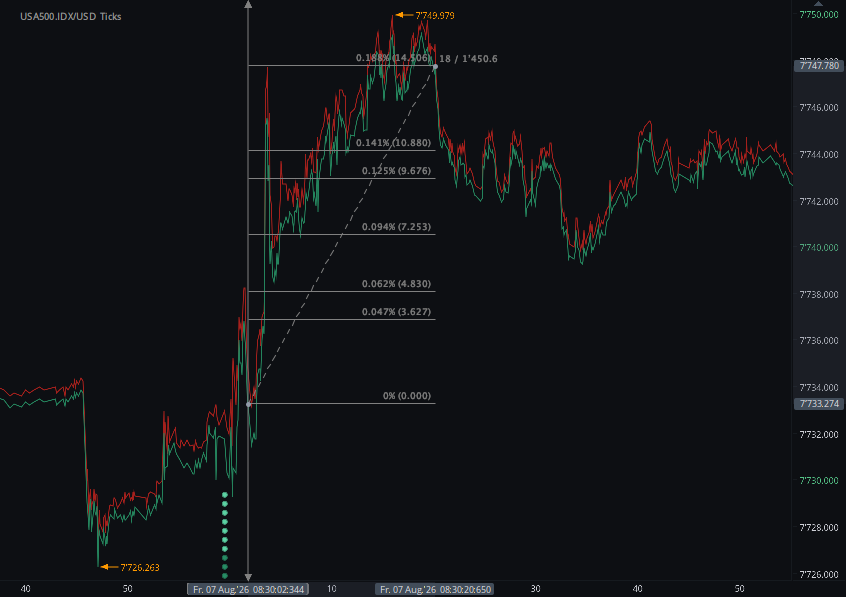
According to our analysis USDJPY moved 42 pips, EURUSD moved 19 pips, XAUUSD (spot gold) moved 17 points and US500 moved 56 ticks (117 ticks total) on US Employment Situation (Non-farm payrolls / NFP) data on 7 August 2026.

USDJPY (42 pips)

EURUSD (19 pips)

XAUUSD (17 points)

US500 (56 ticks)

Charts are exported from JForex (Dukascopy).


HAAWKS Research

July 2026 NFP Shock: Payrolls Fall 23K as Markets Reprice the Fed

A surprise contraction in U.S. payrolls, weaker wage growth and another round of large downward revisions triggered rapid moves across FX, gold and U.S. equity indices.

August 7, 2026 Release time: 8:30 a.m. ET U.S. Employment Situation

The July 2026 U.S. Employment Situation delivered a significantly weaker labor-market signal than news traders had expected. Nonfarm payrolls declined by 23,000, compared with a Reuters consensus forecast for an 80,000 increase.

The unemployment rate fell from 4.2% to 4.1%, but the improvement in the headline rate came alongside another decline in labor force participation. The participation rate slipped to 61.4%, while the civilian labor force contracted by 264,000.

For news traders, the details behind the headline were arguably even more important. May and June payroll growth was revised lower by a combined 103,000 jobs, while annual average hourly earnings growth slowed to 3.2%.

HAAWKS first read: this was not simply a weak headline NFP print. The combination of a 103,000-job downside surprise versus consensus, substantial prior-month revisions, softer wage growth and weaker labor-force participation produced a distinctly dovish labor-market signal.

NFP Estimates vs. Actual Release

Nonfarm Payrolls −23K Reuters consensus: +80K
Unemployment Rate 4.1% Forecast: 4.2%
Wage Growth YoY 3.2% Forecast: 3.5%
Prior Revisions −103K May + June combined
July 2026 U.S. Employment Situation estimates compared with actual results
Labor Indicator Expectation Actual HAAWKS News-Trader Read
Nonfarm Payrolls +80K −23K A 103K downside surprise versus consensus and the primary negative headline for the dollar.
Unemployment Rate 4.2% 4.1% Better on the surface, but less supportive once the decline in labor-force participation was taken into account.
Average Hourly Earnings YoY 3.5% 3.2% Softer wage pressure reinforced the dovish interpretation of the employment report.
Labor Force Participation 61.4% Participation edged down from 61.5%, helping explain why the unemployment rate fell despite weak employment conditions.
May Payroll Revision Previous: +129K +63K Revised lower by 66K.
June Payroll Revision Previous: +57K +20K Revised lower by 37K.

Immediate Market Reaction

The HAAWKS release-window measurements show how quickly the labor-market surprise was incorporated into prices. The initial response was consistent across the major macro markets: the U.S. dollar weakened, gold rallied and U.S. equities moved higher as traders reduced expectations for near-term Federal Reserve tightening.

USD/JPY −42.1 pips 16 seconds
EUR/USD +19.4 pips 12 seconds
XAU/USD +17.96 points 11 seconds
US500 +14.6 points 18 seconds
Immediate market reaction following the July 2026 NFP release
Market Measured Move Time Window Direction News-Trader Interpretation
USD/JPY 42.1 pips 16 seconds Lower The strongest measured FX reaction as the weak employment figures triggered rapid dollar selling against the yen.
EUR/USD 19.4 pips 12 seconds Higher Broad dollar weakness pushed the euro higher immediately after the release.
XAU/USD 17.96 points 11 seconds Higher Gold reacted quickly to lower yields, dollar weakness and a reduction in expected Federal Reserve tightening.
US500 14.6 index points 18 seconds Higher Equity traders initially focused on the lower-rate implications of the employment miss rather than the negative growth signal.

Why This Release Mattered to News Traders

1. The Headline Surprise Was Large

Payrolls were expected to rise by 80,000 but instead declined by 23,000. For automated and discretionary news traders, the 103,000-job gap versus consensus immediately changed the macro interpretation of the release.

2. Revisions Reinforced the Signal

May and June were revised down by a combined 103,000 jobs. That mattered because the release did not just report a weak July; it also showed that the preceding labor-market picture had been weaker than initially reported.

3. Unemployment Sent a Mixed Message

A fall in unemployment to 4.1% would ordinarily be interpreted as labor-market strength. However, the labor force shrank and participation slipped to 61.4%, reducing the positive impact of the headline unemployment rate.

4. Wage Growth Also Missed

Annual average hourly earnings growth slowed to 3.2% versus the 3.5% rate economists had expected. For rate-sensitive markets, softer wages added another dovish element to an already weak payroll report.

HAAWKS view: for news traders, this was a release where the components largely pointed in the same direction. The headline payroll miss, negative revisions and softer wage growth outweighed the lower unemployment rate. The result was a fast cross-asset repricing: USD lower, gold higher and equities higher.

Sector Detail: Where the Jobs Were Lost

The weakness was not evenly distributed across the economy. Local government education employment declined by 50,000, while retail trade lost 19,000 jobs. Financial activities employment continued to trend lower, falling by 14,000.

Health care remained one of the few areas of continued employment growth, adding 22,000 jobs during July, although that was slower than its average monthly gain over the previous year.

Selected July 2026 employment changes by industry
Industry July Change HAAWKS Read-through
Local Government Education −50K The largest highlighted sector decline in the July report.
Retail Trade −19K Added to the evidence of weaker overall hiring momentum.
Financial Activities −14K Continued an existing downward employment trend.
Health Care +22K Continued to add jobs, but at a slower pace than its prior 12-month average.

The Fed Repricing

Before the release, markets were debating whether persistent inflation could lead the Federal Reserve to raise rates at its September meeting. The unexpectedly weak jobs report materially reduced that probability.

That shift helps explain why assets that normally benefit from lower interest-rate expectations reacted so quickly. Treasury yields fell, the U.S. dollar weakened, gold advanced and U.S. stock futures initially rallied.

For news traders, the key point is that the market was not trading the payroll number in isolation. It was trading how the employment surprise changed the expected path of monetary policy.

News Trading Takeaways

Headline Data Is Only the First Layer

A fast NFP strategy must be able to process more than the payroll headline. Unemployment, wage growth and revisions can either confirm or contradict the initial signal.

Revisions Can Be Market-Moving

The 103,000 combined downward revision to May and June strengthened the bearish labor-market message. In some releases, prior-period revisions can matter as much as the current month's number.

Cross-Asset Confirmation Matters

USD/JPY lower, EUR/USD higher, gold higher and US500 higher represented a coherent initial macro reaction. When several rate-sensitive markets respond in the same direction, news traders receive useful confirmation of the market's interpretation.

Execution Risk Remains Critical

A measured market move is not the same as an achievable trading result. During high-impact releases, spreads can widen, liquidity can disappear, prices can gap and slippage can increase. Latency, order type, venue and risk controls remain critical to actual execution.

HAAWKS Conclusion

The July 2026 NFP release delivered a much weaker labor-market picture than traders had expected.

Nonfarm payrolls declined by 23,000 versus expectations for an 80,000 increase. May and June were revised down by another 103,000 jobs, while annual wage growth slowed to 3.2%.

Although unemployment fell to 4.1%, declining labor-force participation reduced the strength of that signal. The broader message from the report was therefore clearly softer than the headline unemployment rate alone suggested.

The immediate market reaction reflected that interpretation. HAAWKS measured 42.1 pips in USD/JPY in 16 seconds, 19.4 pips in EUR/USD in 12 seconds, 17.96 points in XAU/USD in 11 seconds and 14.6 index points in US500 in 18 seconds.

For news traders, the release is a useful example of why low-latency access to the complete data set matters. The payroll headline, unemployment rate, wage figures and revisions all arrived together and collectively determined the market's interpretation within seconds.

Trade smart. Stay informed. Stay ahead.

Built for News Traders

HAAWKS G4A delivers low-latency, machine-readable macroeconomic and commodity data directly from official sources for professional algorithmic and manual news trading.

Explore HAAWKS G4A Data Feeds

Sources

  1. U.S. Bureau of Labor Statistics — Employment Situation, July 2026
    Official source for nonfarm payrolls, unemployment, labor-force participation, earnings, industry employment and prior-month revisions.
  2. Reuters — U.S. job growth expected to pick up in July
    Used for the pre-release economist consensus of +80K payrolls, 4.2% unemployment and 3.5% annual wage growth.
  3. Reuters — U.S. suffers unexpected job losses in July
    Used for post-release labor-market and financial-market context.
  4. Reuters — Dollar drops after weak U.S. jobs data
    Used for broader FX and gold-market reaction following the report.
  5. Reuters — Markets reduce odds of September Fed rate hike
    Used for the post-NFP monetary-policy repricing.
  6. HAAWKS internal tick-chart analysis — August 7, 2026
    Used for the measured release-window reactions in USD/JPY, EUR/USD, XAU/USD and US500.
Disclaimer: This material is provided for informational and educational purposes only. It does not constitute financial advice, investment advice or a recommendation to buy or sell any financial instrument. The market moves described above are historical measured price reactions and do not represent guaranteed or necessarily achievable profits. Actual execution depends on latency, liquidity, spreads, slippage, order type, venue and risk management. Past market behavior is not indicative of future results.

Built for traders who compete on speed. HAAWKS G4A delivers low-latency, machine-readable macroeconomic and commodity data via API infrastructure in Chicago, New York and London. Explore the feed, share your feedback, or contact us to request a free trial for qualified professionals.

Comment

Comment

June 2026 CPI: Cooler Inflation Sends the Dollar Lower and Risk Assets Higher

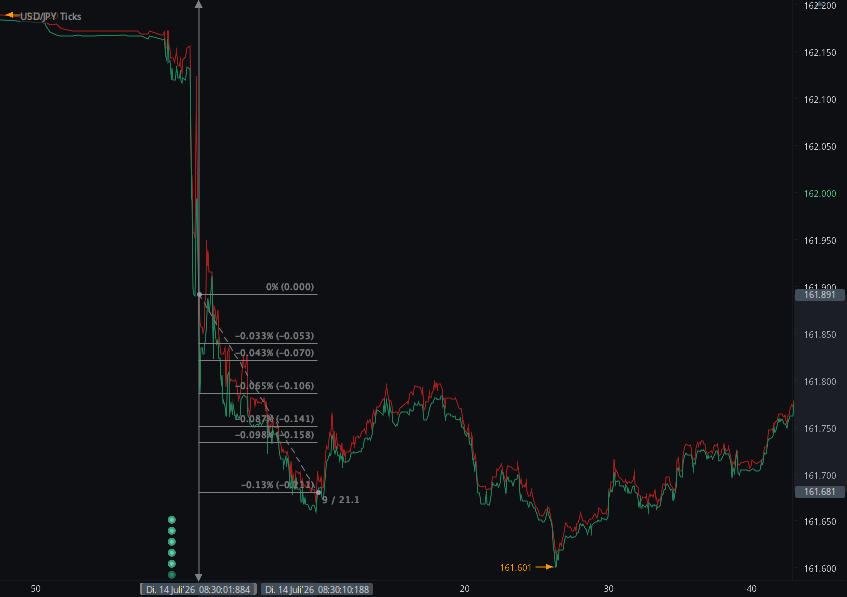
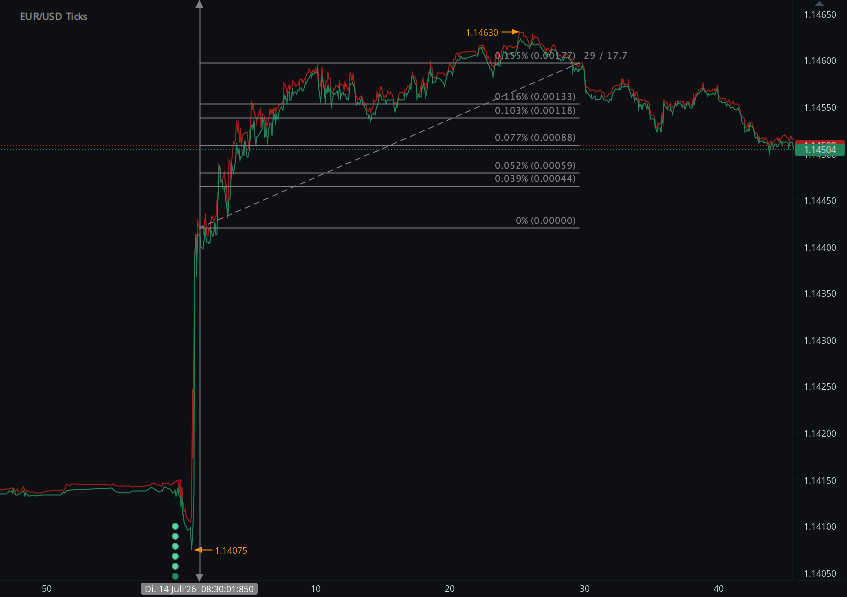
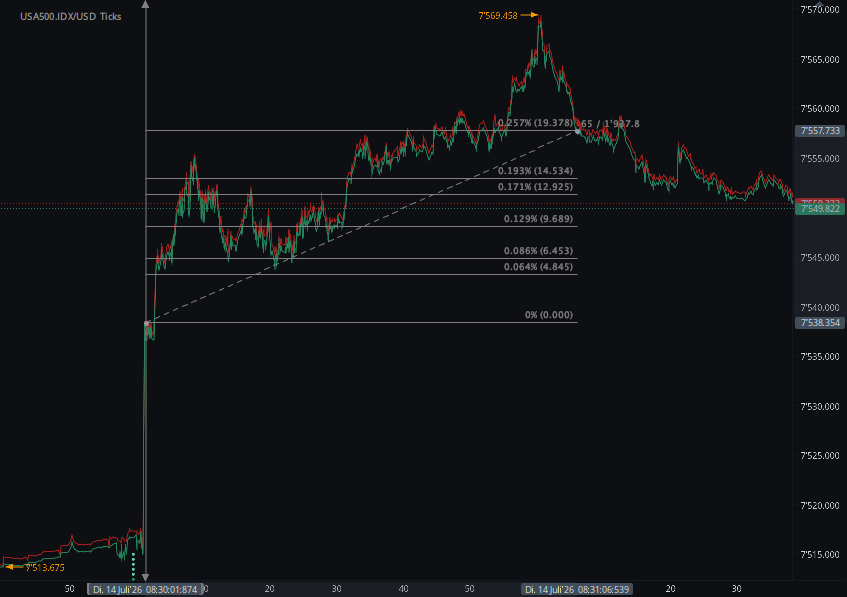
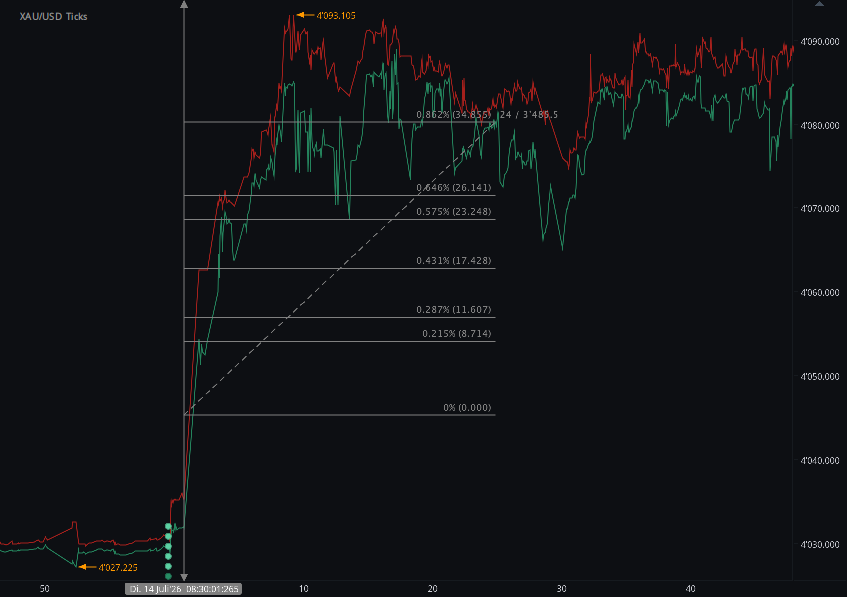
According to our analysis USDJPY moved 21 pips, EURUSD moved 17 pips, US500 moved 76 ticks and XAUUSD 34 points on US BLS Consumer Price Index (CPI) data on 14 July 2026.

USDJPY (21 pips)

EURUSD (17 pips)

US500 (76 ticks)

XAUUSD (34 points)

Charts are exported from JForex (Dukascopy).


HAAWKS Research

June 2026 CPI: Inflation Cools Faster Than Expected

A sharp decline in energy prices and an unexpectedly soft core reading triggered immediate moves across currencies, gold and U.S. equities.

July 14, 2026 Release time: 8:30 a.m. ET Consumer Price Index

The June 2026 U.S. Consumer Price Index delivered a clear downside inflation surprise. Headline CPI declined 0.4% month over month, while annual inflation slowed to 3.5%. Core CPI, which excludes food and energy, was unchanged during the month and slowed to 2.6% year over year.

The report was softer than economists had expected at both the headline and core levels. Markets responded by selling the U.S. dollar and moving into rate-sensitive assets, including gold and U.S. equities.

HAAWKS first read: The release reduced immediate inflation anxiety, but the details require balance. Falling energy prices drove much of the headline decline, while the unchanged core reading showed that underlying inflation also cooled during June.

CPI Estimates vs. Actual Release

Headline CPI MoM −0.4% Forecast: −0.1%
Headline CPI YoY 3.5% Forecast: 3.8%
Core CPI MoM 0.0% Forecast: +0.2%
Core CPI YoY 2.6% Forecast: 2.8%
June 2026 CPI estimates compared with actual results
Inflation Indicator Estimate Actual HAAWKS Read-through
Headline CPI MoM −0.1% −0.4% A materially softer monthly reading, driven primarily by lower energy prices.
Headline CPI YoY 3.8% 3.5% Annual inflation slowed more quickly than markets expected.
Core CPI MoM +0.2% 0.0% The unchanged core index was an important downside surprise.
Core CPI YoY 2.8% 2.6% Underlying annual inflation continued moving toward a more moderate pace.

What Drove the Inflation Decline?

Energy was the largest contributor to the monthly decline. The energy index fell 5.7%, while gasoline prices dropped 9.7%. Those declines more than offset increases in food and shelter.

Food prices increased 0.2% during June, while shelter rose only 0.1%—its smallest monthly increase since January 2021. Motor vehicle insurance, communication, apparel, medical care and used vehicle prices also declined.

Key components of the June 2026 Consumer Price Index
CPI Component Monthly Change Annual Change Interpretation
All Items −0.4% +3.5% The largest monthly headline decline since April 2020.
Core CPI 0.0% +2.6% Underlying price pressures were unchanged during the month.
Energy −5.7% +15.7% The largest contributor to the monthly CPI decline.
Gasoline −9.7% +26.7% A sharp monthly reversal, although prices remained elevated compared with a year earlier.
Shelter +0.1% +3.3% The smallest monthly shelter increase since January 2021.
Food +0.2% +3.0% Food inflation remained positive but relatively contained.

Market Impact at a Glance

HAAWKS tick charts captured the initial release-window moves immediately following the 8:30 a.m. ET CPI announcement.

Market impact following the June 2026 CPI release
Market Measured Move Initial Direction HAAWKS Interpretation
USD/JPY 21 pips Lower The dollar weakened against the yen as traders reduced the probability of near-term Federal Reserve tightening.
EUR/USD 17 pips Higher The euro advanced as the softer inflation reading pressured the broader U.S. dollar.
US500 76 ticks Higher Equities rallied as the inflation surprise reduced immediate concerns about restrictive monetary policy.
XAU/USD 34 points Higher Gold benefited from a weaker dollar and lower expectations for near-term interest-rate increases.

Cross-Asset Market Reading

Foreign Exchange

The immediate FX response was a weaker U.S. dollar. USD/JPY moved lower, while EUR/USD moved higher. This was consistent with markets reducing expectations that the Federal Reserve would need to tighten policy in the immediate future.

Gold

Gold produced one of the strongest reactions. Softer inflation generally supports non-yielding assets when it lowers Treasury yields and weakens the dollar. The HAAWKS measurement recorded a 34-point release-window advance.

U.S. Equities

The US500 initially gained 76 ticks. The market interpreted the report as supportive for valuations because inflation cooled without the release itself presenting a direct signal of collapsing economic demand.

HAAWKS view: The release created a broadly dovish cross-asset response—USD lower, gold higher and equities higher. The core CPI miss strengthened the move because the moderation was not limited entirely to volatile energy prices.

What the CPI Report Means for the Fed

The June figures gave policymakers additional breathing room. Headline inflation remained above the Federal Reserve’s longer-term objective, but both headline and core CPI came in below expectations.

The report does not eliminate future inflation risk. Much of the headline decline reflected lower gasoline and energy prices, which can reverse quickly. Renewed pressure on oil markets could therefore make upcoming inflation reports less favorable.

For traders, the key question is whether the softer core readings continue. A sustained moderation in shelter and services inflation would provide a stronger signal than a single energy-driven monthly decline.

HAAWKS Conclusion

The June CPI release was decisively softer than expected. Headline prices fell 0.4%, core prices were unchanged and both annual measures undershot consensus forecasts.

Markets reacted in a clear and coordinated manner: the dollar weakened, gold advanced and the US500 rallied. The HAAWKS measurements recorded 21 pips in USD/JPY, 17 pips in EUR/USD, 76 ticks in the US500 and 34 points in XAU/USD.

The report offered short-term relief from inflation concerns, but it should not be viewed as an all-clear signal. Energy volatility remains a material risk, and annual headline inflation was still elevated.

The central message is therefore one of moderation rather than victory: inflation cooled faster than expected, underlying pressure eased and markets rapidly repriced the near-term policy outlook.

Trade smart. Stay informed. Stay ahead.

Sources

  1. U.S. Bureau of Labor Statistics — Consumer Price Index, June 2026 . Official CPI figures, component data and release details.
  2. Reuters — U.S. consumer inflation preview and economist consensus
    Used for the pre-release market estimates for headline and core consumer inflation.
  3. Reuters — Traders reduce expectations for a July Fed rate increase
    Used for market-implied Federal Reserve policy expectations following the report.
  4. HAAWKS internal tick-chart screenshots captured on July 14, 2026. Used for the measured release-window moves in USD/JPY, EUR/USD, US500 and XAU/USD.
Disclaimer: This material is provided for informational and educational purposes only. It does not constitute financial advice, investment advice or a recommendation to buy or sell any financial instrument. Trading involves risk, and past market behavior is not indicative of future results.

Start futures forex fx news trading with Haawks G4A low latency machine-readable data, one of the fastest machine-readable news trading feed for US macro-economic and commodity data.

Please let us know your feedback. If you are interested in timestamps, please send us an email to sales@haawks.com.

Comment

Comment

June 2026 NFP: Softer Payroll Growth Triggers Sharp Moves Across FX, Gold and US500 on US Employment Situation (NFP)

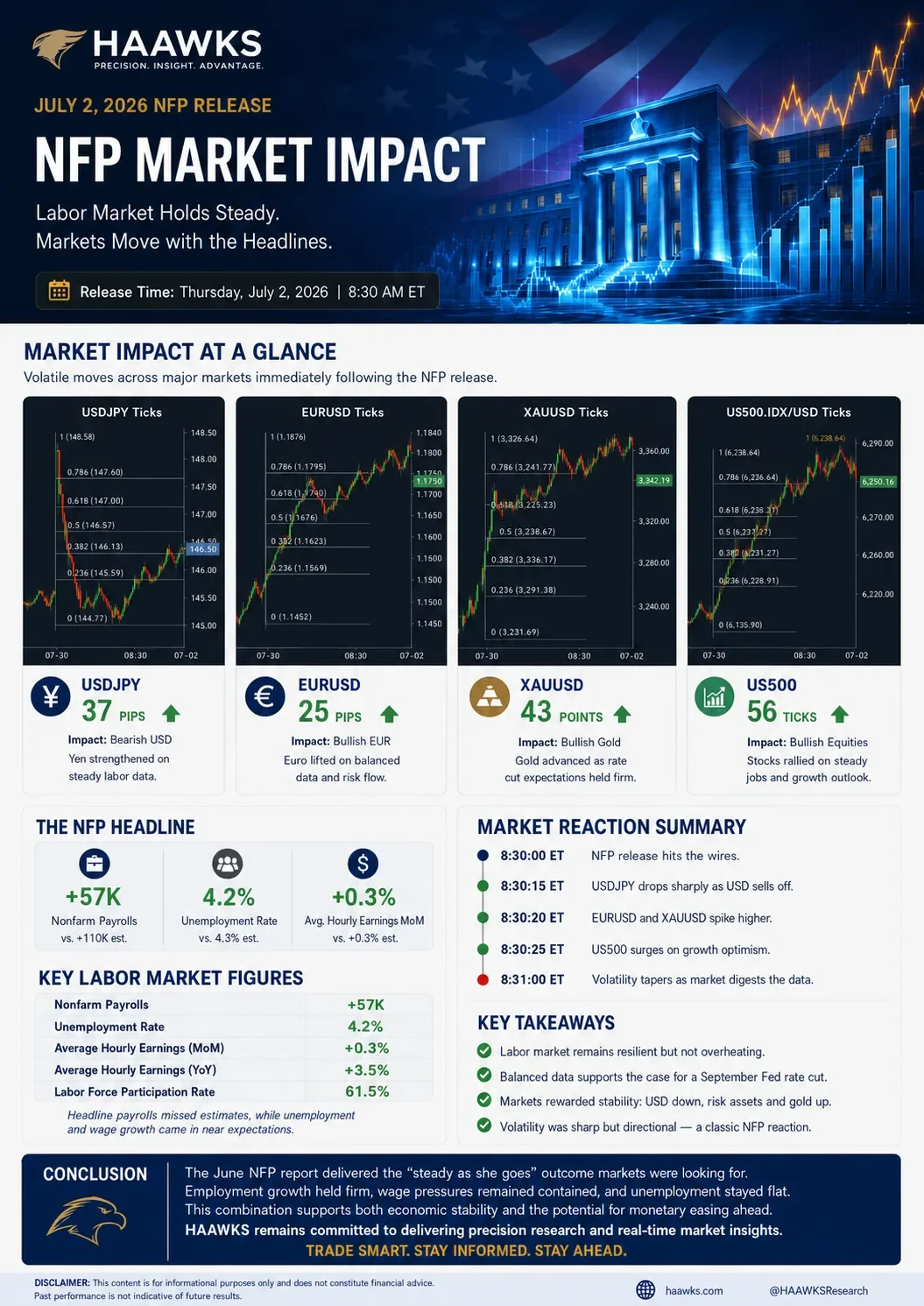
According to our analysis USDJPY moved 37 pips, EURUSD moved 25 pips, XAUUSD (spot gold) moved 43 points and US500 moved 56 ticks (118 ticks total) on US Employment Situation (Non-farm payrolls / NFP) data on 2 July 2026.

USDJPY (37 pips)

EURUSD (25 pips)

XAUUSD (43 points)

US500 (56 ticks)

Charts are exported from JForex (Dukascopy).


June 2026 NFP: Softer Jobs, Stable Wages, Sharp Market Reaction

HAAWKS Research | July 2, 2026

HAAWKS NFP market impact summary showing June 2026 labor market figures and release-window moves in USDJPY, EURUSD, XAUUSD, and US500

The June 2026 U.S. Nonfarm Payrolls release delivered a classic “soft but not broken” labor-market signal. Payroll growth slowed materially, but unemployment remained low and wage growth stayed contained. For markets, that combination was enough to trigger immediate volatility across FX, gold, and equity index futures.

The Bureau of Labor Statistics reported that total nonfarm payroll employment rose by 57,000 in June, while the unemployment rate stood at 4.2%. Average hourly earnings increased 0.3% month over month and 3.5% year over year. The prior two months were also revised lower by a combined 74,000 jobs, with April revised to +148,000 and May revised to +129,000.

Research Estimates vs. Actual Release

Ahead of the release, market expectations were for a stronger labor print. Consensus estimates pointed to nonfarm payrolls rising by roughly 110,000, unemployment near 4.3%, and average hourly earnings increasing 0.3% month over month.

The actual release came in softer on headline job creation, but broadly stable on unemployment and wages.

Indicator Estimate Actual HAAWKS Read-through
Nonfarm Payrolls +110K +57K Clear downside miss. Headline job creation came in softer than expected.
Unemployment Rate 4.3% 4.2% Better than expected, though the participation-rate decline softened the signal.
Average Hourly Earnings MoM +0.3% +0.3% In line. Wage growth remained contained.
Average Hourly Earnings YoY +3.5% +3.5% In line. No upside wage shock.
Prior-Month Revisions -74K April and May were revised lower, pointing to softer labor momentum than previously reported.

The headline payroll miss was the main surprise. However, wage growth did not accelerate, unemployment remained low, and the report avoided the kind of broad deterioration that would suggest an immediate labor-market break.

Market Impact: HAAWKS Tick-Chart Reaction

The HAAWKS market-impact screenshots captured the immediate release-window volatility:

Market Measured Impact Direction HAAWKS Interpretation
USD/JPY 37 pips Lower The U.S. dollar sold off sharply against the yen after the softer payroll print.
EUR/USD 25 pips Higher The euro rallied as dollar weakness spread across major FX pairs.
XAU/USD 43 points Higher Gold rallied as traders repriced rate expectations following the weaker jobs number.
US500 56 ticks Higher Equities initially caught a bid as slower job growth supported the soft-landing narrative.

The market reaction was consistent with a softer-than-expected labor report. The U.S. dollar weakened, gold rallied, and equities reacted positively to the possibility that slower job growth could reduce pressure on the Federal Reserve to keep policy restrictive for longer.

Sector Detail: Slower Hiring, Not a Full Breakdown

The report showed continued job gains in professional and business services, social assistance, and health care, while leisure and hospitality lost 61,000 jobs. That divergence matters. It suggests the labor market is not uniformly weak, but momentum is becoming narrower.

The downward revisions were also important. A one-month payroll miss can be dismissed as noise; a miss combined with negative revisions tells a more cautious story. The labor market still appears functional, but the pace of hiring is clearly cooling.

HAAWKS Conclusion

The June NFP release was not a recession signal, but it was a warning that the labor market is losing speed.

For traders, the key takeaway was not simply that payrolls missed. It was the combination of:

Soft job creation, stable wages, lower unemployment, and negative revisions.

That mix created a “Goldilocks” reaction in markets: weak enough to pressure the dollar and support rate-sensitive assets, but not weak enough to trigger immediate risk-off panic.

Asset Class Reaction Why It Moved Trading Takeaway
FX Dollar weaker The headline payroll miss reduced near-term support for the U.S. dollar. USD vulnerability remained the cleanest immediate signal.
Gold Gold stronger Softer labor data supported lower-rate sensitivity and demand for precious metals. XAU/USD remained supported while rate-cut expectations held firm.
Equities Risk initially bid Stable wages and softer hiring helped support the soft-landing view. US500 strength reflected relief rather than a broad growth acceleration signal.
Rates Narrative Dovish lean The report was soft enough to support easing expectations, but not weak enough to trigger panic. The market reaction fit a classic “Goldilocks” setup.

The HAAWKS read:

USD vulnerability remains the cleanest short-term signal, while gold and equity indices may continue to benefit if incoming data supports the view that inflation pressure is easing without a sharp employment shock.

Final Takeaway

The June 2026 NFP report reinforced a market theme that traders cannot ignore:

Labor momentum is cooling, wage pressure is stable, and markets are increasingly sensitive to every data point that affects the Fed path.

For HAAWKS traders, the opportunity is not just in the headline number. It is in understanding how that number moves liquidity, volatility, and cross-asset positioning in real time.

Trade smart. Stay informed. Stay ahead.

Disclaimer: This blog post is for informational purposes only and should not be construed as financial advice. Always conduct thorough research and consider seeking advice from a financial professional before making any investment decisions.

Sources

  1. U.S. Bureau of Labor Statistics — Employment Situation Summary, June 2026
    Used for the official NFP release figures, including +57K nonfarm payrolls, 4.2% unemployment, +0.3% monthly wage growth, +3.5% annual wage growth, labor-force participation, sector detail, and prior-month revisions.
  2. Reuters — U.S. job growth likely cooled in June after recent string of big gains
    Used for pre-release market expectations, including the +110K nonfarm payroll estimate and 4.3% unemployment forecast.
  3. Reuters — Nasdaq, S&P 500 decline with tech; investors assess softer jobs data
    Used for equity-market context following the softer-than-expected jobs report.
  4. Reuters — Dollar slides after soft jobs report, yen surges
    Used for U.S. dollar and yen market reaction after the NFP release.
  5. Reuters — Gold gains after weak U.S. payrolls report
    Used for gold-market reaction and rate-expectation context after the payroll miss.
  6. HAAWKS internal tick-chart screenshots, captured July 2, 2026.
    Used for measured release-window market impact: USD/JPY 37 pips, EUR/USD 25 pips, XAU/USD 43 points, and US500 56 ticks.

Start forex fx futures news trading with Haawks G4A low latency machine-readable data today, one of the fastest news data feeds for US macro-economic and commodity data.

Please let us know your feedback. If you are interested in timestamps, please send us an email to sales@haawks.com.

Comment

Comment

20 ticks potential profit in 37 seconds on 13 May 2026, analysis on futures forex fx low latency news trading US500 futures on US BLS Producer Price Index (PPI) data

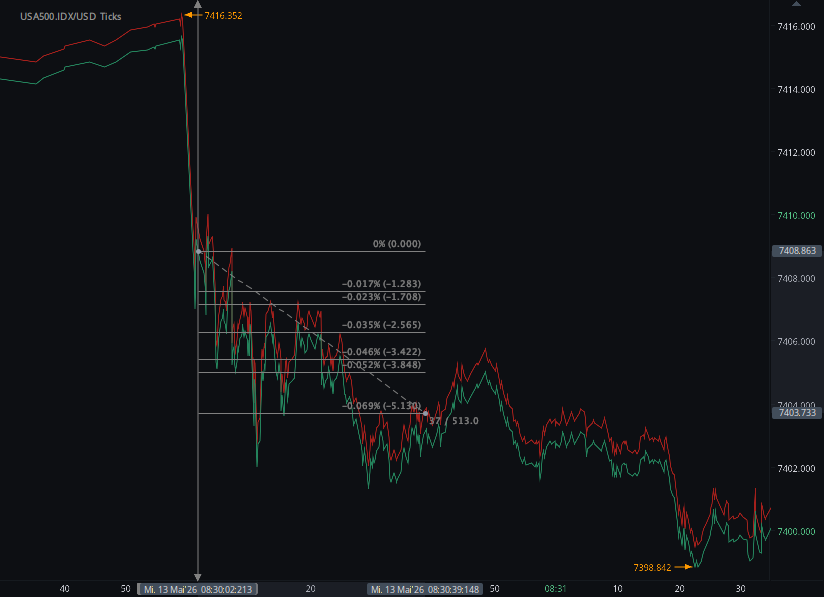
According to our analysis US500 moved 5 points (20 ticks) on US BLS Producer Price Index (PPI) data on 13 May 2026.

US500 (5 points / 20 ticks)

Charts are exported from JForex (Dukascopy).


April 2026 PPI: Wholesale Inflation Surges as Energy, Freight, and Trade Margins Jump

The April 2026 Producer Price Index report delivered a clear signal: price pressures at the producer level accelerated sharply.

The Producer Price Index for final demand rose 1.4% in April, seasonally adjusted, according to the U.S. Bureau of Labor Statistics. That followed increases of 0.7% in March and 0.6% in February, making April the largest monthly gain since March 2022.

On a year-over-year basis, final demand prices were up 6.0%, the largest 12-month increase since December 2022.

For businesses, consumers, and policymakers, the report suggests that inflation pressures are not just lingering; they may be broadening again across key parts of the economy.

Services Did Most of the Heavy Lifting

Nearly 60% of April’s increase in final demand prices came from services. The index for final demand services rose 1.2%, its largest monthly increase since March 2022.

A major driver was trade services, where margins received by wholesalers and retailers jumped 2.7%. Transportation and warehousing services also surged, rising 5.0% in the month.

Several categories contributed to the rise, including:

  • Machinery and equipment wholesaling

  • Truck transportation of freight

  • Fuels and lubricants retailing

  • Health, beauty, and optical goods retailing

  • Chemicals and allied products wholesaling

  • Legal services

Not every service category moved higher. Portfolio management prices fell 2.4%, while food retailing margins and metals, minerals, and ores wholesaling margins also declined.

Still, the services side of the report was notably strong, especially in areas tied to distribution, freight, and wholesale margins.

Goods Prices Also Rose Sharply

Final demand goods prices increased 2.0% in April after rising 1.9% in March.

Energy was the main story. Final demand energy prices jumped 7.8%, accounting for more than three-quarters of the overall goods increase.

Gasoline alone rose 15.6% and accounted for more than 40% of the April rise in final demand goods prices. Other energy-related increases included jet fuel, diesel fuel, and residual fuels.

There were also increases in fresh and dry vegetables and industrial chemicals.

One striking exception was chicken eggs, whose index dropped 49.7%. Nonferrous scrap and residential natural gas prices also declined.

Core Producer Inflation Picked Up Too

The index for final demand less foods, energy, and trade services rose 0.6% in April. That was the largest increase since October 2025.

Over the past 12 months, this core measure increased 4.4%, the largest year-over-year gain since February 2023.

That matters because this measure strips out some of the most volatile categories. A strong increase here suggests the April report was not only about energy swings. Underlying price pressure also strengthened.

Intermediate Demand Shows Pipeline Pressure

The report also showed strong increases earlier in the production chain.

Processed goods for intermediate demand rose 2.7% in April, the sixth straight monthly increase. Processed energy goods rose 7.8%, while processed materials excluding food and energy increased 1.5%.

Over the past year, processed goods for intermediate demand rose 9.4%, the largest 12-month increase since October 2022.

Unprocessed goods prices rose even faster, climbing 4.1% in April. The biggest driver was unprocessed energy materials, up 9.2%. Crude petroleum rose 11.3%, accounting for nearly three-quarters of the advance in unprocessed goods.

The 12-month increase for unprocessed goods reached 20.9%, the largest since September 2022.

These intermediate demand numbers suggest that cost pressures are building not only at the final stage but also deeper in the supply chain.

Freight and Transportation Costs Stand Out

Transportation was one of the clearest pressure points in the report.

Final demand transportation and warehousing services rose 5.0%, while transportation and warehousing services for intermediate demand jumped 3.7%.

Truck transportation of freight was especially important. It contributed to increases in both final demand services and intermediate demand services, with truck freight prices rising 8.1% in the intermediate demand category.

Higher freight costs can ripple through the economy because they affect the cost of moving raw materials, intermediate goods, and finished products. When transportation costs rise quickly, businesses may face pressure to raise prices or absorb lower margins.

Production Flow Data Point to Broad-Based Increases

The production flow measures also showed broad price gains across stages of production.

Stage 4 intermediate demand rose 0.9%, the largest increase since January 2023. Stage 3 rose 2.3%, stage 2 increased 2.8%, and stage 1 advanced 2.1%.

The strongest monthly increase came from stage 2 intermediate demand, where goods inputs climbed 5.1%.

Year-over-year increases were also notable:

  • Stage 4 intermediate demand: 5.4%

  • Stage 3 intermediate demand: 5.9%

  • Stage 2 intermediate demand: 11.1%

  • Stage 1 intermediate demand: 8.9%

The especially large increases in earlier stages suggest cost pressures could continue feeding into later stages if they persist.

What This Means

April’s PPI report was hot across several dimensions.

Energy was a major contributor, especially gasoline, diesel, jet fuel, and crude petroleum. But the report was not limited to energy. Services prices, trade margins, freight costs, chemicals, and several wholesale categories also rose.

The rise in the core final demand measure adds to the significance of the report. When prices excluding food, energy, and trade services are rising at the fastest year-over-year pace in more than three years, it points to broader inflation pressure beneath the headline number.

For businesses, the report suggests higher input costs may be returning across transportation, energy, materials, and distribution channels. For consumers, the PPI does not directly measure retail prices, but producer cost increases can eventually flow through to consumer prices.

For policymakers, the April data complicates the inflation picture. A single month does not make a trend, but this report showed acceleration across headline PPI, core PPI, goods, services, and intermediate demand.

Bottom Line

The April 2026 Producer Price Index report showed a sharp acceleration in wholesale inflation. Final demand prices rose 1.4% for the month and 6.0% from a year earlier, both marking the strongest readings in years.

Energy was the biggest driver, but services, freight, trade margins, and intermediate goods also showed meaningful price pressure.

The next PPI report, covering May 2026, is scheduled for release on Thursday, June 11, 2026, at 8:30 a.m. ET.

Disclaimer: This blog post is for informational purposes only and should not be construed as financial advice. Always conduct thorough research and consider seeking advice from a financial professional before making any investment decisions.

Source: https://www.bls.gov/news.release/ppi.nr0.htm


Start futures forex fx news trading with Haawks G4A low latency machine-readable data, one of the fastest machine-readable news trading feed for US economic and commodity data.

Please let us know your feedback. If you are interested in timestamps, please send us an email to sales@haawks.com.

Comment

Comment

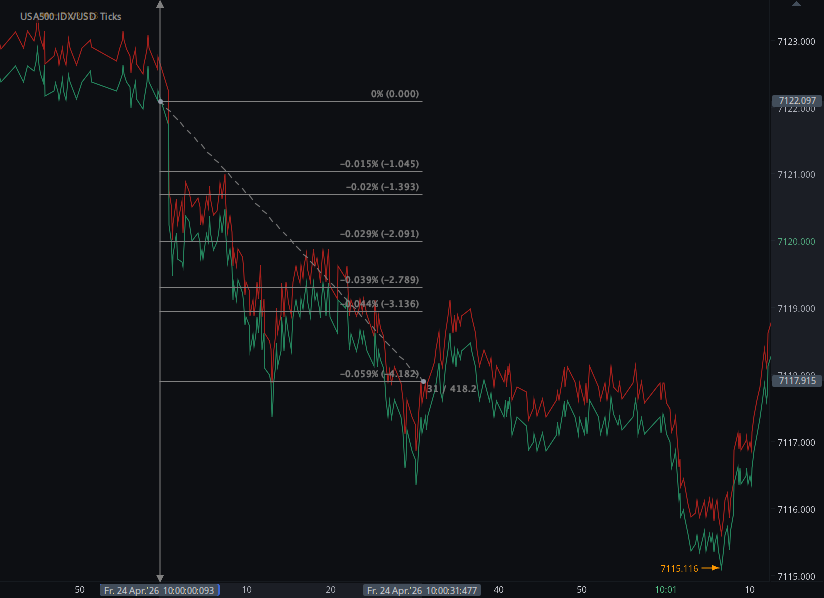
US500 4 points potential profit in 31 seconds on 24 April 2026, analysis on futures forex fx low latency news trading US500 on Michigan Consumer Sentiment

According to our analysis US500 moved 4 points on University Michigan Consumer Sentiment / Inflation Expectations data on 24 April 2026.

US500 (4 points)

Charts are exported from JForex (Dukascopy).


Consumer Confidence Slips Again in April 2026 as Inflation Fears Resurge

Consumer sentiment in the United States took another step downward in April 2026, signaling renewed unease about the economic outlook. According to the latest release from the University of Michigan Surveys of Consumers, the Index of Consumer Sentiment fell to 49.8, down from 53.3 in March and below the 52.2 recorded a year earlier. This represents a 6.6% monthly decline and a 4.6% drop year-over-year, placing sentiment near levels last seen during the mid-2022 economic slowdown.

Broad-Based Decline in Confidence

The decline was not isolated to any single demographic. Sentiment weakened across political affiliations, income brackets, age groups, and education levels. This widespread downturn suggests a shared concern among consumers about the direction of the economy, rather than isolated pessimism.

The Current Economic Conditions Index also slipped, falling 5.9% from March and posting a steep 12.2% decline compared to April 2025. Meanwhile, the Index of Consumer Expectations dropped 7.0% month-over-month, though it remains slightly higher (+1.7%) than a year ago.

Economic Pressures and Global Influences

A key driver of declining sentiment appears to be worsening expectations for business conditions. Consumers are increasingly pessimistic about both short-term and long-term economic prospects. These expectations are now approaching levels seen a year ago, when trade tensions and tariff policies weighed heavily on outlooks.

Recent geopolitical developments have also played a role. A temporary cease-fire and modest easing in gasoline prices helped sentiment recover slightly toward the end of the month. However, ongoing tensions involving Iran continue to influence consumer perceptions, particularly through their impact on energy prices and broader inflation concerns.

Importantly, the data suggest that consumers are less responsive to geopolitical developments unless they directly affect supply chains or reduce price pressures—especially in energy markets.

Inflation Expectations Surge

Perhaps the most striking development in April’s report is the sharp rise in inflation expectations. Year-ahead inflation expectations jumped from 3.8% in March to 4.7% in April—the largest monthly increase since April 2025. This figure now sits well above the pre-pandemic range of 2.3% to 3.0%, highlighting growing concern among consumers about persistent price pressures.

Long-run inflation expectations also edged higher, rising to 3.5% after several months of stability around 3.2–3.3%. This marks the highest level since October 2025 and continues a gradual upward trend from the relatively lower ranges observed in 2019 and 2020.

What This Means Going Forward

The April data paints a picture of an increasingly cautious consumer base. While short-term fluctuations in energy prices and geopolitical developments may provide temporary relief, underlying concerns about inflation and economic stability remain firmly in place.

With inflation expectations climbing and confidence slipping, policymakers and businesses alike may need to prepare for a more restrained consumer environment in the months ahead. The next data release, scheduled for May 8, 2026, will provide further insight into whether this downward trend continues—or if stabilization is on the horizon.

Disclaimer: This blog post is for informational purposes only and should not be construed as financial advice. Always conduct thorough research and consider seeking advice from a financial professional before making any investment decisions.

Source: http://www.sca.isr.umich.edu


Start futures and forex fx news trading with Haawks G4A low latency machine-readable data, one of the fastest machine-readable news trading feeds for US macro-economic and commodity data.

Please let us know your feedback. If you are interested in timestamps, please send us an email to sales@haawks.com.

Comment

Comment

XAUUSD 16 points, US500 31 points potential profit in 24 seconds on 6 March 2026, analysis on forex fx futures news trading XAUUSD (spot gold) and US500 on US Employment Situation (NFP)

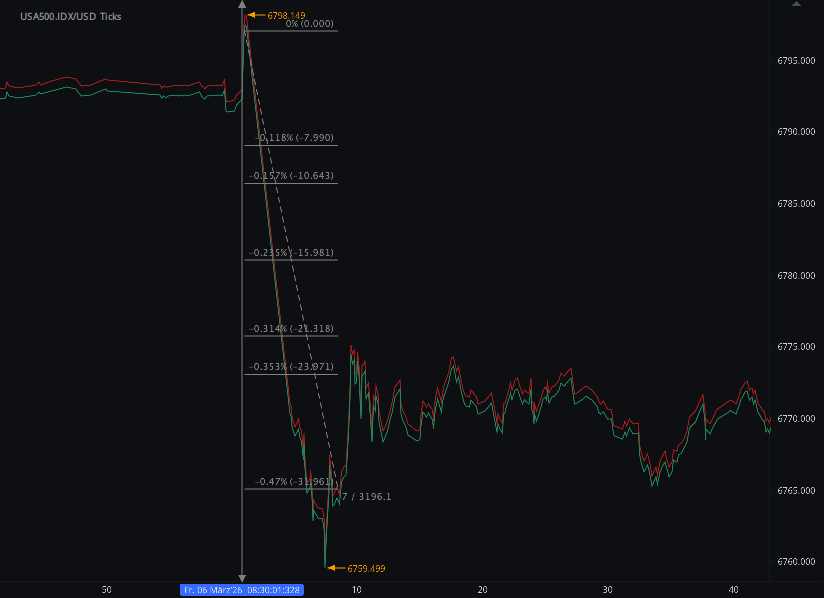
According to our analysis XAUUSD (spot gold) moved 16 points and US500 moved 31 points on US Employment Situation (Non-farm payrolls / NFP) data on 6 March 2026.

XAUUSD (16 points)

US500 (31 points)

Charts are exported from JForex (Dukascopy).


U.S. Jobs Report – February 2026: Payrolls Slip While Unemployment Holds Steady

The U.S. labor market showed signs of cooling in February 2026, according to the latest Employment Situation report from the Bureau of Labor Statistics (BLS). While the unemployment rate remained relatively stable, total nonfarm payroll employment declined slightly, highlighting a labor market that is still resilient but facing pockets of weakness across certain industries.

Payroll Employment Declines Slightly

Total nonfarm payroll employment fell by 92,000 jobs in February, reversing part of January’s gain of 126,000 jobs. The drop was largely influenced by job losses in specific sectors, particularly health care, information, and federal government employment.

Despite the monthly decline, the broader labor market picture remains mixed rather than sharply negative. Job growth throughout 2025 had already slowed considerably, and February’s figures suggest a continuation of that gradual moderation.

Unemployment Rate Holds at 4.4%

The unemployment rate remained unchanged at 4.4%, with approximately 7.6 million people unemployed in February. Across demographic groups—including adult men, adult women, teenagers, and major racial and ethnic categories—unemployment rates showed little change during the month.

However, one area of concern is long-term unemployment. The number of individuals unemployed for 27 weeks or longer reached 1.9 million, up from 1.5 million a year ago. Long-term unemployed workers now account for 25.3% of all unemployed people.

Labor Force Participation Remains Flat

Labor force participation and employment ratios also showed minimal movement:

  • Labor force participation rate: 62.0%

  • Employment-population ratio: 59.3%

Both measures have remained relatively stable over the past year. However, new population estimates from the U.S. Census Bureau affected the underlying data, particularly due to demographic shifts such as fewer men aged 25–54 and more women aged 65 and older—groups that historically participate in the workforce at different rates.

Sector Breakdown: Where Jobs Were Lost and Gained

Several industries experienced notable changes in February:

Health Care
Employment declined by 28,000 jobs, largely due to strike activity affecting physicians’ offices, which lost 37,000 jobs. Hospitals, however, added 12,000 positions.

Information Sector
The information industry continued its downward trend, shedding 11,000 jobs in February and averaging monthly losses over the past year.

Federal Government
Federal employment fell by 10,000 jobs. Since October 2024, federal employment has declined by 330,000 positions, representing an 11% drop.

Social Assistance
One of the few areas of consistent growth, social assistance added 9,000 jobs, primarily in individual and family services.

Transportation and Warehousing
Employment was mostly unchanged overall but saw losses in courier and messenger services, partially offset by gains in air transportation.

Wage Growth Continues

Despite softer employment numbers, wage growth remained solid.

  • Average hourly earnings: $37.32 (up $0.15 in February)

  • Year-over-year wage growth: 3.8%

Production and nonsupervisory employees saw earnings rise to $32.03 per hour, reflecting steady—though not accelerating—income growth for workers.

Workweek and Hours

The average workweek remained stable:

  • All private employees: 34.3 hours

  • Manufacturing: 40.1 hours (slightly lower)

  • Overtime in manufacturing: 3.0 hours

Stable hours suggest that employers are maintaining current staffing levels rather than significantly expanding or cutting back.

Data Revisions

The BLS also revised previous job numbers:

  • December 2025: Revised from +48,000 to –17,000

  • January 2026: Revised from +130,000 to +126,000

These revisions mean employment for those two months combined is 69,000 lower than previously reported.

Population Data Adjustments

February’s report also incorporated updated population estimates based on the 2020 Census. These revisions affected measures like labor force participation but did not change the unemployment rate.

The updated data indicates:

  • A decline in the number of men aged 25–54

  • An increase in women aged 65 and older

  • Changes in the racial composition of the population, including increases in Asian and multiracial populations

These demographic shifts slightly lowered overall labor force participation estimates.

What It Means for the Economy

February’s employment report paints a picture of a labor market that is stable but slowing. Unemployment remains low by historical standards, and wages continue to rise. However, job growth is weakening, certain industries are contracting, and long-term unemployment is creeping upward.

Economists will be watching closely to see whether February’s job losses represent temporary disruptions—such as strike activity—or the beginning of a more pronounced labor market slowdown.

The next Employment Situation report, covering March 2026, will be released on April 3, 2026.

Disclaimer: This blog post is for informational purposes only and should not be construed as financial advice. Always conduct thorough research and consider seeking advice from a financial professional before making any investment decisions.

Source: https://www.bls.gov/news.release/empsit.nr0.htm


Start forex fx futures news trading with Haawks G4A low latency machine-readable data today, one of the fastest news data feeds for US macro-economic and commodity data.

Please let us know your feedback. If you are interested in timestamps, please send us an email to sales@haawks.com.

Comment

Comment

16 pips, US500 12 points points potential profit in 31 seconds on 13 February 2026, analysis on futures forex fx low latency news trading USDJPY, EURUSD and US500 on US Consumer Price Index (CPI)

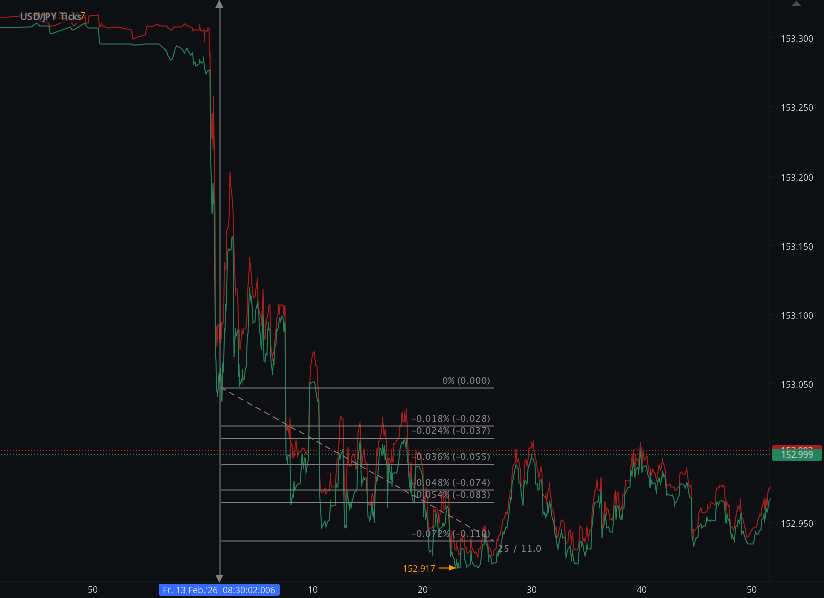
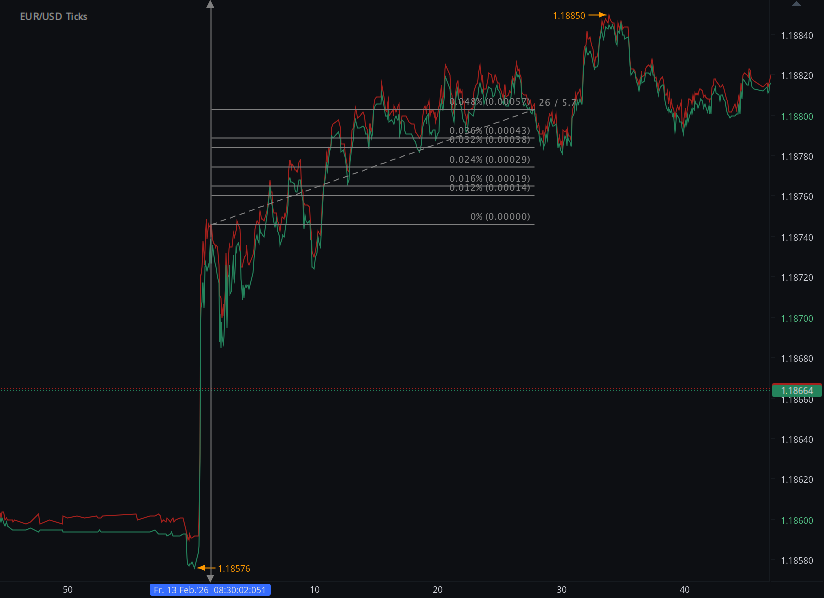
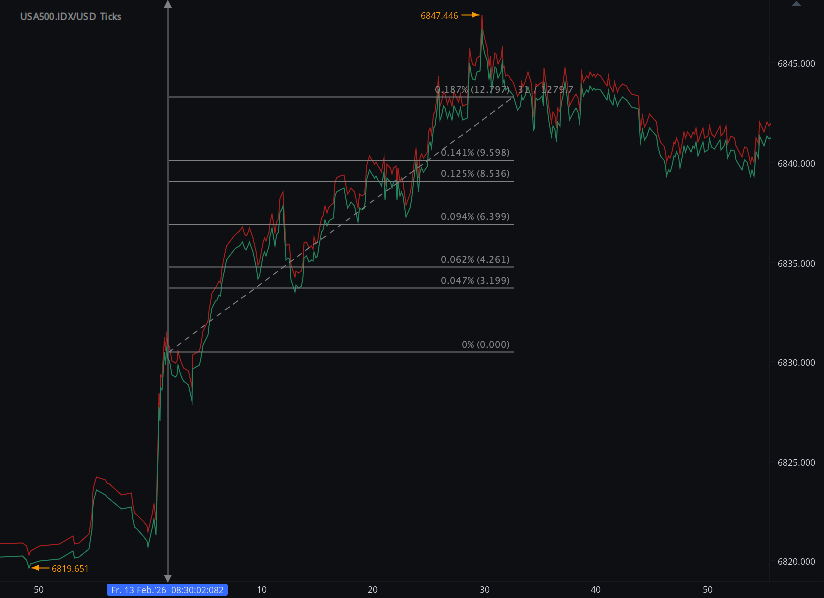
According to our analysis USDJPY and EURUSD moved 16 pips and US500 moved 12 points on US BLS Consumer Price Index (CPI) data on 13 February 2026.

USDJPY (11 pips)

EURUSD (5 pips)

US500 (12 points)

Charts are exported from JForex (Dukascopy).


Inflation Cools Further in January 2026 as Energy Prices Fall

The latest data from the U.S. Bureau of Labor Statistics show that inflation continued to moderate in January 2026, with overall price growth easing on both a monthly and annual basis.

Headline Inflation: Modest Monthly Increase

The Consumer Price Index for All Urban Consumers (CPI-U) rose 0.2 percent in January (seasonally adjusted). Over the past 12 months, prices increased 2.4 percent, down from 2.7 percent in December.

This marks continued progress toward price stability, with year-over-year inflation now firmly in the mid-2 percent range.

What Drove January’s Increase?

Several categories contributed to the monthly increase:

  • Shelter: +0.2%

  • Food: +0.2%

  • Core inflation (all items less food and energy): +0.3%

However, falling energy prices helped offset some of the upward pressure.

Energy Prices: A Key Relief Factor

Energy prices declined 1.5 percent in January, providing a notable offset to increases elsewhere.

  • Gasoline: −3.2% (−7.5% over the past year)

  • Electricity: −0.1% (but +6.3% over the past year)

  • Natural gas: +1.0% (+9.8% over the past year)

Over the last 12 months, overall energy prices are down 0.1 percent, largely due to the steep annual decline in gasoline.

Food Prices: Gradual but Persistent Growth

Food prices increased 0.2 percent in January.

Grocery Prices (Food at Home): +0.2%

Five of six major grocery categories rose:

  • Cereals and bakery products: +1.2%

  • Dairy products: +0.8%

  • Meats, poultry, fish, and eggs: +0.2%

  • Fruits and vegetables: +0.1%

  • Nonalcoholic beverages: +0.1%

On a 12-month basis, grocery prices are up 2.1 percent.

Dining Out (Food Away from Home): +0.1%

Restaurant prices rose more modestly in January but are still up 4.0 percent over the past year, with:

  • Full service meals: +4.7%

  • Limited service meals: +3.2%

Restaurant inflation continues to outpace grocery inflation.

Core Inflation: Services Still Firm

Core CPI (excluding food and energy) rose 0.3 percent in January and is up 2.5 percent year-over-year.

Key contributors:

Shelter

  • +0.2% in January

  • +3.0% over the past year

Owners’ equivalent rent and rent both rose 0.2% for the month.

Transportation Services

  • +1.4% in January

  • Airline fares surged 6.5% for the month.

Medical Care

  • +0.3% in January

  • +3.9% over the past year

  • Hospital services: +0.9% in January

Used Cars

  • −1.8% in January

  • −2.0% over the past year

Vehicle prices continue to normalize after earlier volatility.

Big Picture: Inflation Is Cooling, But Not Gone

Here’s where inflation stands:

Category12-Month ChangeAll Items2.4%Core (less food & energy)2.5%Food2.9%Energy−0.1%Shelter3.0%

The overall trend shows:

  • Energy prices helping moderate inflation.

  • Core services (especially shelter and medical care) continuing to rise.

  • Restaurant inflation remaining elevated.

  • Goods prices (like used vehicles) generally softening.

Additional Notes

  • The CPI index level now stands at 325.252 (1982–84 = 100).

  • CPI-W (Urban Wage Earners and Clerical Workers) rose 2.2% year-over-year.

  • The Chained CPI (C-CPI-U) increased 2.2% year-over-year.

  • October and November 2025 data were unavailable due to the 2025 lapse in appropriations.

  • Seasonal adjustment factors were revised, affecting data back five years.

What to Watch Next

The February 2026 CPI report will be released on March 11, 2026.

Markets and policymakers will be watching closely to see:

  • Whether energy continues to ease pressure,

  • If shelter inflation continues to moderate,

  • And whether core services remain sticky.

For now, January’s data suggest inflation is gradually stabilizing, though certain categories—particularly services—remain areas of persistent upward pressure.

Disclaimer: This blog post is for informational purposes only and should not be construed as financial advice. Always conduct thorough research and consider seeking advice from a financial professional before making any investment decisions.

Source: https://www.bls.gov/news.release/cpi.nr0.htm


Start futures forex fx news trading with Haawks G4A low latency machine-readable data, one of the fastest machine-readable news trading feed for US macro-economic and commodity data.

Please let us know your feedback. If you are interested in timestamps, please send us an email to sales@haawks.com.

Comment

Comment

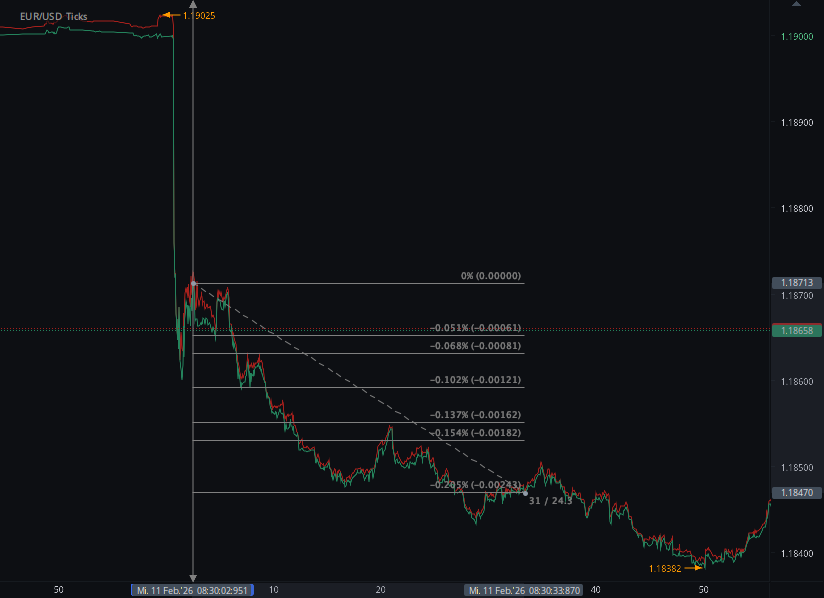
60 pips potential profit in 31 seconds on 11 February 2026, analysis on forex fx futures news trading USDJPY and EURUSD on US Employment Situation (NFP)

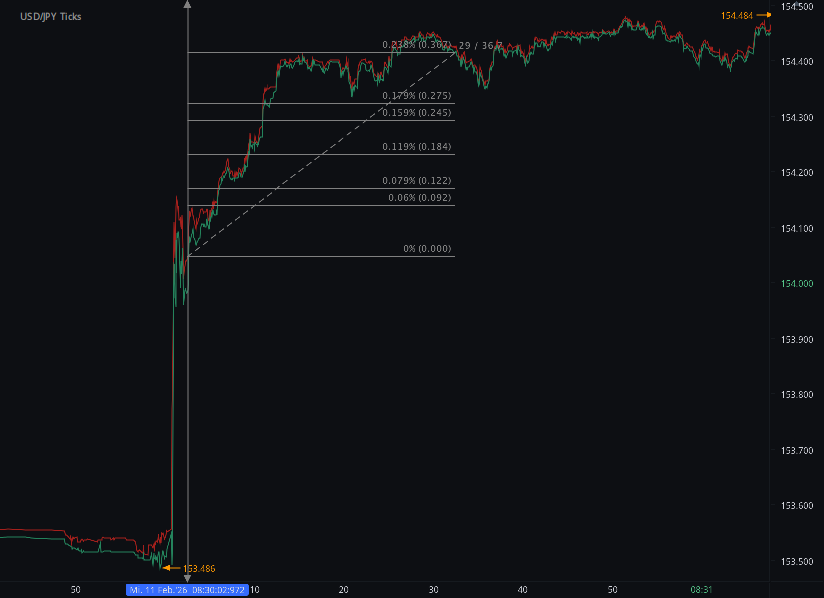
According to our analysis USDJPY and EURUSD moved 60 pips on US Employment Situation (Non-farm payrolls / NFP) data on 11 February 2026.

USDJPY (36 pips)

EURUSD (24 pips)

Charts are exported from JForex (Dukascopy).


U.S. Jobs Report – January 2026

Payrolls Rise by 130,000; Unemployment Rate Steady at 4.3%

The latest Employment Situation report from the U.S. Bureau of Labor Statistics shows a modest start to 2026. In January, total nonfarm payroll employment increased by 130,000 jobs, while the unemployment rate held steady at 4.3%.

Here’s what the numbers reveal about the current state of the labor market.

The Big Picture

  • 130,000 jobs added in January

  • Unemployment rate: 4.3% (unchanged)

  • Average hourly earnings: Up 0.4% to $37.17

  • Year-over-year wage growth: 3.7%

  • Labor force participation rate: 62.5% (little change)

While job growth continues, it remains moderate compared with historical expansion periods. The unemployment rate is slightly higher than a year ago (4.0% in January 2025), suggesting some cooling compared to last year.

Where Jobs Are Growing

Health Care Leads

Health care added 82,000 jobs in January:

  • +50,000 in ambulatory health care services

  • +18,000 in hospitals

  • +13,000 in nursing and residential care facilities

Health care averaged 33,000 jobs per month in 2025, making January’s increase notably strong.

Social Assistance Expands

Employment in social assistance rose by 42,000 jobs, primarily in individual and family services, reflecting continued demand for community-based support services.

Construction Rebounds

Construction added 33,000 jobs, largely in nonresidential specialty trade contractors (+25,000). After being essentially flat in 2025, the sector showed renewed momentum in January.

Sectors Losing Jobs

Not all industries expanded:

  • Federal government employment declined by 34,000, continuing a downward trend that began after a peak in October 2024. Since then, federal payrolls are down 327,000 jobs (−10.9%).

  • Financial activities fell by 22,000 jobs, including losses in insurance carriers.

These declines partially offset gains in health care and construction.

Household Survey Highlights

The household survey shows a largely stable labor market:

  • 7.4 million unemployed Americans

  • Long-term unemployed (27+ weeks): 1.8 million

  • Long-term unemployed account for 25% of all unemployed

Teen unemployment declined to 13.6%, while unemployment rates for adult men (3.8%), adult women (4.0%), and major racial and ethnic groups were largely unchanged.

The number of people working part time for economic reasons fell by 453,000 in January, though it remains higher than a year ago.

Wages and Hours

Wage growth remains steady:

  • Average hourly earnings: $37.17

  • Up 15 cents (0.4%) in January

  • Up 3.7% over the past year

For production and nonsupervisory workers:

  • $31.95 per hour

  • Also up 0.4% over the month

The average workweek edged up to 34.3 hours, suggesting stable labor demand.

Revisions and Benchmarking

The January release includes annual benchmark revisions:

  • March 2025 total nonfarm employment was revised down by 898,000 (seasonally adjusted).

  • 2025 job growth was revised from +584,000 to +181,000.

These revisions reflect updated payroll data from unemployment insurance records and improved seasonal adjustments — a standard statistical process designed to enhance accuracy.

Weather Impact?

Major winter storms affected large parts of the country in January. According to the BLS, they had no discernible impact on national payroll employment or unemployment rates, though survey response rates were slightly below average.

What This Means

January’s report shows:

  • Continued but moderate job growth

  • Stable unemployment

  • Solid wage gains

  • Sector-specific strength in health care and services

  • Ongoing weakness in federal government and financial activities

Overall, the labor market remains resilient but is expanding at a measured pace. The next Employment Situation report, due in early March, will provide further insight into whether this steady trend continues.

Disclaimer: This blog post is for informational purposes only and should not be construed as financial advice. Always conduct thorough research and consider seeking advice from a financial professional before making any investment decisions.

Source: https://www.bls.gov/news.release/empsit.nr0.htm


Start forex fx futures news trading with Haawks G4A low latency machine-readable data today, one of the fastest news data feeds for US macro-economic and commodity data.

Please let us know your feedback. If you are interested in timestamps, please send us an email to sales@haawks.com.

Comment

Comment

5 pips, US500 13 points, BTC 177 points potential profit in 62 seconds on 13 January 2026, analysis on futures forex fx low latency news trading EURUSD, US500 and BTC on US CPI

According to our analysis EURUSD moved 5 pips, US500 moved 13 points and BTC moved 177 points on US BLS Consumer Price Index (CPI) data on 13 January 2026.

EURUSD (5 pips)

US500 (13 points)

BTC (177 points)

Charts are exported from JForex (Dukascopy).


Inflation Ends 2025 Steady: What the December CPI Report Tells Us

The latest Consumer Price Index (CPI) report from the U.S. Bureau of Labor Statistics offers a clear snapshot of how inflation wrapped up 2025—and what it means for households heading into the new year.

Released on January 13, 2026, the report shows that inflation remains moderate but persistent, with price pressures still concentrated in essentials like housing, food, and certain services.

Headline Numbers at a Glance

  • Monthly CPI (December 2025): +0.3% (seasonally adjusted)

  • 12-month inflation rate: 2.7%, unchanged from November

  • Core inflation (excluding food & energy): 2.6% year over year

These figures suggest inflation is no longer accelerating, but it also hasn’t fully cooled back to pre-pandemic norms.

Housing: Still the Biggest Driver

Shelter costs were once again the largest contributor to December’s increase:

  • Shelter index: +0.4% in December

  • 12-month shelter inflation: +3.2%

Rent and owners’ equivalent rent both rose, while lodging away from home jumped sharply (+2.9% for the month). Housing remains the stickiest part of inflation—and the hardest for consumers to avoid.

Food Prices Pick Up Speed

Food prices rose faster than overall inflation in December:

  • Food (overall): +0.7% in December

  • Food at home: +2.4% year over year

  • Food away from home: +4.1% year over year

Notable details:

  • Grocery staples like dairy, cereals, fruits, and vegetables all increased.

  • Egg prices fell sharply (-8.2%), offering rare relief.

  • Restaurant prices continue to climb, especially for full-service meals.

For many households, food remains one of the most noticeable inflation pressures.

Energy: Mixed Signals

Energy prices edged higher overall, but the details matter:

  • Energy index: +0.3% in December, +2.3% over the year

  • Gasoline: -0.5% in December, -3.4% year over year

  • Electricity: +6.7% year over year

  • Natural gas: +10.8% year over year

Drivers benefited from cheaper gasoline, but utility bills—especially heating—continued to rise.

Services Inflation Remains Firm

Core services showed broad-based increases:

  • Medical care: +0.4% in December, +3.2% year over year

  • Recreation: +1.2% in December (largest monthly jump on record)

  • Airline fares: +5.2% in December

  • Personal care & education: continued steady increases

On the flip side:

  • Used cars and trucks: -1.1% in December

  • Communication services: -1.9%

What This Means for 2026

As 2025 closed:

  • Inflation appears stable, not surging—but not fully subdued.

  • Housing and services remain the key inflation risks.

  • Goods inflation (like vehicles and gasoline) continues to ease.

With the January 2026 CPI report scheduled for February 11, 2026, policymakers and consumers alike will be watching closely to see whether inflation finally drifts closer to the Federal Reserve’s long-term comfort zone.

Bottom Line

Inflation ended 2025 steady but uneven. While energy and goods offered some relief, everyday essentials—housing, food, and services—kept upward pressure on household budgets. The battle against inflation isn’t over, but it’s no longer spiraling out of control either.

Disclaimer: This blog post is for informational purposes only and should not be construed as financial advice. Always conduct thorough research and consider seeking advice from a financial professional before making any investment decisions.

Source: https://www.bls.gov/news.release/cpi.nr0.htm


Start futures forex fx news trading with Haawks G4A low latency machine-readable data, one of the fastest machine-readable news trading feed for US macro-economic and commodity data.

Please let us know your feedback. If you are interested in timestamps, please send us an email to sales@haawks.com.

Comment

Comment

12 pips, US500 6 points, BTC 678 points potential profit in 43 seconds on 18 December 2025, analysis on futures forex fx news trading EURUSD, US500 and BTC on US CPI and US Jobless Claims data

According to our analysis EURUSD moved 12 pips and US500 moved 6 points and BTC 678 points on US CPI and US Jobless Claims data on 18 December 2025.

EURUSD (12 points)

US500 (6 points)

BTC (678 points)

Charts are exported from JForex (Dukascopy).


Unemployment Claims, CPI, and the Macro Signal Going into 2026
A more technical read on the December 18, 2025 UI & CPI releases

The December 18, 2025 data dump gives us a fairly coherent macro picture:

  • Labor market: still tight by historical standards, with some sectoral and regional softening but no broad deterioration.

  • Inflation: headline and core running in the high-2% range, drifting down from 3%, with housing and services still doing most of the work on the “sticky” side.

Below is a more policy-wonk breakdown of what these releases are actually saying.

1. Labor Market: Claims Still at “Expansion” Levels

1.1 Initial claims: well within “normal” range

  • Initial claims (SA), week ending Dec 13:

    • 224k (-13k w/w from a revised 237k).

    • 4-week moving average: 217.5k (+0.5k).

In a labor force north of 165–170 million, claims in the low 200k range are typically associated with continuing expansion, not recession onset. This is consistent with past cycles where recessionary conditions usually show up with claims closer to 300k+ and/or a persistently rising 4-week average.

The November 29 print at 192k now looks like a bit of an outlier to the low side, and the December 6 spike to 237k looks like noise rather than the start of a trend.

1.2 Continued claims and IUR: mild firming, but no spike

  • Insured unemployment (SA), week ending Dec 6:

    • 1.897 million (+67k w/w from a revised 1.83 million).

    • Insured unemployment rate (IUR): 1.2% (unchanged).

    • 4-week average: 1.902 million (-14k).

Insured unemployment is oscillating in a pretty narrow band: 1.83–1.95 million over much of 2025. The fact that the IUR is flat at 1.2% while levels move around is a reminder that this is mostly noise around a tight steady state, not a structural shift.

You also see divergence between SA and NSA:

  • NSA insured unemployment: 1.88 million (week of Dec 6), down 75k w/w, rate down from 1.3% to 1.2%.

  • Seasonal factors had expected a larger decline, so relative to expectations, the labor market is slightly weaker than the NSA drop alone suggests—but not dramatically.

1.3 State-level patterns: sectoral and regional pockets

Highest insured unemployment rates (week ending Nov 29):

  • Washington 2.5%, New Jersey 2.4%, California 2.3%, Minnesota 2.2%, Massachusetts 2.1%, and Puerto Rico / Rhode Island 2.0%, with Alaska, Oregon 1.9% and Nevada, New York 1.8% close behind.

This is a familiar pattern: elevated IUR in states with:

  • Higher exposure to tech / services / high-wage sectors (CA, WA, MA).

  • Historically higher baseline UI recipiency rates and more generous programs (NJ, RI).

  • Structural or cyclical sectoral exposure (e.g., construction and logistics on the West Coast).

For the week ending Dec 6, the largest NSA increases in initial claims were:

  • CA +14,258

  • IL +11,074

  • NY +10,346

  • TX +8,206

  • GA +6,333

State comments attribute this largely to layoffs in construction, manufacturing, transportation/warehousing, and admin/support/waste management plus some health care and accommodation/food services.

Policy-relevant point: These look like sectoral adjustments, not broad-based, demand-driven layoffs. Construction and manufacturing are classic late-cycle cyclicals; seeing choppiness here doesn’t, on its own, scream “recession.”

1.4 Federal programs and total UI usage

On a not-seasonally adjusted basis:

  • Total continued weeks claimed in all programs, week ending Nov 29:

    • 1,993,823 (up 262,500 w/w; versus 1,960,319 a year earlier).

  • Extended Benefits (EB) is basically inactive:

    • Only 9 continued weeks claimed, and no state is triggered “on” EB.

  • STC/workshare: ~22.7k continued weeks, slightly below the prior year’s 23.2k.

From a macro/financial-stability lens, the fact that EB is not triggered anywhere is a strong indicator that labor market weakness is not yet systemic.

2. Inflation: A Controlled Downshift toward 2–3%

2.1 Headline vs. core

For November 2025 (12-month changes):

  • All items CPI-U: +2.7% (down from +3.0% for 12 months ending September).

  • Core CPI (all items less food and energy): +2.6%.

From September to November (2-month SA changes, because October is missing):

  • Headline CPI: +0.2% total over 2 months.

  • Core CPI: +0.2% over the same period.

  • Shelter: +0.2% over 2 months.

  • Energy: +1.1%, food: +0.1% (both over 2 months).

If you roughly annualize that 2-month +0.2% move, you’re getting something in the ballpark of 1–2% annualized, i.e., softer than the 12-month headline figure. You don’t want to over-interpret two months (especially with a measurement gap), but the direction is clearly disinflationary.

2.2 Shutdown-related measurement caveat

BLS did not collect survey data for October 2025 due to a lapse in appropriations, and could only retroactively acquire most non-survey data.

Implications:

  • Standard month-over-month time-series analysis is noisier than usual.

  • The 2-month percent changes (September–November) are a workaround, not a model change.

  • 12-month figures (e.g., +2.7% headline, +2.6% core) still serve as the main anchor for trend inflation.

For policy analysis, you basically discount very fine-grained inferences about October but still treat the broader trajectory as valid.

2.3 Decomposing headline inflation

Food (12-month changes):

  • Food overall: +2.6%

    • Food at home: +1.9%

      • Meats/poultry/fish/eggs: +4.7%

      • Nonalcoholic beverages: +4.3%

      • Cereals/bakery: +1.9%

      • Fruits/vegetables: +0.1%

      • Dairy and related products: -1.6%

    • Food away from home: +3.7%

      • Full-service meals: +4.3%

      • Limited service: +3.0%

Interpretation:

  • Grocery inflation is sub-3% and clustered mostly around protein and beverages.

  • Restaurant inflation remains notably hotter than food-at-home, reflecting labor and overhead costs—a classic “services stickiness” story.

Energy (12-month changes):

  • Energy overall: +4.2%

    • Gasoline: +0.9%

    • Fuel oil: +11.3%

    • Electricity: +6.9%

    • Utility (piped) gas: +9.1%

So energy is still a positive contributor, but the gasoline component is comparatively mild; the bigger story is household energy (utilities and fuel oil), both of which have direct cost-of-living and political salience.

Core components (12-month):

  • Core CPI: +2.6%

    • Shelter: +3.0%

    • Services less energy: +3.0%

    • Used cars and trucks: +3.6%

    • Household furnishings/operations: +4.6%

    • Medical care services: +3.3%

This is a services-heavy inflation profile with goods not doing much damage except in a handful of categories (used vehicles, furnishings). The shelter component is still running above 2%, but at levels much closer to pre-pandemic “normal high” than the 6–8% rates seen in the earlier inflation spike.

3. Policy Implications

3.1 Monetary policy: This is what “orderly disinflation” looks like

From a central bank perspective, this combination is about as close as you get to “soft landing” conditions:

  • Inflation has drifted down from 3.0% to 2.7%, with core at 2.6%, i.e., slightly above typical 2% targets but trending down.

  • Labor market is still tight: low initial claims, low insured unemployment, no EB triggers, and only modest increases in continued claims.

Key angles for policymakers:

  1. Output gap / NAIRU context

    • Claims and IUR at these levels are not consistent with a large positive unemployment gap. Labor markets still appear close to or slightly above most estimates of NAIRU.

    • Yet, inflation is not accelerating; it’s easing, which reinforces the idea that the post-pandemic inflation burst may have been driven more by supply shocks and sectoral imbalances than by persistent overheating alone.

  2. Wage-price dynamics

    • With services inflation still around 3% and restaurant prices up 3–4% YoY, underlying wage growth is likely still above 2–2.5%, but not clearly incompatible with a medium-term glide path to 2%.

    • The Fed will view the moderation in goods inflation and slowing shelter inflation as evidence that pass-through from earlier cost shocks is fading.

  3. Risk balance for rate decisions

    • Data like this tends to lower the urgency of further tightening.

    • It does not yet justify aggressive easing, given that core is still above target and services/shelter remain sticky.

    • Translation: it’s the kind of setup that supports a “hold for longer, cut cautiously later” stance rather than “hike again” or “slash now.”

3.2 Fiscal & labor-market policy: No crisis, but some micro hot spots

From a fiscal / labor-programs lens:

  • No sign of a UI-driven emergency:

    • EB is off everywhere.

    • Total UI usage is up only modestly year-over-year.

  • Sectoral and regional shocks are present:

    • Concentrated in construction, manufacturing, transportation/warehousing, and some services.

    • These are classic cases where targeted adjustment assistance, retraining, or infrastructure/green capex could absorb displaced workers rather than broad UI expansions.

The high IUR in states like WA, CA, NJ, MA, and OR suggests watching:

  • Tech and high-skill services exposure.

  • Local housing and cost-of-living issues that interact with labor mobility.

But nothing in the data screams “we’re about to blow through automatic stabilizers and need emergency discretionary intervention.”

3.3 Distributional and political economy angles

  • Shelter and utilities are still rising faster than headline, which hits renters and lower-income households hardest.

  • Food-at-home inflation is manageable, but restaurant prices remain elevated—visible to households and politically salient.

  • The shutdown-driven data gaps will likely become part of the “governance risk” discussion: if recurring shutdowns degrade data quality, it complicates real-time macro management.

4. How to Read This Going Forward

If you’re thinking about these releases in a policy-wonk framework, a few takeaways:

  • Trend inflation: High-2% and drifting down, not stuck in a 4–5% range.

  • Labor market: Still tight, but with normal late-cycle churn concentrated in cyclical sectors.

  • Policy stance: Data-dependent central bank can credibly stay on hold, lean dovish later if this disinflation trend persists, without immediate pressure to either re-tighten or pivot hard.

Disclaimer: This blog post is for informational purposes only and should not be construed as financial advice. Always conduct thorough research and consider seeking advice from a financial professional before making any investment decisions.

Source: https://www.dol.gov/ui/data.pdf, https://www.bls.gov/news.release/cpi.nr0.htm


Please let us know your feedback. If you are interested in timestamps, please send us an email to sales@haawks.com.

Start futures forex fx news trading with Haawks G4A low latency machine-readable data today, one of the fastest news data feeds for US macro-economic and commodity data.

Comment