
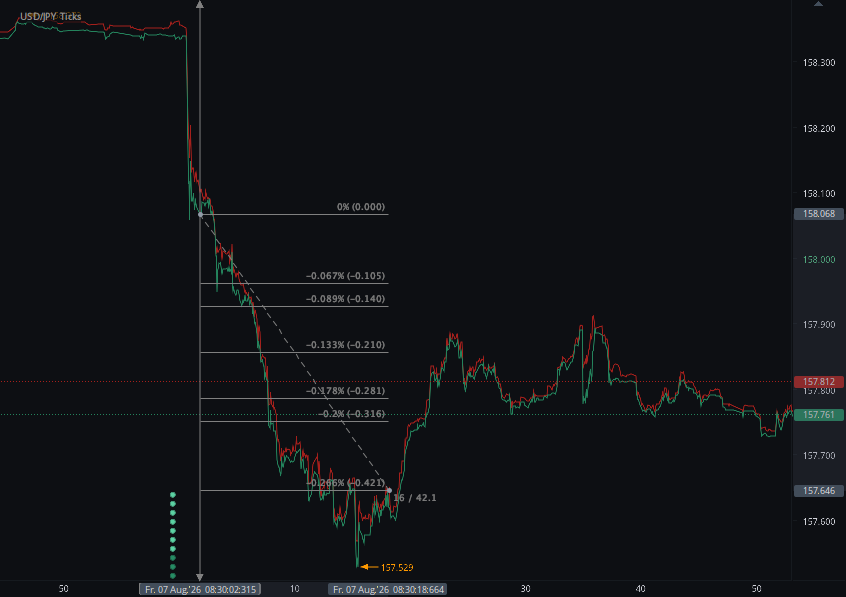
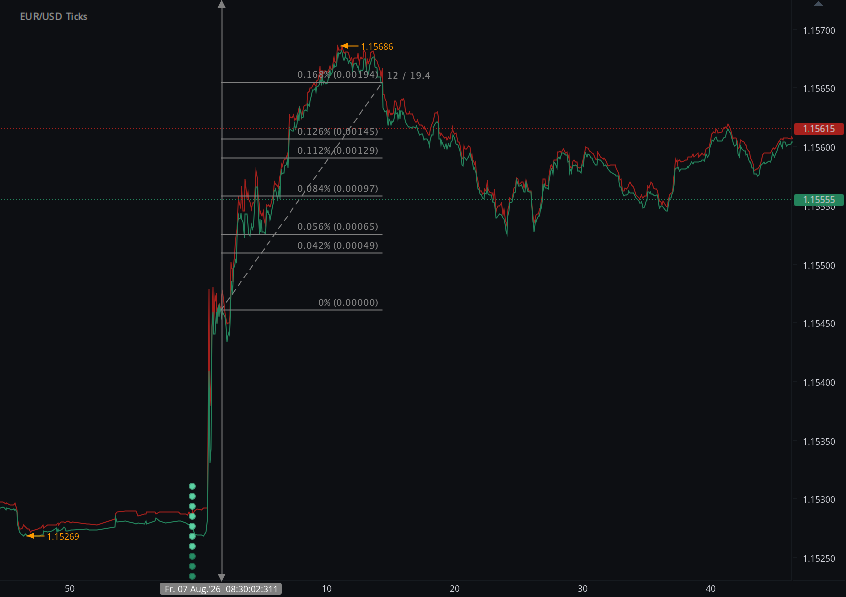
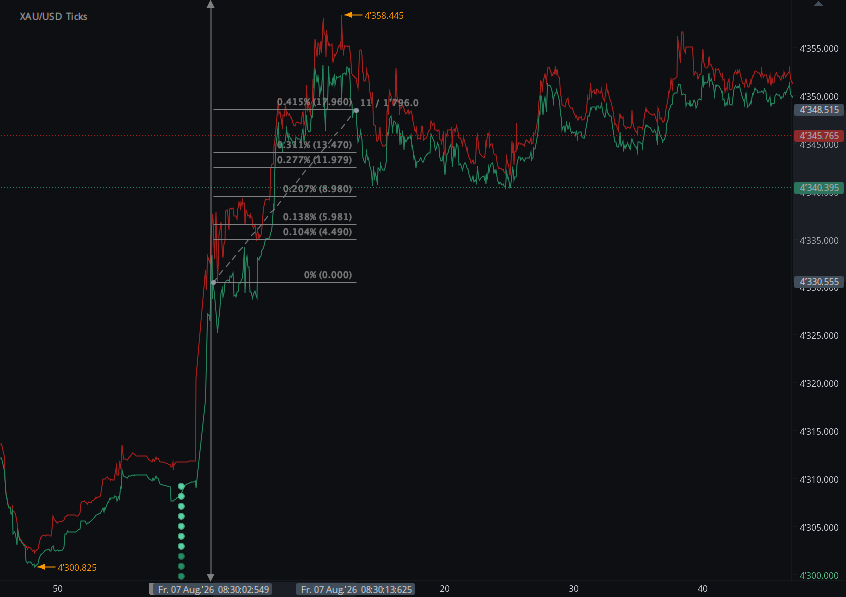
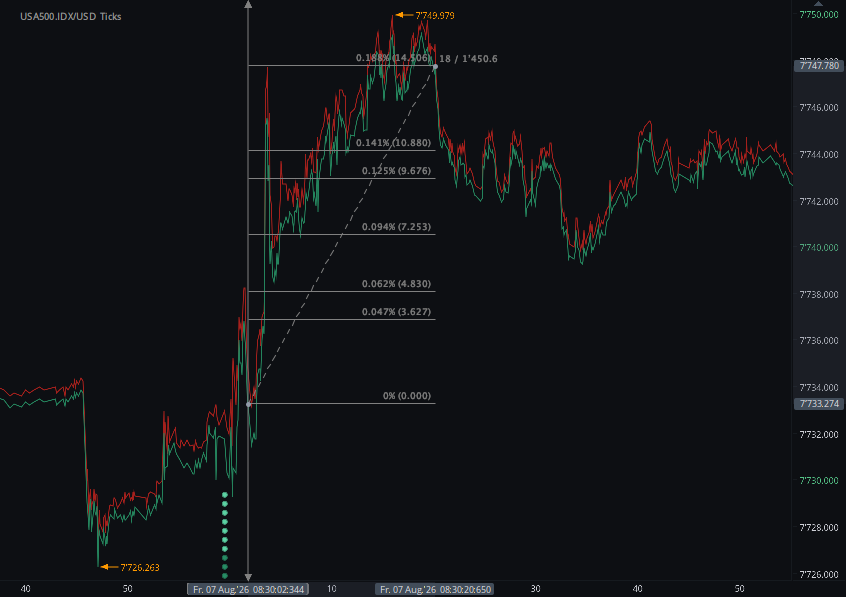
According to our analysis USDJPY moved 42 pips, EURUSD moved 19 pips, XAUUSD (spot gold) moved 17 points and US500 moved 56 ticks (117 ticks total) on US Employment Situation (Non-farm payrolls / NFP) data on 7 August 2026.
USDJPY (42 pips)
EURUSD (19 pips)
XAUUSD (17 points)
US500 (56 ticks)
Charts are exported from JForex (Dukascopy).
July 2026 NFP Shock: Payrolls Fall 23K as Markets Reprice the Fed
A surprise contraction in U.S. payrolls, weaker wage growth and another round of large downward revisions triggered rapid moves across FX, gold and U.S. equity indices.
The July 2026 U.S. Employment Situation delivered a significantly weaker labor-market signal than news traders had expected. Nonfarm payrolls declined by 23,000, compared with a Reuters consensus forecast for an 80,000 increase.
The unemployment rate fell from 4.2% to 4.1%, but the improvement in the headline rate came alongside another decline in labor force participation. The participation rate slipped to 61.4%, while the civilian labor force contracted by 264,000.
For news traders, the details behind the headline were arguably even more important. May and June payroll growth was revised lower by a combined 103,000 jobs, while annual average hourly earnings growth slowed to 3.2%.
NFP Estimates vs. Actual Release
| Labor Indicator | Expectation | Actual | HAAWKS News-Trader Read |
|---|---|---|---|
| Nonfarm Payrolls | +80K | −23K | A 103K downside surprise versus consensus and the primary negative headline for the dollar. |
| Unemployment Rate | 4.2% | 4.1% | Better on the surface, but less supportive once the decline in labor-force participation was taken into account. |
| Average Hourly Earnings YoY | 3.5% | 3.2% | Softer wage pressure reinforced the dovish interpretation of the employment report. |
| Labor Force Participation | — | 61.4% | Participation edged down from 61.5%, helping explain why the unemployment rate fell despite weak employment conditions. |
| May Payroll Revision | Previous: +129K | +63K | Revised lower by 66K. |
| June Payroll Revision | Previous: +57K | +20K | Revised lower by 37K. |
Immediate Market Reaction
The HAAWKS release-window measurements show how quickly the labor-market surprise was incorporated into prices. The initial response was consistent across the major macro markets: the U.S. dollar weakened, gold rallied and U.S. equities moved higher as traders reduced expectations for near-term Federal Reserve tightening.
| Market | Measured Move | Time Window | Direction | News-Trader Interpretation |
|---|---|---|---|---|
| USD/JPY | 42.1 pips | 16 seconds | Lower | The strongest measured FX reaction as the weak employment figures triggered rapid dollar selling against the yen. |
| EUR/USD | 19.4 pips | 12 seconds | Higher | Broad dollar weakness pushed the euro higher immediately after the release. |
| XAU/USD | 17.96 points | 11 seconds | Higher | Gold reacted quickly to lower yields, dollar weakness and a reduction in expected Federal Reserve tightening. |
| US500 | 14.6 index points | 18 seconds | Higher | Equity traders initially focused on the lower-rate implications of the employment miss rather than the negative growth signal. |
Why This Release Mattered to News Traders
1. The Headline Surprise Was Large
Payrolls were expected to rise by 80,000 but instead declined by 23,000. For automated and discretionary news traders, the 103,000-job gap versus consensus immediately changed the macro interpretation of the release.
2. Revisions Reinforced the Signal
May and June were revised down by a combined 103,000 jobs. That mattered because the release did not just report a weak July; it also showed that the preceding labor-market picture had been weaker than initially reported.
3. Unemployment Sent a Mixed Message
A fall in unemployment to 4.1% would ordinarily be interpreted as labor-market strength. However, the labor force shrank and participation slipped to 61.4%, reducing the positive impact of the headline unemployment rate.
4. Wage Growth Also Missed
Annual average hourly earnings growth slowed to 3.2% versus the 3.5% rate economists had expected. For rate-sensitive markets, softer wages added another dovish element to an already weak payroll report.
HAAWKS view: for news traders, this was a release where the components largely pointed in the same direction. The headline payroll miss, negative revisions and softer wage growth outweighed the lower unemployment rate. The result was a fast cross-asset repricing: USD lower, gold higher and equities higher.
Sector Detail: Where the Jobs Were Lost
The weakness was not evenly distributed across the economy. Local government education employment declined by 50,000, while retail trade lost 19,000 jobs. Financial activities employment continued to trend lower, falling by 14,000.
Health care remained one of the few areas of continued employment growth, adding 22,000 jobs during July, although that was slower than its average monthly gain over the previous year.
| Industry | July Change | HAAWKS Read-through |
|---|---|---|
| Local Government Education | −50K | The largest highlighted sector decline in the July report. |
| Retail Trade | −19K | Added to the evidence of weaker overall hiring momentum. |
| Financial Activities | −14K | Continued an existing downward employment trend. |
| Health Care | +22K | Continued to add jobs, but at a slower pace than its prior 12-month average. |
The Fed Repricing
Before the release, markets were debating whether persistent inflation could lead the Federal Reserve to raise rates at its September meeting. The unexpectedly weak jobs report materially reduced that probability.
That shift helps explain why assets that normally benefit from lower interest-rate expectations reacted so quickly. Treasury yields fell, the U.S. dollar weakened, gold advanced and U.S. stock futures initially rallied.
For news traders, the key point is that the market was not trading the payroll number in isolation. It was trading how the employment surprise changed the expected path of monetary policy.
News Trading Takeaways
Headline Data Is Only the First Layer
A fast NFP strategy must be able to process more than the payroll headline. Unemployment, wage growth and revisions can either confirm or contradict the initial signal.
Revisions Can Be Market-Moving
The 103,000 combined downward revision to May and June strengthened the bearish labor-market message. In some releases, prior-period revisions can matter as much as the current month's number.
Cross-Asset Confirmation Matters
USD/JPY lower, EUR/USD higher, gold higher and US500 higher represented a coherent initial macro reaction. When several rate-sensitive markets respond in the same direction, news traders receive useful confirmation of the market's interpretation.
Execution Risk Remains Critical
A measured market move is not the same as an achievable trading result. During high-impact releases, spreads can widen, liquidity can disappear, prices can gap and slippage can increase. Latency, order type, venue and risk controls remain critical to actual execution.
HAAWKS Conclusion
The July 2026 NFP release delivered a much weaker labor-market picture than traders had expected.
Nonfarm payrolls declined by 23,000 versus expectations for an 80,000 increase. May and June were revised down by another 103,000 jobs, while annual wage growth slowed to 3.2%.
Although unemployment fell to 4.1%, declining labor-force participation reduced the strength of that signal. The broader message from the report was therefore clearly softer than the headline unemployment rate alone suggested.
The immediate market reaction reflected that interpretation. HAAWKS measured 42.1 pips in USD/JPY in 16 seconds, 19.4 pips in EUR/USD in 12 seconds, 17.96 points in XAU/USD in 11 seconds and 14.6 index points in US500 in 18 seconds.
For news traders, the release is a useful example of why low-latency access to the complete data set matters. The payroll headline, unemployment rate, wage figures and revisions all arrived together and collectively determined the market's interpretation within seconds.
Trade smart. Stay informed. Stay ahead.
Built for News Traders
HAAWKS G4A delivers low-latency, machine-readable macroeconomic and commodity data directly from official sources for professional algorithmic and manual news trading.
Explore HAAWKS G4A Data FeedsSources
-
U.S. Bureau of Labor Statistics — Employment Situation,
July 2026
Official source for nonfarm payrolls, unemployment, labor-force participation, earnings, industry employment and prior-month revisions. -
Reuters — U.S. job growth expected to pick up in July
Used for the pre-release economist consensus of +80K payrolls, 4.2% unemployment and 3.5% annual wage growth. -
Reuters — U.S. suffers unexpected job losses in July
Used for post-release labor-market and financial-market context. -
Reuters — Dollar drops after weak U.S. jobs data
Used for broader FX and gold-market reaction following the report. -
Reuters — Markets reduce odds of September Fed rate hike
Used for the post-NFP monetary-policy repricing. -
HAAWKS internal tick-chart analysis — August 7, 2026
Used for the measured release-window reactions in USD/JPY, EUR/USD, XAU/USD and US500.
Built for traders who compete on speed. HAAWKS G4A delivers low-latency, machine-readable macroeconomic and commodity data via API infrastructure in Chicago, New York and London. Explore the feed, share your feedback, or contact us to request a free trial for qualified professionals.
