
Viewing entries in
Forex News Trading

Comment

US500 21 points and BTC 305 points potential profit in 180 seconds on 30 April 2025, analysis on futures forex fx low latency news trading US500 and BTC on US Gross Domestic Product (GDP) data

According to our analysis US500 moved 21 points and BTC moved 305 points on US Gross Domestic Product (GDP) data on 30 April 2025.

477 pips potential performance in 2025 (2025: 4,305)

US500 (21 points)

BTC (305 points)

Charts are exported from JForex (Dukascopy).


U.S. Economy Contracts Slightly in Q1 2025 Amid Rising Imports and Government Spending Cuts

Posted April 30, 2025

The U.S. economy experienced a mild contraction in the first quarter of 2025, according to the advance estimate released today by the Bureau of Economic Analysis (BEA). Real Gross Domestic Product (GDP) decreased at an annual rate of 0.3 percent from January through March, a sharp reversal from the 2.4 percent growth posted in the final quarter of 2024.

This downturn was driven primarily by a surge in imports—especially in consumer goods such as pharmaceuticals and capital goods like computer hardware—and a decline in federal government spending, notably on defense. These negative contributions were only partly offset by gains in investment, consumer spending, and exports.

A Deeper Look at the Components

Consumer Spending:
Consumer activity remained a bright spot in the economy, increasing during the quarter. Services led the charge, particularly in health care and housing-related expenditures. On the goods side, spending on nondurable goods rose, though this was partially offset by a dip in durable goods purchases.

Investment:
Private inventory investment saw notable growth, largely due to increased inventory in wholesale trade—especially drugs and sundries. This uptick played a major role in mitigating the overall GDP decline.

Imports and Exports:
The increase in imports significantly outpaced export growth, dragging down GDP. While exports did rise, they were not enough to offset the negative impact of higher imports. Notably, the BEA made an adjustment to remove a spike in silver bar imports from investment calculations, as such metals are considered valuables rather than productive assets under GDP accounting rules.

Government Spending:
Federal government expenditures decreased sharply, led by cuts in defense spending. This was partially balanced by a rise in compensation at the state and local government level, but overall, public sector spending contributed negatively to GDP.

Inflation Pressures Mount

Inflation picked up across key indicators. The gross domestic purchases price index rose 3.4 percent in Q1, compared to 2.2 percent in Q4 2024. The Personal Consumption Expenditures (PCE) price index increased 3.6 percent, with the core PCE index—excluding food and energy—rising 3.5 percent. These figures point to growing inflationary pressure, potentially shaping future monetary policy decisions.

Underlying Strength in Private Demand

Despite the headline GDP contraction, underlying private demand remained strong. Real final sales to private domestic purchasers—which combines consumer spending and fixed investment—grew by 3.0 percent, slightly higher than the 2.9 percent gain in Q4. This suggests the domestic private sector remains resilient.

The Wildfire Factor

Economic disruptions from January’s wildfires in Southern California, primarily in Los Angeles County, were embedded within the broader data but not isolated in the GDP estimate. Preliminary BEA figures estimate that these fires caused $34.0 billion in damage to privately owned fixed assets and $11.0 billion in losses to state and local government infrastructure. While such destruction does not directly affect GDP, it represents a significant loss of wealth.

Looking Ahead

Today’s report is an advance estimate and subject to revision. The second estimate, which will incorporate more complete data, is scheduled for release on May 29, 2025. This will also include preliminary figures on corporate profits, offering additional insight into the underlying economic conditions as the U.S. navigates a complex mix of inflation, investment shifts, and climate-related disruptions.

Disclaimer: This blog post is for informational purposes only and should not be construed as financial advice. Always conduct thorough research and consider seeking advice from a financial professional before making any investment decisions.

Source: https://www.bea.gov/news/2025/gross-domestic-product-1st-quarter-2025-advance-estimate


Start futures forex fx news trading with Haawks G4A low latency machine-readable data, one of the fastest machine-readable news trading feeds for macro-economic and commodity data from the US and Europe.

Please let us know your feedback. If you are interested in timestamps, please send us an email to sales@haawks.com.

Comment

Comment

28 ticks potential profit in 48 seconds on 24 April 2025, analysis on futures news trading natural gas on DOE Natural Gas Storage Report data

According to our analysis natural gas moved 28 ticks on DOE Natural Gas Storage Report data on 24 April 2025.

477 pips potential performance in 2025 (2024: 4,305)

Natural gas (28 ticks)

Charts are exported from JForex (Dukascopy).


Natural Gas Market Update: Week Ending April 23, 2025

The U.S. natural gas market experienced a broad decline in prices and demand this past week, influenced primarily by unseasonably warm weather and lower residential consumption across key regions. Here's a snapshot of the major trends driving the market, based on data from the U.S. Energy Information Administration (EIA) and S&P Global Commodity Insights.

Price Movements

National Benchmarks:

  • Henry Hub Spot Price dropped by 28 cents, from $3.21/MMBtu to $2.93/MMBtu.

  • May 2025 NYMEX Futures fell by 23 cents, ending at $3.022/MMBtu.

  • The 12-month strip (May 2025–April 2026) averaged $3.756/MMBtu, down 17 cents from the prior week.

Regional Highlights:

  • Northeast prices saw sharp declines due to warming temperatures. Boston’s Algonquin Citygate fell 68 cents to $2.19/MMBtu, while Transco Zone 6 NY dropped 65 cents to $2.08/MMBtu.

  • Waha Hub in the Permian Basin saw the largest regional decline, falling $1.33.

  • Houston Ship Channel stood out with an 11-cent increase.

Weather and Demand Impacts

Temperature swings significantly reduced heating demand in the Northeast:

  • Boston: Avg. temperature rose from 45°F to 56°F, leading to 72 fewer heating degree days.

  • New York (Central Park): Avg. temperature climbed 14°F to 62°F.

This warming trend led to a 51% drop in residential and commercial natural gas consumption in the Northeast, down 4.6 Bcf/d week-over-week.

Supply and Demand Overview

  • Total supply of natural gas fell by 1.0 Bcf/d (0.9%), mainly due to a 16.3% drop in net imports from Canada.

  • Dry gas production remained flat at 106.3 Bcf/d.

  • Total U.S. consumption dropped by 6.3 Bcf/d (8.7%), driven by a:

    • 31.7% decline in residential and commercial use (-6.7 Bcf/d),

    • 2.6% decline in industrial consumption (-0.6 Bcf/d),

    • Slight 3.3% increase in power generation use (+0.9 Bcf/d).

LNG Exports and Pipeline Activity

  • LNG pipeline receipts averaged 16.1 Bcf/d, down 0.7 Bcf/d from the previous week.

    • South Louisiana terminals led the drop, down 6.7% (0.7 Bcf/d).

    • South Texas and other U.S. terminals held steady.

  • 27 LNG vessels departed U.S. ports, carrying a combined 102 Bcf of natural gas.

Rig Activity

  • Natural gas rig count increased by 1 rig to 98.

    • Gains were noted in the Marcellus (+1) and Utica (+2).

    • Two rigs were dropped in unspecified regions.

  • Oil-directed rigs also rose by 1, bringing the total U.S. rig count to 585, still 34 rigs fewer than the same time last year.

Storage Update

  • Net injections into storage totaled 88 Bcf, above both the five-year average (58 Bcf) and last year’s injections (86 Bcf) for this week.

  • Working gas stocks stood at 1,934 Bcf, which is:

    • 2% below the five-year average,

    • 20% below last year’s level at this time.

Key Takeaway:
Warmer weather across the U.S. has significantly reduced natural gas consumption, especially in the Northeast, leading to falling prices and a slight build in storage. While supply has held relatively steady, the combination of reduced imports, softening demand, and flat production paints a picture of a well-supplied market under less pressure—at least for now.

Disclaimer: This blog post is for informational purposes only and should not be construed as financial advice. Always conduct thorough research and consider seeking advice from a financial professional before making any investment decisions.

Source: https://www.eia.gov/naturalgas/weekly/archivenew_ngwu/2025/04_24/


Start futures forex fx commodity news trading with Haawks G4A low latency machine-readable data, one of the fastest data feeds for DOE data.

Please let us know your feedback. If you are interested in timestamps, please send us an email to sales@haawks.com.
Comment

Comment

19 ticks potential profit in 93 seconds on 23 April 2025, analysis on futures news trading crude oil on DOE Petroleum Status Report data

According to our analysis crude oil moved 19 ticks on DOE Petroleum Status Report data on 23 April 2025.

449 pips potential performance in 2025 (2024: 4,305)

Light sweet crude oil (19 ticks)

Charts are exported from JForex (Dukascopy).


U.S. Weekly Petroleum Snapshot – April 18, 2025

The U.S. petroleum landscape for the week ending April 18, 2025, reveals a dynamic balance of supply, demand, and prices amid seasonal transitions and evolving energy trends. Let’s break down the latest Weekly Petroleum Status Report from the U.S. Energy Information Administration (EIA).

Refinery Operations and Output

U.S. crude oil refinery inputs averaged 15.9 million barrels per day, rising by 326,000 barrels per day compared to the previous week. Refineries operated at 88.1% of their operable capacity, reflecting an uptick as refineries ramp up ahead of peak driving season.

  • Gasoline production: Rose to 10.1 million barrels/day

  • Distillate fuel production: Dropped slightly to 4.6 million barrels/day

Imports and Inventories

Crude oil imports fell notably:

  • Crude imports: Dropped to 5.6 million barrels/day, down 412,000 from the previous week

  • Four-week average: 6.1 million barrels/day, 6.8% lower than last year

Meanwhile, inventory trends showed a mixed bag:

  • Crude oil inventories (excluding SPR): Up by 0.2 million barrels to 443.1 million barrels, still 5% below the five-year seasonal average

  • Gasoline inventories: Down 4.5 million barrels, now 3% below average

  • Distillate inventories: Down 2.4 million barrels, a significant 13% below average

  • Propane/propylene: Up 2.3 million barrels, but 7% below average

  • Total commercial petroleum inventories: Declined 0.7 million barrels

Product Demand

Demand remained relatively strong:

  • Total products supplied: Averaged 19.9 million barrels/day, up 0.4% year-over-year

  • Gasoline supplied: 8.7 million barrels/day, slightly down (0.4%) from last year

  • Distillate fuel supplied: 3.9 million barrels/day, up a robust 12.8%

  • Jet fuel supplied: Surged 13.8%, signaling increased air travel demand

Retail Fuel Prices

Prices continued their downward trend:

  • Regular gasoline: Averaged $3.141/gallon, down $0.027 from last week and $0.527 below last year

  • Diesel fuel: Averaged $3.534/gallon, down $0.045 week-over-week and $0.458 below year-ago levels

Looking Ahead

The report suggests a seasonal tightening in gasoline inventories even as production ramps up. Meanwhile, strong distillate and jet fuel demand reflects broader economic activity. Retail fuel prices remain considerably lower than in 2024, which could support continued consumer travel and freight movement into the summer.

Refiners appear to be preparing for peak season with increased utilization and production. However, below-average inventories in key product categories may make markets more sensitive to disruptions or spikes in demand.

Conclusion With gasoline inventories dropping and demand for jet and distillate fuels rising sharply, all eyes are on how refiners and importers respond heading into summer. Continued lower prices at the pump are welcome news for consumers, though tightening supply conditions warrant close monitoring.

Disclaimer: This blog post is for informational purposes only and should not be construed as financial advice. Always conduct thorough research and consider seeking advice from a financial professional before making any investment decisions.

Source: https://www.eia.gov/petroleum/supply/weekly/archive/2025/2025_04_23/pdf/highlights.pdf


Start futures forex fx commodity news trading with Haawks G4A low latency machine-readable data, one of the fastest data feeds for DOE data.

Please let us know your feedback. If you are interested in timestamps, please send us an email to sales@haawks.com.

Comment

Comment

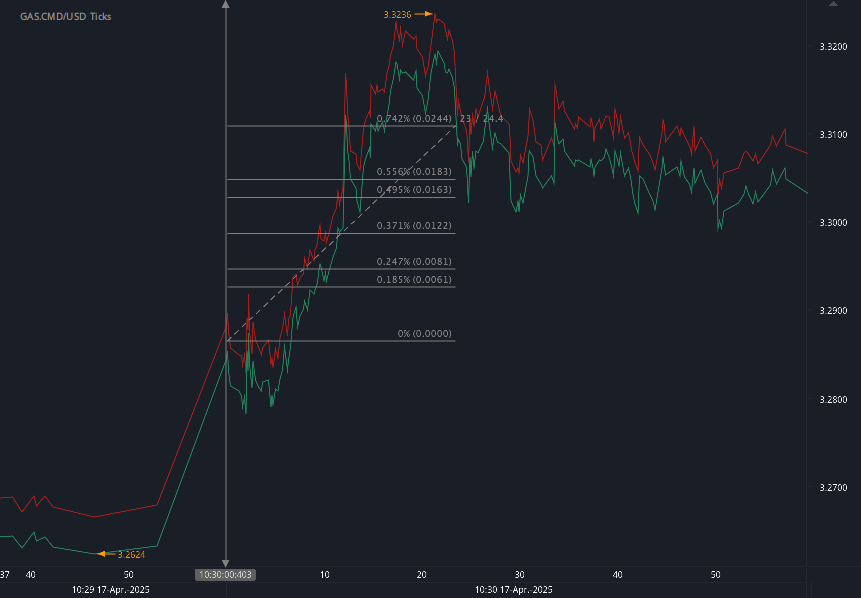
24 ticks potential profit in 23 seconds on 17 April 2025, analysis on futures news trading natural gas on DOE Natural Gas Storage Report data

According to our analysis natural gas moved 24 ticks on DOE Natural Gas Storage Report data on 17 April 2025.

430 pips potential performance in 2025 (2024: 4,305)

Natural gas (24 ticks)

Charts are exported from JForex (Dukascopy).


Natural Gas Market Update: Prices Decline Despite Regional Spikes and Supply Constraints
Week Ending April 16, 2025

This past week in the natural gas market saw a notable divergence between national and regional pricing trends, slight shifts in supply and demand dynamics, and continued robust activity in liquefied natural gas (LNG) exports.

Price Trends: National Benchmarks Down, Regional Prices Mixed

Henry Hub Prices:
The benchmark Henry Hub spot price dropped by $0.22, settling at $3.21/MMBtu. Futures prices followed suit, with the May 2025 NYMEX contract falling $0.57 to $3.247/MMBtu. The 12-month strip (May 2025–April 2026) also declined $0.34 to average $3.929/MMBtu.

Regional Spot Markets:
Spot price movements were varied. While the Algonquin Citygate saw a steep $0.66 drop, the Northwest Sumas hub surged $1.01 to $1.82/MMBtu, driven by cooler temperatures and a temporary outage at the Columbia Nuclear Generating Station. Southern California's SoCal Citygate also saw a $0.23 increase, coinciding with warmer weather and elevated cooling demand.

International LNG Markets:
East Asian LNG prices fell $0.45 to $12.40/MMBtu, while Dutch TTF futures dropped $0.39 to $11.35/MMBtu. Despite these decreases, both markets remain well above their year-ago levels.

Supply and Demand Dynamics

Supply:
Total U.S. natural gas supply dipped slightly by 0.1% to 106.3 Bcf/d. Dry production increased by 0.5 Bcf/d, but net imports from Canada fell 9.3%, or 0.6 Bcf/d—impacted in part by reduced flows into the Pacific Northwest.

Demand:
Overall consumption fell 6.9%, with the most significant drop in the residential/commercial sector (-14.1%). Power generation demand declined 5.4%, and industrial use slipped 1.4%. Exports to Mexico fell by 3.6%, while LNG feed gas deliveries rose modestly by 0.2 Bcf/d to 16.8 Bcf/d.

LNG Activity Remains Strong

Thirty-four LNG vessels departed U.S. terminals between April 10 and April 16, carrying a total capacity of 129 Bcf. Sabine Pass led departures with 10 vessels. Deliveries to South Louisiana terminals increased, while South Texas saw a minor decline.

Storage Levels Lag Behind Seasonal Norms

Net injections into storage were 16 Bcf—well below the five-year average of 50 Bcf and last year’s 46 Bcf. Total working stocks now sit at 1,846 Bcf, marking a 4% deficit against the five-year average and a 21% shortfall year-over-year.

Rig Count Shows Slight Rebalancing

The natural gas rig count rose by one to 97. Regional shifts included a gain in Haynesville and a drop in the Marcellus. The overall rig count (including oil and miscellaneous) fell to 583, down 34 from a year ago.

Conclusion:
Despite seasonal shifts in weather and slight production gains, the natural gas market continues to feel pressure from subdued demand and underwhelming storage injections. While regional price volatility reflects localized supply issues and temperature-driven demand, national and international markets are trending downward—pointing to a cautious short-term outlook.

Disclaimer: This blog post is for informational purposes only and should not be construed as financial advice. Always conduct thorough research and consider seeking advice from a financial professional before making any investment decisions.

Source: https://www.eia.gov/naturalgas/weekly/archivenew_ngwu/2025/04_17/


Start futures forex fx commodity news trading with Haawks G4A low latency machine-readable data, one of the fastest data feeds for DOE data.

Please let us know your feedback. If you are interested in timestamps, please send us an email to sales@haawks.com.

Comment

Comment

29 ticks potential profit in 29 seconds on 9 April 2025, analysis on futures news trading crude oil on DOE Petroleum Status Report data

According to our analysis crude oil moved 29 ticks on DOE Petroleum Status Report data on 9 April 2025.

406 pips potential performance in 2025 (2024: 4,305)

Light sweet crude oil (29 ticks)

Charts are exported from JForex (Dukascopy).


U.S. Petroleum Market Snapshot – Week Ending April 4, 2025

The U.S. Energy Information Administration’s latest Weekly Petroleum Status Report offers a detailed overview of refinery activity, inventory shifts, import levels, and product supply trends. The data highlights a broadly steady refining environment with subtle but important changes in stock levels and product flows.

Refinery Activity

During the week ending April 4, 2025, U.S. crude oil refinery inputs averaged 15.6 million barrels per day. This represents a slight increase of 69,000 barrels per day compared to the previous week. Refineries operated at 86.7% of operable capacity, nearly unchanged from the prior week's 86.6%, but lower than the 88.3% level recorded during the same period last year.

Production of key refined products showed a week-over-week decline. Motor gasoline production averaged 8.9 million barrels per day, while distillate fuel oil production averaged 4.7 million barrels per day—both lower than the previous week’s figures and also below year-ago levels.

Crude Oil and Product Imports

U.S. crude oil imports averaged 6.2 million barrels per day, a decrease of 277,000 barrels per day from the prior week. Over the last four weeks, imports have averaged 6.1 million barrels per day, 6.9% less than during the same period last year.

Motor gasoline imports last week averaged 778,000 barrels per day, while distillate fuel imports came in at 69,000 barrels per day.

Net imports over the past four weeks averaged:

  • Crude oil: 1.96 million barrels per day

  • Petroleum products: -4.95 million barrels per day

  • Total: -2.98 million barrels per day

Inventory Changes

Commercial crude oil inventories, excluding those in the Strategic Petroleum Reserve (SPR), increased by 2.6 million barrels, reaching a total of 442.3 million barrels. This level is approximately 5% below the five-year average for this time of year.

Motor gasoline inventories decreased by 1.6 million barrels to 236.0 million barrels, which is in line with the five-year average. Within that category, finished gasoline stocks increased, while blending component inventories decreased.

Distillate fuel inventories dropped significantly, falling by 3.5 million barrels to 111.1 million barrels. These inventories are now about 9% below the five-year average. Propane/propylene inventories rose by 1.5 million barrels but remain 5% below the seasonal norm.

Total commercial petroleum inventories increased modestly by 1.2 million barrels over the week.

Product Supplied

The four-week average for total products supplied—a proxy for demand—was 19.6 million barrels per day, down 1.9% compared to the same period last year.

Motor gasoline product supplied averaged 8.6 million barrels per day over the past four weeks, down 2.8% from the same period last year. In contrast, distillate fuel oil product supplied rose by 7.3% to 3.8 million barrels per day. Jet fuel product supplied also increased, up 5.2% year-over-year.

This data reflects ongoing structural shifts in supply and demand across key fuel categories and underscores the importance of monitoring both production levels and inventory trends.

Disclaimer: This blog post is for informational purposes only and should not be construed as financial advice. Always conduct thorough research and consider seeking advice from a financial professional before making any investment decisions.

Source: https://www.eia.gov/petroleum/supply/weekly/archive/2025/2025_04_09/pdf/highlights.pdf


Start futures forex fx commodity news trading with Haawks G4A low latency machine-readable data, one of the fastest data feeds for DOE data.

Please let us know your feedback. If you are interested in timestamps, please send us an email to sales@haawks.com.

Comment

Comment

27 ticks potential profit in 26 seconds on 3 April 2025, analysis on futures forex fx news trading natural gas on DOE Natural Gas Storage Report data

According to our analysis natural gas moved 27 ticks on DOE Natural Gas Storage Report data on 3 April 2025.

377 pips potential performance in 2025 (2024: 4,305)

Natural gas (27 ticks)

Charts are exported from JForex (Dukascopy).


Weekly Natural Gas Storage Report: Bearish Signal as Storage Builds, Prices Slip

Published April 5, 2025

Natural Gas Slips as Storage Climbs—Is a Bearish Trend Setting In?

Traders keeping a close eye on the EIA's Weekly Natural Gas Storage Report just got a fresh signal—and it’s leaning bearish.

For the week ending March 28, 2025, working gas in storage across the Lower 48 increased by 29 Bcf, bringing total inventories to 1,773 Bcf. This marks a steady build from the prior week’s 1,744 Bcf and sends a clear message: demand isn’t outpacing supply just yet.

The market reacted accordingly—natural gas futures slid 27 ticks on the report release. With warmer spring temps starting to roll in and injection season underway, traders are now weighing the potential for additional downside in the weeks ahead.

Key Takeaways from the Report:

  • Total Storage: 1,773 Bcf (+29 Bcf week-over-week)

  • Year-over-Year Deficit: -491 Bcf vs. March 28, 2024

  • 5-Year Average Gap: -80 Bcf

  • Regions Seeing Gains:

    • South Central led with a 33 Bcf build

    • Pacific and Mountain regions also saw increases

  • Declines Noted:

    • East (-14 Bcf) and Midwest (-3 Bcf) showed drawdowns, but not enough to offset overall builds

What This Means for Traders:

Despite inventories still being below the 5-year average, the consistent builds—and especially the strength from the South Central region—are signaling a pivot from withdrawal season into a more storage-heavy pattern. That’s typically bearish unless unexpected weather shifts or LNG exports shake up demand.

The fact that natural gas dropped 27 ticks post-release reinforces that sentiment. Traders are likely seeing this as confirmation that supply is adequate for now.

Price Action & Market Outlook:

This 27-tick drop could be the start of a broader move if upcoming reports show continued builds. With total stocks still within the 5-year historical range, the downside may have room to run unless production slows or cooling demand picks up unexpectedly.

Watchlist for Next Week:

  • April 10, 2025: Next storage report

  • Weather forecasts—any late-season cold could shift the tone

  • LNG export data—still a wild card for demand strength

Source: https://ir.eia.gov/ngs/ngs.html


Start futures forex fx commodity news trading with Haawks G4A low latency machine-readable data, one of the fastest data feeds for DOE data.

Please let us know your feedback. If you are interested in timestamps, please send us an email to sales@haawks.com.

Comment

Comment

21 pips potential profit in 24 seconds on 1 April 2025, analysis on futures forex fx news trading EURUSD and USDJPY on US BLS Job Openings and Labor Turnover Survey (JOLT)

According to our analysis USDJPY and EURUSD moved 21 pips on US BLS Job Openings and Labor Turnover Survey (JOLT) data on 1 April 2025.

350 pips potential performance in 2025 (2024: 4,305)

USDJPY (17 pips)

EURUSD (4 pips)

Charts are exported from JForex (Dukascopy).


JOLTS Report Breakdown – What February 2025 Tells Traders About the Labor Market

The latest Job Openings and Labor Turnover Survey (JOLTS) report dropped this morning, and while the headline summary says “little changed,” the details tell a more nuanced story for markets.

For February 2025:

  • Job Openings: 7.6 million (down 194,000 month-over-month, down 877,000 year-over-year)

  • Hires: 5.4 million (unchanged)

  • Total Separations: 5.3 million (unchanged)

  • Quits: 3.2 million (unchanged, down 273,000 year-over-year)

  • Layoffs & Discharges: 1.8 million (unchanged)

Here’s what it all means from a trading lens:

1. Job Openings Decline Continues
Job openings fell by 194,000 in February following a slight upward revision to January’s number. That’s nearly 900,000 fewer openings compared to a year ago. At 4.5%, the openings rate suggests employer demand is still solid but cooling.

Market Implication:
This labor market softening supports a dovish tilt from the Fed. A slower pace of hiring demand should help temper wage inflation, giving rate-cut narratives more traction. Expect continued strength in bonds and growth equities if this trend holds.

2. Quits Rate Remains Low
At 2.0%, the quits rate hasn’t budged. Workers still aren’t leaving jobs like they were a year ago, which points to reduced job-hopping confidence and easing wage pressures.

Market Implication:
Wage growth moderation is a positive signal for inflation control. This is especially bullish for duration-sensitive assets, including tech, Treasuries, and REITs.

3. Layoffs Up in Retail and Real Estate
The total number of layoffs and discharges held steady overall, but under the hood, key sectors saw increases:

  • Retail Trade: +67,000

  • Real Estate and Leasing: +24,000

  • Federal Government: +18,000

  • Transportation/Warehousing: -42,000 (a notable decline)

Market Implication:
Weakness in retail and real estate may translate into pressure on consumer and housing stocks. But fewer layoffs in transportation could support cyclical or industrial names.

4. Small Business Labor Pressure
Firms with 1–9 employees saw a decrease in quits and other separations but an increase in layoffs/discharges—hinting at mounting strain in the small business segment.

Market Implication:
Small caps and regional banks could feel more pressure if this continues. Keep an eye on the Russell 2000 and credit-sensitive financials.

5. January Revisions Worth Watching

  • Job openings revised up to 7.8M

  • Hires revised down by 22K

  • Quits revised down by 10K

  • Layoffs revised up by 39K

Market Implication:
While the revisions are modest, they reinforce the theme of a gradually softening labor market. That may strengthen the argument for Fed cuts if this trajectory continues.

Looking Ahead
The next JOLTS report (for March) lands April 29—right before the next FOMC meeting. If labor demand and confidence continue sliding, expect the market to more aggressively price in rate cuts for mid-2025.

Source: https://www.bls.gov/news.release/jolts.nr0.htm


Start futures #forex fx news #trading with Haawks G4A low latency machine-readable data today, one of the fastest news data feeds for US macro-economic and commodity data.

Please let us know your feedback. If you are interested in timestamps, please send us an email to sales@haawks.com.

Comment

Comment

US30 154 points and BTC 592 points potential profit in 12 seconds on 14 March 2025, analysis on futures forex fx low latency news trading US30 and BTC Bitcoin on Michigan Consumer Sentiment

According to our analysis US30 moved 154 points and BTC 592 points on University Michigan Consumer Sentiment / Inflation Expectations data on 14 March 2025.

329 pips potential performance in 2025 (2024: 4,305)

US30 (154 points)

BTC (592 points)

Charts are exported from JForex (Dukascopy).


Market Sentiment Crashes: What Traders Need to Know

March 2025 has delivered another major blow to consumer sentiment, marking the third consecutive month of decline. According to the preliminary data, the Index of Consumer Sentiment dropped 10.5% from February and a staggering 27.1% year-over-year. Economic uncertainty continues to rattle consumers and traders alike, with ripple effects visible across the markets.

Key Takeaways:

  • Consumer sentiment plunged to 57.9, down from 64.7 in February and 79.4 a year ago.

  • Economic expectations deteriorated sharply, with the Index of Consumer Expectations plummeting 15.3% month-over-month and 30.0% year-over-year.

  • Year-ahead inflation expectations surged to 4.9%, up from 4.3% last month, the highest reading since November 2022.

  • Long-run inflation expectations spiked to 3.9%, marking the biggest monthly jump since 1993.

  • Market reactions: The Dow Jones Industrial Average (US30) dropped 154 points, while Bitcoin (BTC) fell 592 points.

Breaking Down the Market Impact

Equities Market: Bearish Momentum Persists

Consumer sentiment is often a leading indicator of market performance, and the latest data suggests continued weakness. The 154-point drop in the Dow underscores mounting concerns about economic uncertainty and inflationary pressures.

Key sectors to watch:

  • Retail & Consumer Goods: With sentiment tumbling, discretionary spending could take a hit. Watch out for bearish trends in companies reliant on consumer confidence, such as major retailers and automakers.

  • Financials: Rising inflation expectations could push interest rates higher, impacting lending and borrowing costs. Banks may see short-term gains but long-term risks.

  • Technology: Growth stocks, particularly those sensitive to interest rate movements, may experience increased volatility.

Crypto Market: BTC’s Decline Reflects Risk Aversion

Bitcoin’s 592-point drop aligns with the broader trend of risk-off sentiment. Higher inflation expectations can lead to more aggressive monetary tightening, reducing liquidity and dampening demand for speculative assets like crypto. Traders should watch for:

  • Support Levels: BTC needs to hold key technical levels to prevent further downside pressure.

  • Macroeconomic Cues: Any hawkish signals from central banks could exacerbate selling pressure.

  • Altcoin Correlations: The broader crypto market tends to follow BTC’s lead, so caution is warranted across the board.

Trading Strategies in a Volatile Environment

Short-Term Plays:

  • Hedge Against Inflation: Consider commodities such as gold and energy stocks, which often perform well in inflationary environments.

  • Short Weak Sectors: Retail, consumer discretionary, and high-growth tech stocks may struggle in the current climate.

  • Play the Volatility: Options strategies like straddles or strangles could be useful given heightened uncertainty.

Long-Term Positioning:

  • Defensive Stocks: Sectors like healthcare, utilities, and consumer staples tend to be more resilient during economic downturns.

  • Dividend Payers: Stocks with strong dividend yields can provide stability amidst market turbulence.

  • Crypto Accumulation: If BTC continues to correct, long-term holders might find opportunities to buy on dips.

What’s Next?

The final March sentiment report is set for release on March 28, 2025. Until then, expect continued volatility as traders digest the latest data. The biggest wild card remains policy uncertainty—any shifts in fiscal or monetary policy could further disrupt market stability. Keep a close eye on inflation trends, central bank actions, and earnings reports for guidance on the next moves.

Stay sharp, stay hedged, and trade smart!

Disclaimer: This blog post is for informational purposes only and should not be construed as financial advice. Always conduct thorough research and consider seeking advice from a financial professional before making any investment decisions.

Source: http://www.sca.isr.umich.edu


Start futures and forex fx news trading with Haawks G4A low latency machine-readable data, one of the fastest machine-readable news trading feeds for US macro-economic and commodity data.

Please let us know your feedback. If you are interested in timestamps, please send us an email to sales@haawks.com.

Comment

Comment

20 pips and BTC 280 points potential profit in 218 seconds on 14 Februar 2025, analysis on futures forex fx news trading USDJPY and BTC on US Retail Sales data

According to our analysis USDJPY and BTC moved 20 pips and 280 points on US Retail Sales data on 14 February 2025.

289 pips potential performance in 2025 (2024: 4,305)

USDJPY (20 pips)

BTC (280 points)

Charts are exported from JForex (Dukascopy).


Market Reaction: USD/JPY Drops, Bitcoin Rallies After Weak Retail Sales Data

📅 February 14, 2025

The latest U.S. retail sales report has sent ripples through financial markets, causing USD/JPY to drop 20 pips while Bitcoin surged 280 points. With traders reacting swiftly to the data, let’s break down what’s happening and how you can capitalize on the volatility.

📉 USD/JPY Falls 20 Pips – Weak U.S. Data Weighs on Dollar

The U.S. retail and food services sales for January fell 0.9% from December, worse than market expectations. While still up 4.2% YoY, the weaker month-over-month figure has sparked concerns about consumer spending trends.

💡 Market Reaction:

  • The dollar weakened as traders reassess Fed rate cut expectations—a slowdown in retail activity could push the Fed to ease sooner.

  • USD/JPY fell 20 pips as demand for the safe-haven yen increased.

  • U.S. Treasury yields ticked lower, signaling growing expectations of monetary easing.

🚀 Bitcoin Rallies 280 Points – Risk-On Sentiment Creeping Back?

Bitcoin surged 280 points following the report, as traders bet on softer economic data fueling rate cut speculation. With lower rates favoring risk assets, BTC has resumed its upward momentum.

📢 Final Thoughts

Today’s retail sales report has triggered FX and crypto volatility, with USD/JPY sliding and Bitcoin soaring. As traders digest the data, all eyes will be on Fed policy signals and risk sentiment in the coming days.

🚀 What’s your move? Are you shorting USD/JPY or riding the BTC rally? Drop your strategy in the comments!

Disclaimer: This blog post is for informational purposes only and should not be construed as financial advice. Always conduct thorough research and consider seeking advice from a financial professional before making any investment decisions.

Source: https://www.census.gov/retail/sales.html


Please let us know your feedback. If you are interested in timestamps, please send us an email to sales@haawks.com.

Start futures forex fx news trading with Haawks G4A low latency machine-readable data today, one of the fastest news data feeds for US macro-economic and commodity data.

Comment

Comment

23 pips, US30 147 points and BTC 1279 points potential profit in 32 seconds on 12 February 2025, analysis on futures forex fx low latency news trading USDJPY on US Consumer Price Index (CPI)

According to our analysis USDJPY moved 23 pips, US30 moved 147 points and Bitcoin (BTC) moved 1279 points on US BLS Consumer Price Index (CPI) data on 12 February 2025.

269 pips potential performance in 2025 (2024: 4,305)

USDJPY (23 pips)

US30 (147 points)

Bitcoin BTC (1279 points)

Charts are exported from JForex (Dukascopy).


CPI Report Shakes Markets: USD/JPY Gains, US30 Drops, BTC Dips

The January 2025 Consumer Price Index (CPI) report released by the Bureau of Labor Statistics showed a higher-than-expected inflation increase of 0.5% month-over-month, bringing the annual CPI to 3.0%. This data immediately sent ripples through the financial markets, impacting major asset classes, including forex, equities, and crypto.

Key CPI Highlights:

  • Headline CPI: +0.5% (MoM), +3.0% (YoY)

  • Core CPI (Ex-Food & Energy): +0.4% (MoM), +3.3% (YoY)

  • Shelter Costs: +0.4% MoM, a major driver of inflation

  • Energy Index: +1.1% MoM, fueled by a 1.8% increase in gasoline prices

  • Food Index: +0.4% MoM, with food-at-home prices up 0.5%

Market Reaction:

Forex – USD/JPY Rises 23 Pips

The U.S. dollar strengthened against the Japanese yen, with USD/JPY climbing 23 pips post-release. This move reflects increased expectations that the Federal Reserve may need to maintain higher interest rates for longer to combat inflation. The resilience of core CPI above 3.0% further solidifies the Fed’s hawkish stance, making USD more attractive compared to JPY, which remains under the Bank of Japan’s ultra-loose policy.

Equities – US30 Drops 147 Points

Wall Street reacted negatively to the inflation data, with the Dow Jones Industrial Average (US30) falling 147 points. Investors are concerned that persistent inflation may delay any potential Fed rate cuts, dampening risk appetite. Additionally, rising costs for shelter and transportation services indicate that consumer spending power could take a hit, affecting corporate earnings.

Crypto – Bitcoin Drops 1,279 Points

Bitcoin (BTC) saw a sharp decline of 1,279 points following the CPI release, reflecting a risk-off sentiment in the broader market. Higher-than-expected inflation led to speculation that Fed policy will remain tight, reducing liquidity for riskier assets like crypto. BTC’s drop also aligns with a broader sell-off in tech and growth stocks, which tend to be more sensitive to interest rate outlooks.

Final Thoughts

Traders should brace for continued volatility as inflation concerns linger. The next major catalyst will be the Fed’s response in upcoming meetings and market reactions to any further economic data releases. Stay alert to potential breakout moves in USD/JPY, US30, and BTC as inflation trends develop.

Disclaimer: This blog post is for informational purposes only and should not be construed as financial advice. Always conduct thorough research and consider seeking advice from a financial professional before making any investment decisions.

Source: https://www.bls.gov/news.release/cpi.nr0.htm


Start futures forex fx news trading with Haawks G4A low latency machine-readable data, one of the fastest machine-readable news trading feed for US macro-economic and commodity data.

Please let us know your feedback. If you are interested in timestamps, please send us an email to sales@haawks.com.

Comment