

HAAWKS G4A Adds CES Benchmark Revision Data: What News Traders Need to Know
HAAWKS is introducing seven new machine-readable CES benchmark revision data points as research shows U.S. payroll benchmark revisions have become materially larger in recent years.
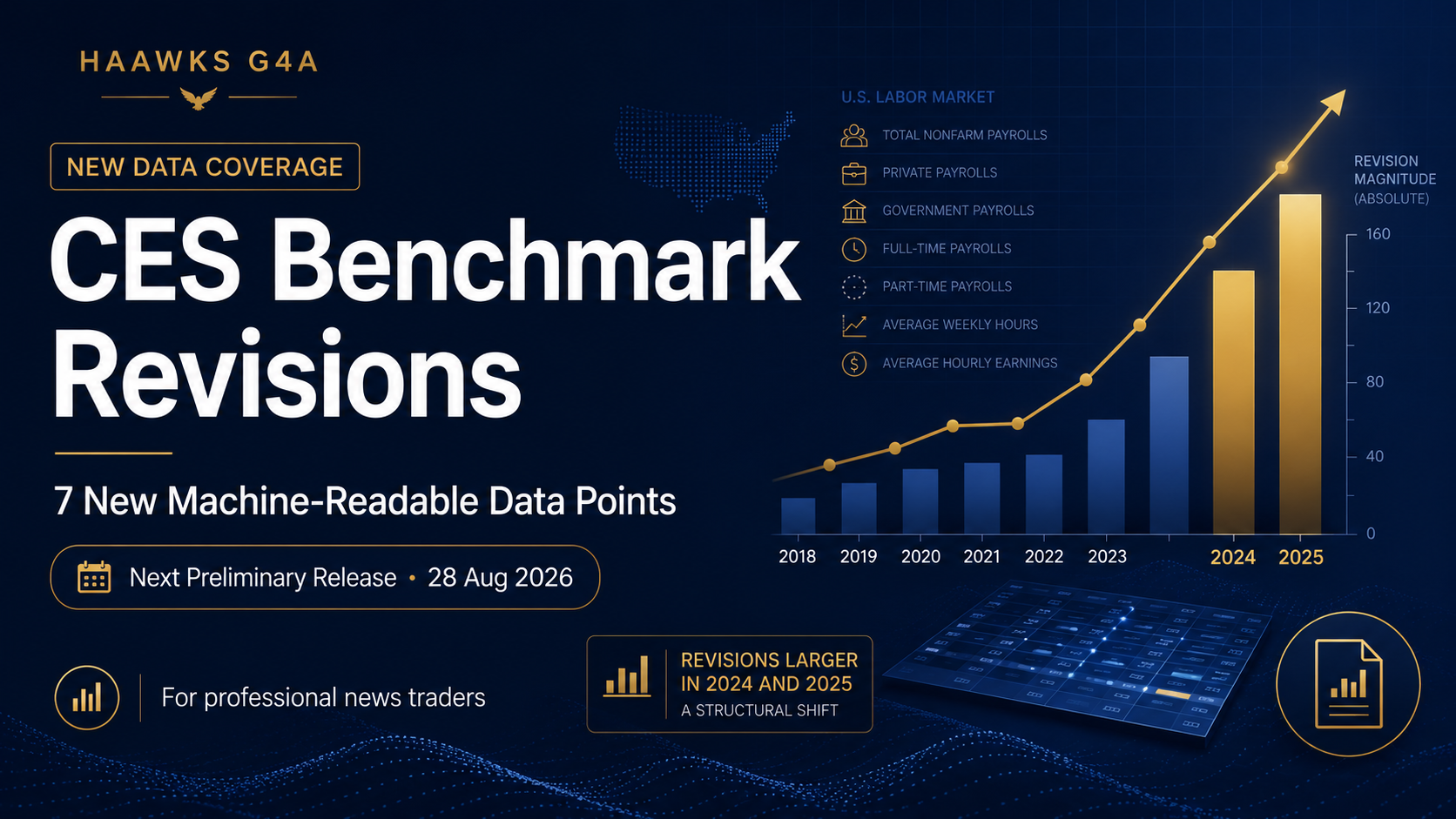
HAAWKS G4A Adds CES Benchmark Revision Data: Why Payroll Benchmark Revisions Matter to News Traders
Ahead of the August 28, 2026 preliminary CES benchmark release, HAAWKS is expanding its low-latency machine-readable U.S. labor-market coverage with seven new benchmark-revision data points.
HAAWKS G4A will introduce machine-readable coverage of the Current Employment Statistics Preliminary Benchmark Revision and the subsequent CES Annual Benchmark Revision, giving professional news traders direct access to some of the most important annual revisions to U.S. payroll employment data.
Most news traders know the monthly Nonfarm Payrolls release. Fewer focus on the annual benchmark process that determines how closely the sample-based Current Employment Statistics estimates match more comprehensive employment counts.
That benchmark process has become increasingly relevant. HAAWKS research covering the 2016–2025 preliminary benchmark revisions shows that the magnitude of the revisions has increased materially in recent years, particularly in 2024 and 2025.
Seven New HAAWKS G4A Data Points
HAAWKS will initially disseminate two machine-readable fields from the preliminary benchmark release and five fields from the annual benchmark revision.
- Total nonfarm employment benchmark revision, March of the current year, not seasonally adjusted, thousands.
- Total private employment benchmark revision, March of the current year, not seasonally adjusted, thousands.
- Total nonfarm employment benchmark revision, March of the prior year, not seasonally adjusted, thousands.
- Total private employment benchmark revision, March of the prior year, not seasonally adjusted, thousands.
- Total nonfarm employment annual revision, March of the prior year, seasonally adjusted, thousands.
- Total private employment annual revision, March of the prior year, seasonally adjusted, thousands.
- Total nonfarm employment annual revision, December of the prior year, seasonally adjusted, thousands, observation status preliminary.
BLS has confirmed that the final March 2026 benchmark revision will be incorporated with the January 2027 Employment Situation release in February 2027. The exact release date has not yet been published on the official BLS calendar.
What Is a CES Benchmark Revision?
The monthly Current Employment Statistics survey estimates payroll employment from a sample of businesses and government agencies. Each year, those estimates are benchmarked against more comprehensive employment counts from the Quarterly Census of Employment and Wages, or QCEW.
QCEW counts are derived primarily from state unemployment-insurance tax records that nearly all employers are required to file. BLS defines the benchmark revision as the difference between the March universe count and the corresponding sample-based CES employment estimate, after accounting for changes in employment scope.
Important for news traders: a preliminary benchmark revision is not the same thing as a monthly NFP revision and it is not a direct estimate of how many jobs were created during the year. It is a revision to the estimated March employment level.
Preliminary Does Not Mean the Monthly Series Changes Immediately
The August preliminary release provides an early estimate of the benchmark difference, but BLS does not immediately rewrite the official CES monthly employment series using that number.
The benchmark is incorporated later as part of the annual benchmark process. This distinction is particularly important for automated news trading systems: the preliminary benchmark is new information about the estimated employment level, while the later annual release actually incorporates benchmark and seasonal-adjustment changes into the historical CES series.
The 2025 benchmark provides a useful example. In September 2025, BLS estimated a preliminary total nonfarm revision of −911,000 jobs, or −0.6%, for March 2025. When the annual benchmark was incorporated in February 2026, the final not-seasonally-adjusted March revision was −862,000, or −0.5%. The seasonally adjusted March employment level was revised by −898,000.
In other words, the preliminary release can provide a powerful signal, but news traders also need to distinguish it from the later official benchmarked series.
HAAWKS Research: Preliminary Revisions 2016–2025
HAAWKS reviewed 10 years of national preliminary CES benchmark revisions. Negative figures indicate that the previously published CES employment level was above the preliminary benchmark estimate.
| Benchmark Year | Total Nonfarm Revision | Total Nonfarm % | Total Private Revision | Total Private % |
|---|---|---|---|---|
| 2016 | −150K | −0.1% | −224K | −0.2% |
| 2017 | +95K | +0.1% | +98K | +0.1% |
| 2018 | +43K | <+0.05% | −17K | <−0.05% |
| 2019 | −501K | −0.3% | −514K | −0.4% |
| 2020 | −173K | −0.1% | −229K | −0.2% |
| 2021 | −166K | −0.1% | −421K | −0.3% |
| 2022 | +462K | +0.3% | +571K | +0.4% |
| 2023 | −306K | −0.2% | −358K | −0.3% |
| 2024 | −818K | −0.5% | −819K | −0.6% |
| 2025 | −911K | −0.6% | −880K | −0.7% |
The two largest preliminary revisions in the 10-year sample occurred in 2024 and 2025 for both total nonfarm and total private employment.
Revision Magnitudes Have Increased Recently
| Statistic, 2016–2025 | Total Nonfarm | Total Private |
|---|---|---|
| Mean Signed Revision | −0.15% | −0.22% |
| Mean Absolute Revision | 0.23% | 0.32% |
| Median Absolute Revision | 0.15% | 0.30% |
| Sample Standard Deviation | 0.27 percentage points | 0.33 percentage points |
| Mean Absolute Revision, 2016–2020 | 0.12% | 0.18% |
| Mean Absolute Revision, 2021–2025 | 0.34% | 0.46% |
| Increase Between Five-Year Windows | 2.83× | 2.56× |
| Largest Absolute Revision | 0.6% — 2025 | 0.7% — 2025 |
| Second Largest | 0.5% — 2024 | 0.6% — 2024 |
Is the Increase Statistically Significant?
HAAWKS also tested whether the absolute size of preliminary revisions has been trending upward over the full 2016–2025 period.
| Simple Linear Trend | Total Nonfarm | Total Private |
|---|---|---|
| Increase Per Year | +0.050 percentage points | +0.058 percentage points |
| R² | 0.61 | 0.67 |
| p-value | 0.007 | 0.004 |
| 95% Confidence Interval | +0.018 to +0.083 points/year | +0.025 to +0.091 points/year |
On the complete 10-year sample, the upward trend in absolute revision size is statistically detectable.
However, there is an important qualification: the result is heavily influenced by the exceptionally large revisions in 2024 and 2025. Removing those two years causes the trend to lose conventional statistical significance.
Direction of the Revisions
Total Nonfarm
Seven of the 10 preliminary benchmark years were negative, two were positive and one was effectively near zero in percentage terms. The last three observations — 2023, 2024 and 2025 — were all negative.
Total Private
Eight of the 10 revisions were negative, including the very small −17,000 revision in 2018, while only 2017 and 2022 were positive. The largest negative percentage revision was −0.7% in 2025.
Why Benchmark Revisions Matter to News Traders
They Can Change the Employment Narrative
A large negative benchmark estimate can indicate that previously published payroll employment levels overstated the underlying employment count, potentially changing how traders assess labor market momentum.
They Can Affect Fed Expectations
Labor-market strength is a major input into monetary-policy expectations. A materially different benchmark can therefore affect the market's interpretation of the employment outlook and the expected path of interest rates.
The Preliminary Release Is a Separate Event
The August preliminary benchmark is released independently from the normal 8:30 a.m. monthly NFP release. For 2026, the national preliminary benchmark is scheduled for 10:00 a.m. ET on August 28.
The Annual Release Arrives With NFP
The final annual benchmark is incorporated with the January Employment Situation in February. News-trading systems therefore need to distinguish current-month payroll data from benchmark and historical-revision fields arriving in the same release.
HAAWKS view: benchmark data deserve their own structured fields. A large benchmark revision can change the historical employment picture even when the current monthly NFP headline receives most of the attention. For low-latency news traders, identifying the exact field, observation period, seasonal-adjustment status and preliminary or final status is essential.
Preliminary vs. Annual Benchmark: What Traders Need to Distinguish
| Feature | Preliminary Benchmark | Annual / Final Benchmark |
|---|---|---|
| Typical Timing | Late August / early September | February with January Employment Situation |
| Key Reference Month | March | March, plus revised historical monthly series |
| Preliminary Release Updates Official CES Series? | No | Yes |
| HAAWKS Initial Coverage | 2 machine-readable fields | 5 machine-readable fields |
| News-Trading Focus | Size and direction of the preliminary benchmark difference | Final benchmark plus revised seasonally adjusted employment levels |
HAAWKS Conclusion
HAAWKS is adding seven machine-readable CES benchmark-revision data points to expand G4A coverage of the U.S. labor market beyond the standard monthly Nonfarm Payrolls release.
Two fields will cover the annual CES Preliminary Benchmark Revision, beginning with the March 2026 benchmark scheduled for August 28, 2026 at 10:00 a.m. ET.
Five additional fields will cover the subsequent CES Annual Benchmark Revision, including March benchmark revisions and seasonally adjusted March and December employment revisions.
The historical evidence explains why these numbers deserve attention. From 2016–2020, the average absolute preliminary total-nonfarm revision was only 0.12%. In 2021–2025, it increased to 0.34%. For total private employment, the corresponding increase was from 0.18% to 0.46%.
The 2024 and 2025 revisions were unusually large, so the evidence should not be interpreted as proof that revisions will continue increasing each year. It does, however, demonstrate that benchmark releases can contain economically significant information and should not be overlooked by professional news traders.
For latency-sensitive strategies, the challenge is not merely receiving the release quickly. It is receiving each data point with the correct reference period, seasonal-adjustment status, units and observation status in a structured format that can be processed immediately.
Trade smart. Stay informed. Stay ahead.
New CES Benchmark Data Coming to HAAWKS G4A
HAAWKS G4A delivers low-latency machine-readable macroeconomic and commodity data for professional news traders. The new CES benchmark fields expand our coverage of U.S. labor-market releases and will be available through the same machine-readable API infrastructure.
HAAWKS G4A data is available via API access in Chicago, New York and London. Free trials are available for qualified professionals.
Explore HAAWKS G4A Low-Latency DataSources & Methodology
-
U.S. Bureau of Labor Statistics — Current Employment Statistics
Official CES program page and current release schedule. -
U.S. Bureau of Labor Statistics — 2026 Release Calendar
Confirms the March 2026 national preliminary CES benchmark release for August 28, 2026 at 10:00 a.m. ET. -
U.S. Bureau of Labor Statistics — Current Employment Statistics
Preliminary Benchmark
Official preliminary benchmark release, methodology and benchmark revision tables. -
U.S. Bureau of Labor Statistics — Technical Notes for the
CES National Benchmark
Used for benchmark definitions, historical benchmark information and methodology. -
U.S. Bureau of Labor Statistics — January 2026 Employment Situation
Used for the final March 2025 benchmark revision and the annual incorporation of benchmarked CES data. -
U.S. Bureau of Labor Statistics — Current Employment Situation
Confirms that the final March 2026 benchmark revision will be issued with the January 2027 Employment Situation in February 2027. -
HAAWKS Research — CES Preliminary Benchmark Revisions,
2016–2025
Historical preliminary benchmark figures compiled from BLS preliminary benchmark announcements and contemporaneous archived releases. Statistical calculations use the preliminary March not-seasonally-adjusted percentage revisions. Revisions reported by BLS as less than 0.05% in absolute magnitude for 2018 were encoded as 0.0% for percentage-based statistical calculations.